
1-805-484-2992
Quotes - Engineering - SalesCompressed Air Dryers for Printing & Converting
A pressroom and a converting floor run on hundreds of small pneumatic devices rather than a few large ones: unwind and rewind brakes and clutches, dancer rolls that hold web tension, expanding air shafts and core chucks, doctor-blade chambers on flexo decks, diaphragm ink pumps, nip cylinders on laminators, knife holders on slitters, glue guns on folder-gluers, and the air knives and ionizing bars that strip static and dust from the web. A label converter on a 25 hp screw uses about 100 SCFM; a wide-web flexo or offset plant on a 75 hp screw uses 300 to 350.
Water in that air shows up as register and tension faults before it shows up as rust. A brake or clutch with wet friction surfaces grabs and slips, the dancer hunts, and the web walks off register at every splice. Air shafts leak down and cores slip. An air knife aimed at a printed web spits condensate onto the ink. Oil aerosol is worse: fisheyes where ink or coating will not wet out on the film, and a rejected roll where that film is going into food packaging.
A refrigerated dryer holding a 38°F pressure dew point covers all of it, because a pressroom is held at 70 to 80°F and the coldest thing the air touches is a chill roll at 50 to 60°F. The dryer sits in the compressor room after the receiver and is sized to the compressor at the summer room temperature. Oil removal is what a converter should think hardest about: a 0.01 micron coalescing afterfilter on every plant, and an activated carbon filter behind it where the web is food-contact film.
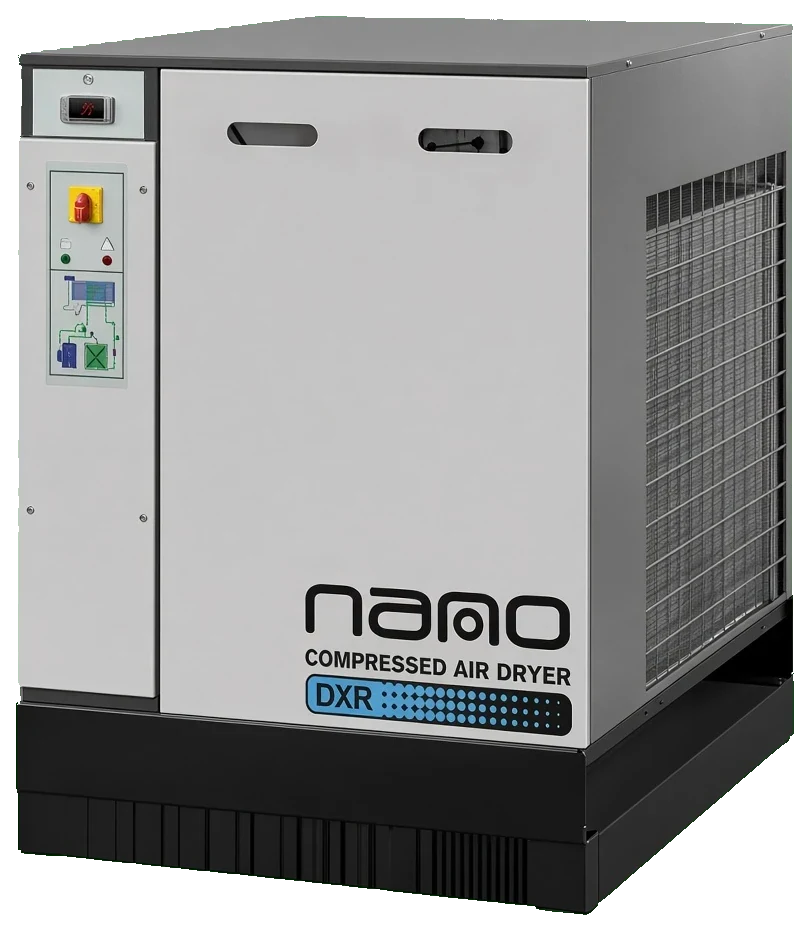
Printing loads swing. A press runs flat out for an hour and then sits through a makeready, a converter runs one shift, and the compressor holds pressure overnight for the finishing line. That is the duty where a cycling dryer stops its refrigeration compressor and earns its price: the TMC Series from 30 to 635 SCFM and the FLXA Series from 75 to 2,000 SCFM. A three-shift web plant at steady load does as well with the non-cycling DXR Series.
Request a pressroom dryer quote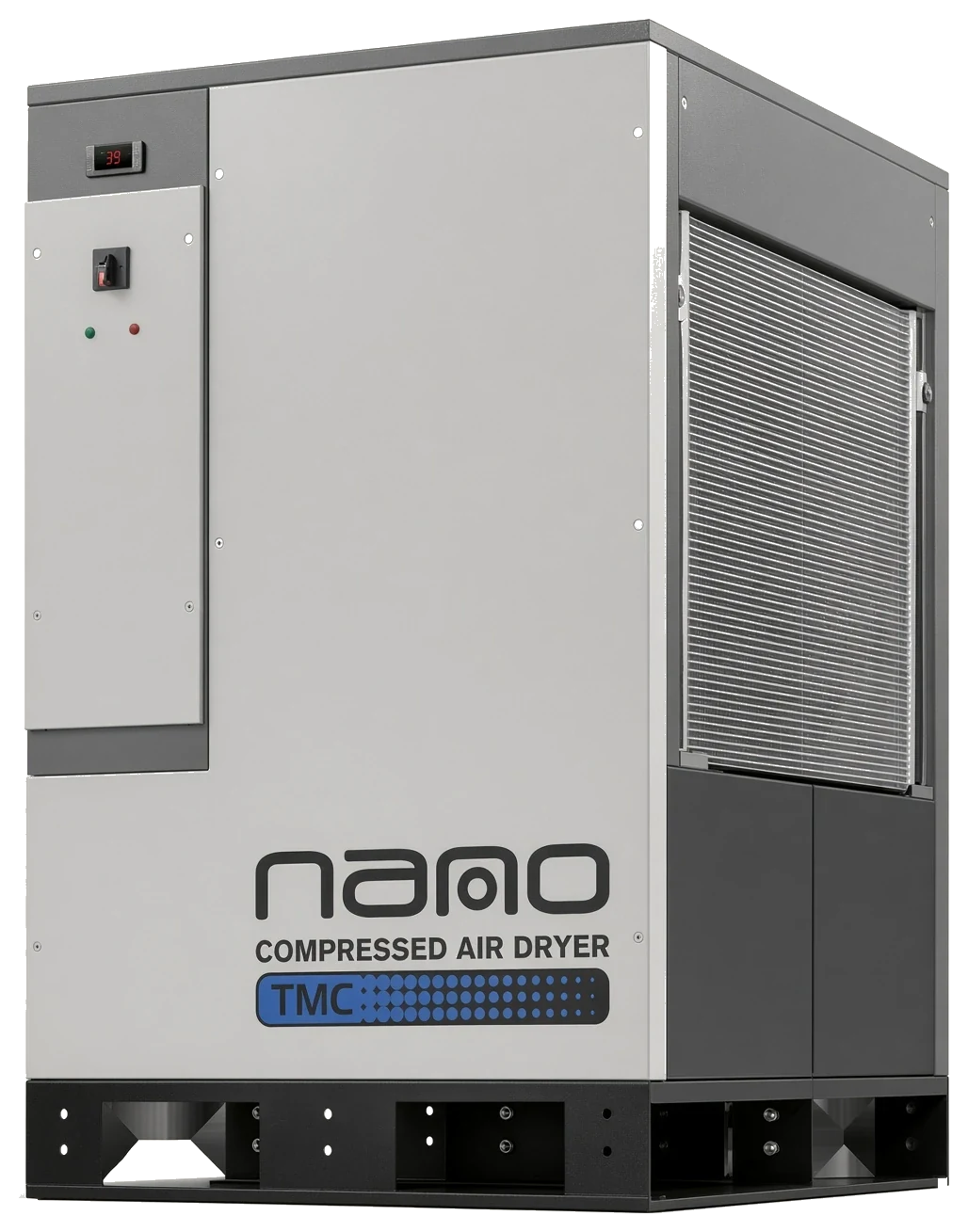
What wet or oily air does to a press
The symptoms an operator sees before anyone checks the dryer
- Register drift and tension hunting as wet brakes and clutches grab and slip
- Air shafts and core chucks that leak down and let rolls telescope
- Condensate spat from air knives and ionizing bars onto the printed web
- Fisheyes and dewetting where oil aerosol lands on film ahead of a coating or ink station
The dryer specification for a converting plant
What the purchase order should say
- 38°F pressure dew point, ISO 8573-1 class 4, sized to the compressor at the summer compressor-room temperature
- 0.01 micron oil-removal afterfilter on every plant; activated carbon after it for food-contact film and foil
- Cycling dryer for one- and two-shift plants with makeready gaps; non-cycling for three-shift steady load
- Zero-loss drains so the dryer and filter bowls do not blow air across the pressroom every few minutes
Dryers that fit a printing or converting plant
Ratings at 100 psig and 100°F inlet. A 15 to 30 hp screw lands in the 65 to 150 SCFM sizes, a 50 to 100 hp plant in the 230 to 450 SCFM sizes.
| SERIES | TYPE | FLOW RANGE | MAX INLET | MAX PRESSURE |
| TMC Series | Thermal Mass Cycling | 30 to 635 SCFM | 140°F | 210 psig |
| FLXA Series | Cycling | 75 to 2,000 SCFM | 120°F | — |
| DXR Series | Non-Cycling | 10 to 4,200 SCFM | 131°F | 203 psig |
| NXC Series | Cycling | 20 to 2,000 SCFM | 158°F | 232 psig |
| GFN Series Filters | Compressed Air Filter | 6 to 1,500 SCFM | — | 232 psig |
| NGF Series Filters | Compressed Air Filter | 20 to 1,500 SCFM | — | 250 psig |
| HF Series Filters | Compressed Air Filter | 20 to 21,250 SCFM | — | 300 psig |
| ND Series Zero-Loss Drains | Condensate Drain | Call for sizing | — | 290 psig |
Tell us the compressor horsepower, the number of presses and whether the web is food-contact; we size the dryer and the filter train together.
Change the carbon filter on hours, not on pressure drop
A coalescing filter announces its own end: the element loads with oil and dirt, the differential pressure gauge climbs, and at 6 to 10 psid the element is changed. An activated carbon element does not. It adsorbs oil vapor until its bed is saturated and then passes vapor at full flow with no change in pressure drop, which on a food-packaging line means the first warning is a customer's odor complaint. Carbon elements are rated in hours, typically 1,000, and belong on the calendar rather than the gauge; keep them on the cold, dry, aerosol-free side of the 0.01 micron filter, since oil droplets and water blind the carbon in days.
- Change carbon elements at their rated hours, not at a pressure-drop reading
- Install the carbon filter last, downstream of the dryer and the 0.01 micron coalescer
- Log element changes against press hours so the interval stands up in an audit
Where the dryer goes in a pressroom
Compressor, aftercooler, receiver, 1 micron prefilter, dryer, 0.01 micron afterfilter, carbon filter where used, then the header. Keep the compressor and dryer out of the pressroom itself: infrared and hot-air web dryers push the room past 90°F, and a refrigerated dryer loses 12 percent of its capacity at 110°F ambient. The air line from a cool compressor room into the hot pressroom is no problem; air dried at 38°F and then warmed only moves further from its dew point.
Oil is the converter's problem
A lubricated screw compressor carries 2 to 5 ppm of oil aerosol past its separator, and film, foil and coated paper show every trace of it as a dewetting defect. The 0.01 micron coalescing afterfilter behind the dryer takes that to 0.01 ppm, and for food packaging the activated carbon filter behind it removes the vapor a coalescer cannot see. Put the carbon element last, on cold dry air, and change it on hours rather than pressure drop, since a saturated carbon bed shows no rise in differential pressure. The filter placement page covers the order.
Sizing a dryer for swinging loads
Size to the compressor's full delivery, not the average pressroom draw, because the dryer sees the compressor's output whenever it runs. A 50 hp screw delivering 220 SCFM into a 105°F compressor room needs 250 SCFM of dryer at rating conditions, so the 265 or 300 size once the room is allowed for. Averages are what make a cycling dryer worthwhile: at a 40 percent average load a TMC Series thermal-mass dryer runs its refrigeration compressor less than half the time, and the cycling versus non-cycling page shows what that saves.
Long runs and roof spaces
Converting plants are long buildings, and the air main often runs through an unheated roof space to reach a slitter at the far end. Air dried to 38°F and then cooled below that in a January roof space condenses in the pipe, so insulate the run, drop the main into the conditioned space, or put a small point-of-use dryer at the far machine, and give every long run a drip leg and drain at its low point.
Pressroom and converting air questions
Yes, through the tension system. Pneumatic brakes, clutches and dancer loading cylinders respond to water on their friction surfaces and seals by grabbing and slipping, the tension controller chases it, and the web walks off register. Drying the air to 38°F removes the water before it reaches the brake.
You need ISO 8573-1 class 1 oil at the point of use, which a lubricated compressor reaches with a 0.01 micron coalescing filter and an activated carbon filter downstream of the dryer. An oil-free compressor still needs the coalescer for particles and the carbon stage where hydrocarbon vapor drawn in with the intake air matters.
The dryer is at or past its capacity on hot afternoons, so the outlet dew point rises above the pipe temperature and condensate forms on the way to the knife. Check the compressor room temperature and the dryer inlet temperature; a plugged compressor aftercooler is the usual cause.
Usually. A one-shift plant has the compressor up for 10 hours and loaded for perhaps four, and a thermal-mass TMC Series dryer runs its refrigeration compressor only when the stored cold is used up. Over 250 working days that is most of the dryer's power bill returned.
A 30 hp screw delivers about 130 SCFM, so the 130 or 150 SCFM dryer at a normal compressor room temperature and the next size up if the room passes 105°F. Two presses do not change the answer; the compressor sets the flow the dryer sees.
More on drying pressroom air
Ambient temperature corrections for a hot compressor room
How a 105 or 110°F compressor room changes the dryer size, with the factors.
Learn More
PET Blow Molding
Drying 500 to 725 psig blow air for PET stretch blow molders: why bottles haze, the HHPR and APET high-pressure dryers, and plant air.
Learn More
Injection Molding
Refrigerated air drying for injection molding: core pulls, valve gates, robots and hopper loaders, sizing by compressor, and filtration.
Learn More