
1-805-484-2992
Quotes - Engineering - SalesHigh Inlet Temperature Refrigerated Air Dryers, 20 to 125 SCFM
Dryers built for 180 to 200°F air straight off a piston compressor
A reciprocating compressor without an aftercooler discharges air at 180 to 200°F, and a standard refrigerated dryer rated for 100°F inlet either trips on high pressure or dries at less than half its nameplate. The dryers on this page are built for that air: they cool it, separate the water that condenses, and deliver dry air to a 2 to 30 hp shop, service bay or small plant without an aftercooler in front of them.
Two current series cover the duty. One accepts 200°F inlet air in five sizes from 25 to 100 SCFM with a zero-loss drain and a smart controller; the other takes 180°F air in five sizes from 25 to 125 SCFM and is built to sit next to the compressor with a matched high-temperature inlet filter. Both run from a 115 V cord. The retired 180°F series, 20 to 125 SCFM, is listed with its successor.
Cooling 200°F air costs refrigeration capacity, so these dryers deliver a 50°F pressure dew point, ISO 8573-1 class 6, rather than the 38°F of a standard dryer. For tools, tire machines, lifts and blow-off air that is more than enough; a paint line or a process needing class 4 air gets an aftercooler and a standard dryer instead.
- Rated for 180°F or 200°F inlet air from piston compressors with no aftercooler
- 20 to 125 SCFM covers 5 to 30 hp reciprocating compressors
- 115 V single phase, 1/2 in to 1 in NPT, integrated separator and drain
- 50°F pressure dew point, ISO 8573-1 class 6, at rated flow
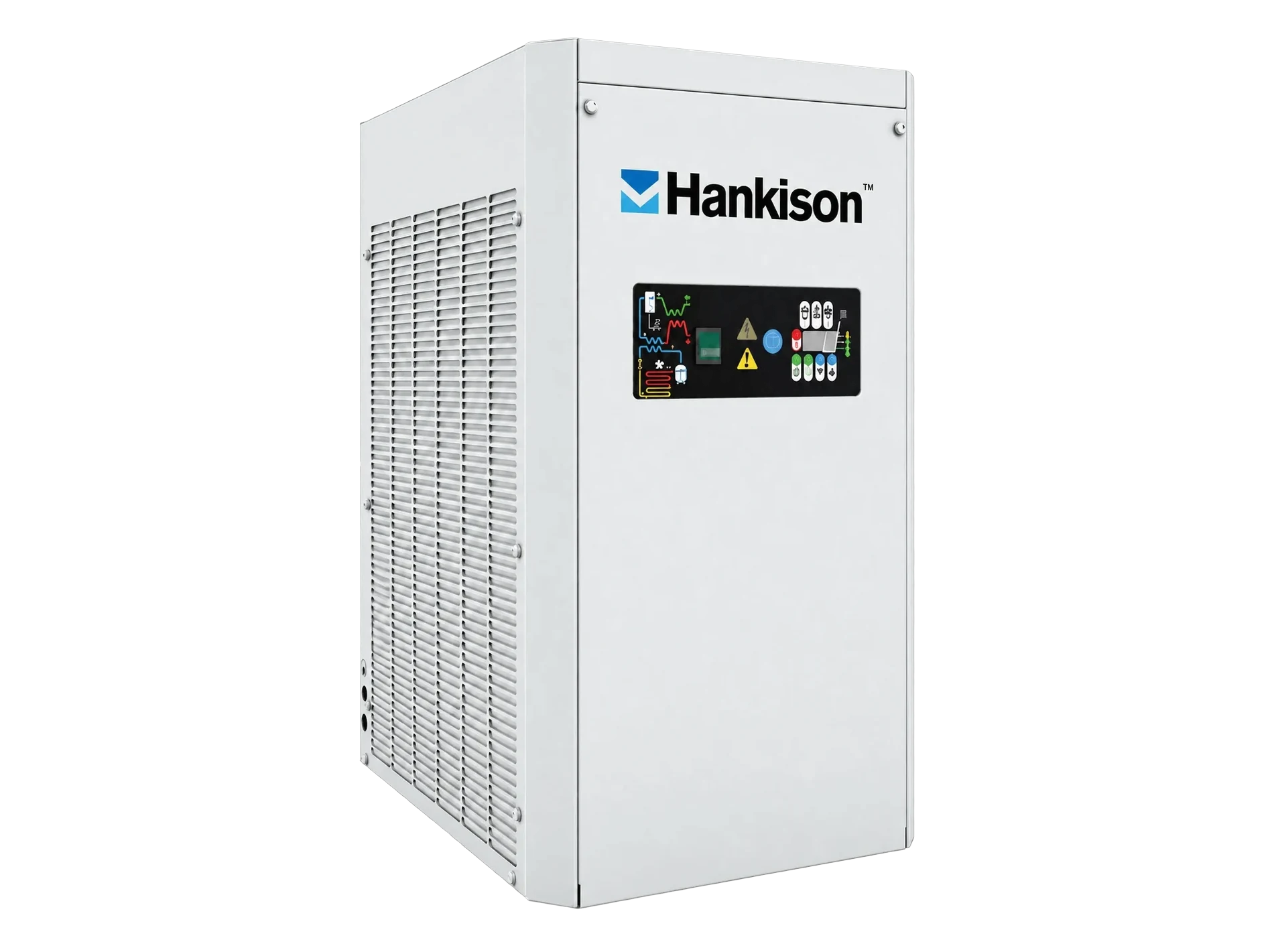
Every high inlet temperature model
Sixteen models rated at their high-temperature inlet conditions and 100 psig. The two current series come first; the retired series follows with the series that replaces it.
| PART NUMBER | SERIES | SCFM | CONNECTION | VOLTAGE | STATUS |
| HRHT25A | HRHT Series | 25 | 3/4 in MNPT | 115/1/60 | Current |
| HRHT35A | HRHT Series | 35 | 3/4 in MNPT | 115/1/60 | Current |
| HRHT60A | HRHT Series | 60 | 3/4 in FNPT | 115/1/60 | Current |
| HRHT80A | HRHT Series | 80 | 3/4 in FNPT | 115/1/60 | Current |
| HRHT100A | HRHT Series | 100 | 1 in FNPT | 115/1/60 | Current |
| HTR 0025 | HTR Series | 25 | 1/2 in MNPT | 115/1/60 | Current |
| HTR 0050 | HTR Series | 50 | 1 in FNPT | 115/1/60 | Current |
| HTR 0075 | HTR Series | 75 | 3/4 in FNPT | 115/1/60 | Current |
| HTR 0100 | HTR Series | 100 | 3/4 in FNPT | 115/1/60 | Current |
| HTR 0125 | HTR Series | 125 | 3/4 in FNPT | 115/1/60 | Current |
| HITN20 | HITN Series | 20 | 3/4 in NPT | 115/1/60 | Replaced by HRHT |
| HITN25 | HITN Series | 25 | 3/4 in NPT | 115/1/60 | Replaced by HRHT |
| HITN35 | HITN Series | 35 | 3/4 in NPT | 115/1/60 | Replaced by HRHT |
| HITN50 | HITN Series | 50 | 1 in NPT | 115/1/60 | Replaced by HRHT |
| HITN75 | HITN Series | 75 | 1 in NPT | 115/1/60 | Replaced by HRHT |
| HITN125 | HITN Series | 125 | 1 in NPT | 230/1/60 | Replaced by HRHT |
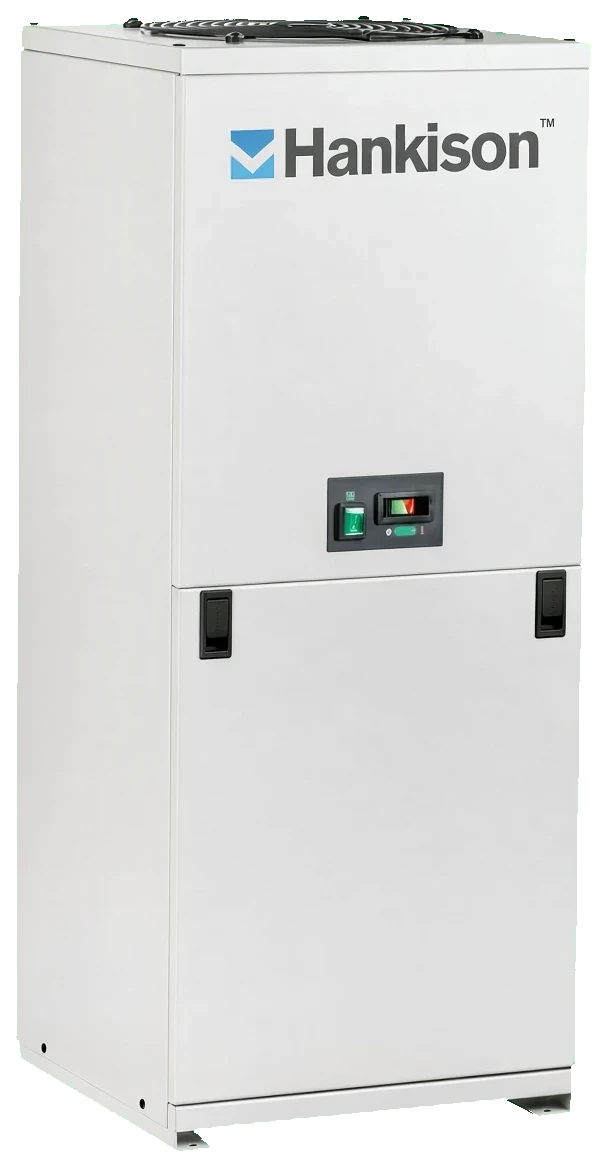
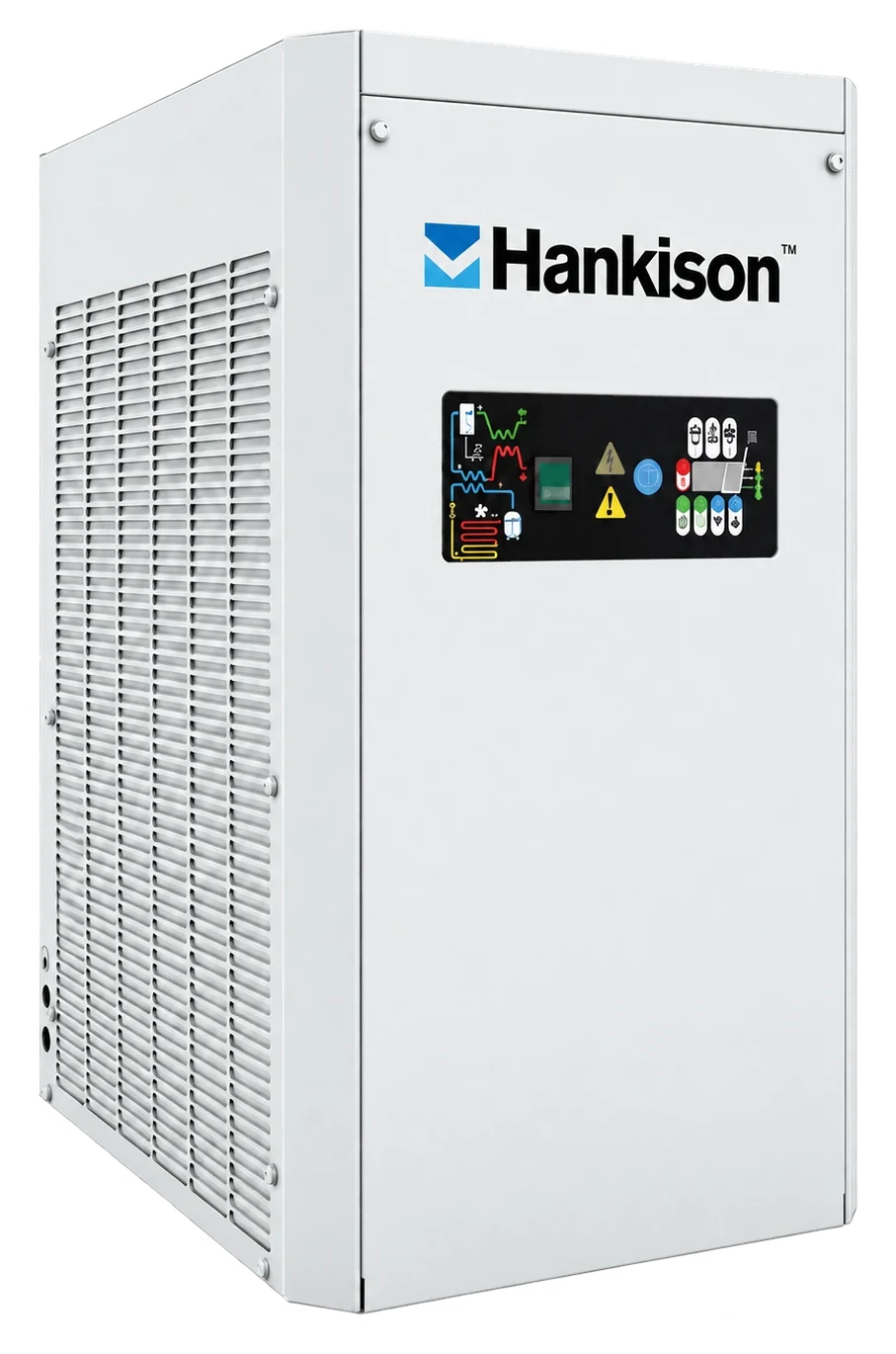
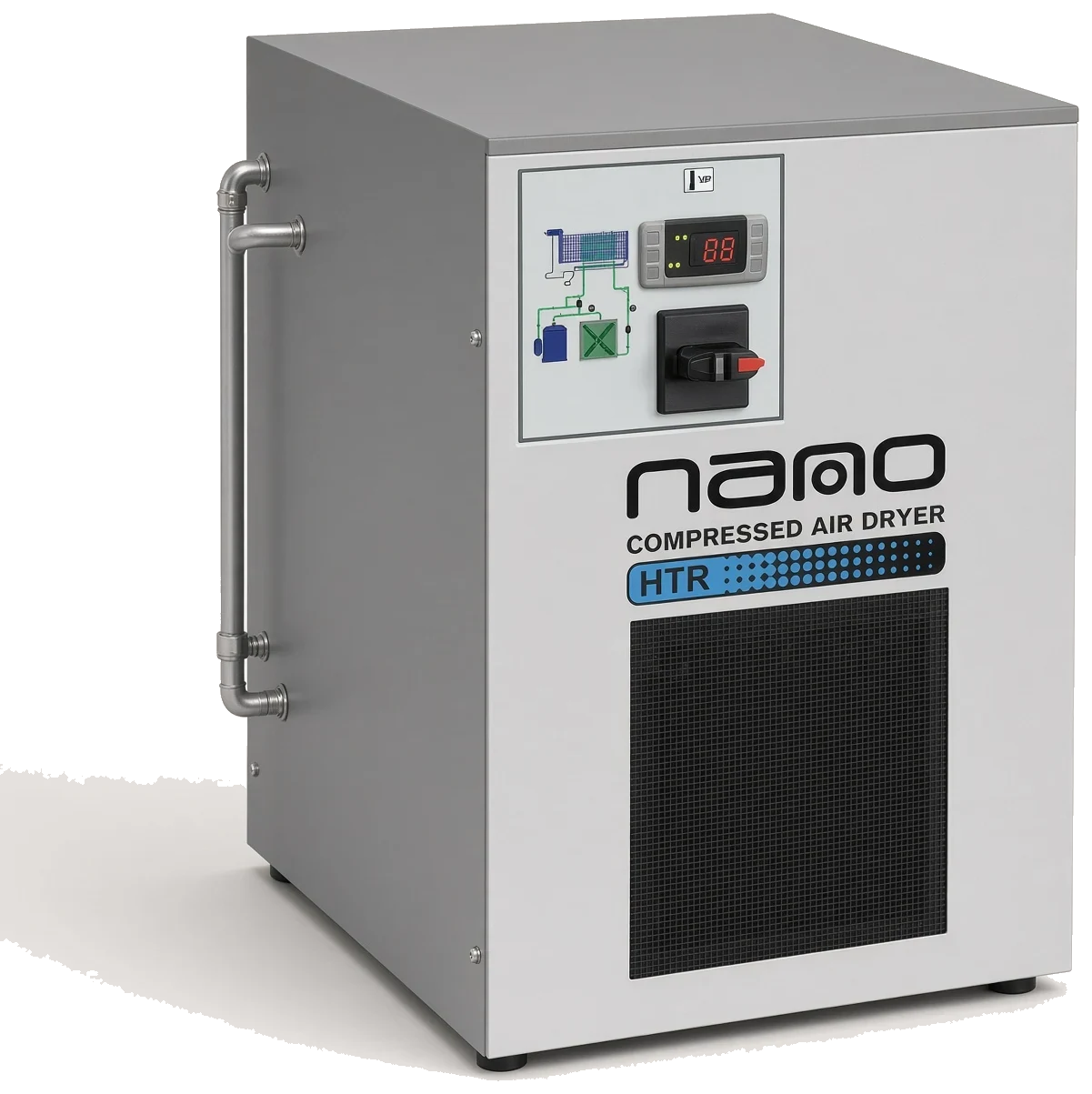
Three series for hot inlet air
Why a standard dryer fails on hot air
Air at 190°F holds roughly ten times the water of air at 100°F, and every pound of that water must be condensed by the refrigeration circuit. A standard dryer's evaporator and condenser were sized for the 100°F case; fed 190°F air it runs its compressor at the limit, trips on high discharge pressure on a warm afternoon, and passes wet air the rest of the time. A high-inlet-temperature dryer has a larger condenser and exchanger for its nominal flow, a separator ahead of the chiller to take the bulk condensate, and a drain sized for the volume, which on a 10 hp piston compressor can be several gallons a day.
Which compressor, which size
Piston compressors deliver 3.5 to 4 SCFM per horsepower, so a 5 hp unit is 18 to 20 SCFM and the 25 SCFM model, a 7.5 hp is 26 to 30 and the 35 SCFM model, a 10 hp is 35 to 40 and the 50 SCFM, a 15 hp is 52 to 60 and the 60 or 75, a 20 hp is 70 to 80 and the 80 or 100, and a 25 to 30 hp is 87 to 120 and the 100 or 125 SCFM model. Two-stage compressors run somewhat cooler than single-stage machines but still above 150°F without an aftercooler, so they belong here too.
What is in the box
The 200°F line uses a brazed-plate exchanger on the 25 and 35 SCFM units and an aluminum plate-fin exchanger on the 60 to 100 SCFM units, an integrated moisture separator, a zero-loss electronic drain, and a controller with LED diagnostics, alarm history and, on the larger sizes, energy-saving fan control; the refrigerant is low-GWP R513A. The 180°F direct-expansion line puts a water separator ahead of the chiller, fits a zero-air-loss drain and a digital dew point display, and is offered with a 1 micron inlet filter package sized to each model. The retired series carried a two-stage separator, a timed electric drain and a dew point indicator.
Installing next to the compressor
Keep the pipe run from the compressor head short and give it a drop leg with a drain, because the air is at its wettest between the head and the dryer. Fit a high-temperature particulate filter rated for 450°F at the dryer inlet to stop carbon and scale from the hot cylinders, and put the 0.01 micron oil-removal filter after the dryer where the air is cool enough for it's element. Mount the dryer where the condenser draws room air rather than the compressor's discharge, and pipe the drain to a condensate separator; a small piston compressor with no aftercooler makes surprising amounts of water. The reciprocating compressor section sizes the dryer from horsepower.
Drying hot air off a piston compressor
The refrigeration circuit runs out of capacity. On a mild day the dew point simply climbs above 50°F and water shows up at the tools; on a hot afternoon the dryer trips on high discharge pressure and passes undried air until someone resets it. Measure the air at the dryer inlet at the end of a long loaded run on a warm day, and if it is near 180°F, choose the 200°F series.
Not everywhere in the building. Any pipe colder than 50°F condenses water out of that air, so drops running along an outside wall in January collect water and can freeze below 32°F. Keep the distribution inside the heated space with a drain leg at each drop, or fit an aftercooler and a standard dryer for a 38°F dew point. Lines that must run outdoors below freezing need a desiccant dryer.
Size on delivered air, not the horsepower label. At 3.5 to 4 SCFM per hp that compressor makes 52 to 60 SCFM, which points to the 60 or the 75 SCFM model. Take the larger one when the compressor room runs hot in summer, because the dryer's condenser loses capacity as the room warms. A two-stage machine runs cooler than a single-stage one, but it still needs a high-inlet-temperature dryer without an aftercooler.