
1-805-484-2992
Quotes - Engineering - SalesDew Point Monitors for Compressed Air Dryers
A portable instrument that tells you what the dryer is actually delivering
A refrigerated dryer has no gauge that proves it is working. The panel display on a current unit shows the dew point the controller calculates from its own sensor, and an older unit shows a green light or nothing; neither tells the plant what the air in the header measures after the afterfilter, on a hot afternoon, at full flow. A dew point monitor does, and it settles the argument between the dryer and the wet air at the far end of the shop in twenty minutes.
The catalogued instrument is a self-contained sample-and-measure unit in a NEMA 4X case: a ceramic hygrometer probe reading -148 to +68°F pressure dew point, or 0 to 3,000 ppmv, on a four-digit display, fed by a sample line through a built-in 0.3 micron filter and flow meter. It carries between dryers in its case for audits and troubleshooting, or screws to a wall as a permanent monitor with a 4-20 mA output and two programmable alarm relays wired to the dryer alarm or the plant PLC.
The range reaches desiccant-dryer dew points as well as refrigerated ones, so one instrument checks a 38°F refrigerated dryer, a -40°F desiccant dryer and the class 2 air on a paint line. It is sold as a single model with 6 mm quick-connect sample fittings, a 145 psig sample pressure limit and an 85 to 265 V supply.
- -148 to +68°F pressure dew point, or 0 to 3,000 ppmv, accuracy plus or minus 3.6°F
- Built-in 0.3 micron sample filter, flow meter and 6 mm quick-connect fittings
- 4-20 mA output and two alarm relays for a dryer alarm or PLC
- NEMA 4X case, carrying case included, wall-mountable for permanent monitoring
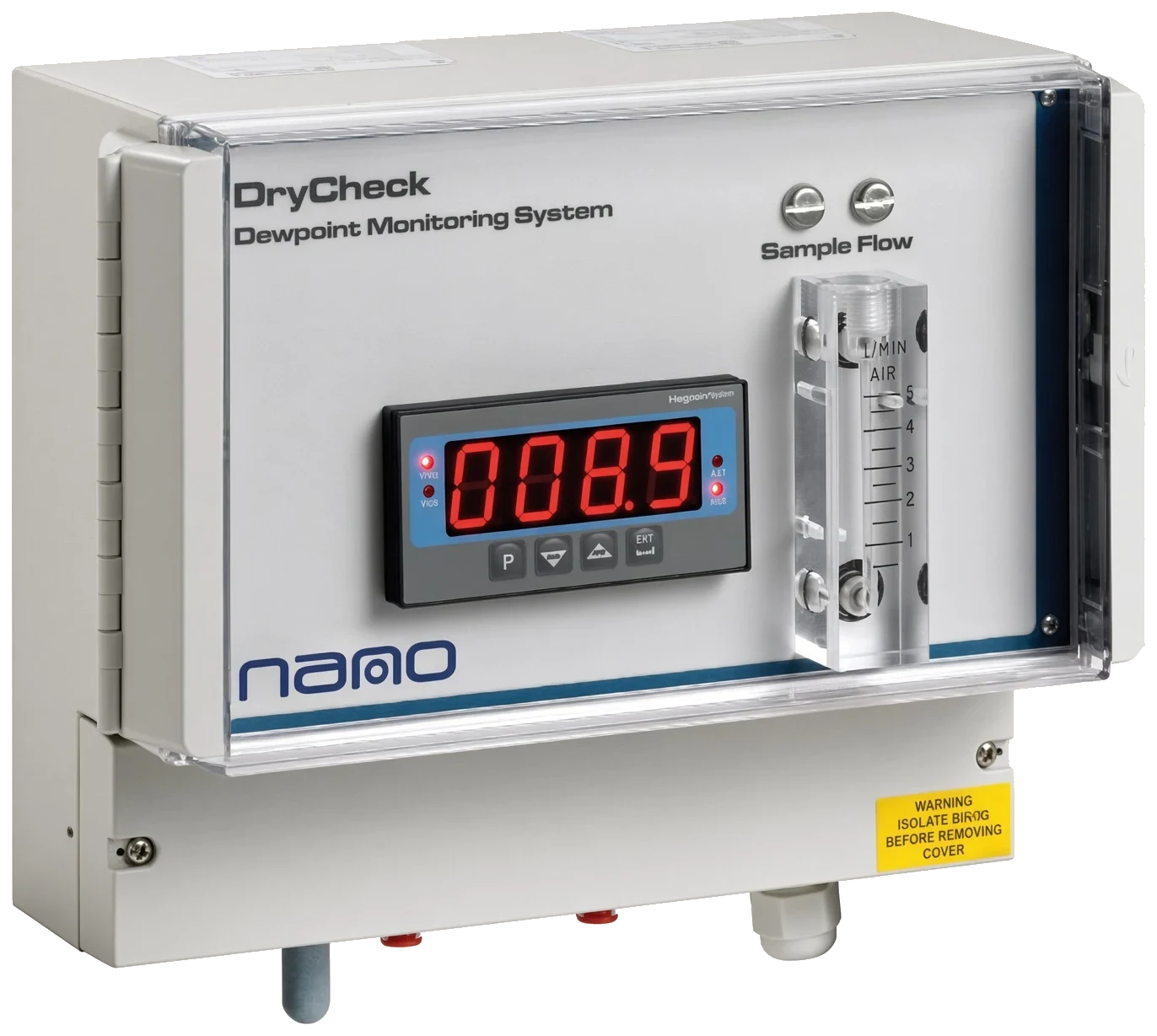
The dew point monitor
One instrument covers the whole site. The series page carries its range, accuracy, connections and supply details.
| SERIES | TYPE | FLOW RANGE | PART NUMBERS | NOTES |
| PDM Dew Point Monitor | Dew Point Monitor | See series | 1 listed | 122°F max |
Dew point monitor series
How to check a refrigerated dryer
Tap the sample after the afterfilter, at line pressure, through the supplied fittings or downstream of a regulator set below 145 psig, and let the probe settle; a reading that is still falling after twenty minutes is the sample line drying out, not the dryer. Note the flow, the inlet temperature and the room at the same time, because the 38°F rating applies at 100 psig, 100°F inlet and 100°F ambient and nowhere else. A dryer reading 42 to 48°F at 115°F inlet on a 105°F afternoon is doing what its correction factors predict; the same reading in a cool room at half flow means something is wrong.
Reading the number
A steady dew point above 50°F at rated conditions points at an overloaded dryer, a fouled condenser, a low refrigerant charge or a hot-gas bypass valve that has drifted. A dew point that is fine most of the time and then jumps wet points at a failed drain or a flooded separator carrying water over, or at a bypass valve passing wet air around the dryer. A reading that never gets below 45°F while the panel says 38°F is a dryer sensor that has drifted, and the monitor is the only way to know. Measure at the header, not at the dryer outlet, when the complaint is water at a machine; the two can differ by 20°F where a long uninsulated run cools the air below the dryer's dew point.
Permanent monitoring
Wall-mounted, the instrument watches one dryer continuously and its two relays give the plant a dew point alarm that the dryer's own controller may not, set at whatever the process tolerates: 45°F for plant air, 40°F for a paint line. The 4-20 mA output logs to the plant system and turns a dryer complaint into a trend that shows when the dew point started climbing, which is usually weeks before anyone noticed water. Food, pharmaceutical and electronics plants that certify air quality to ISO 8573-1 keep one on each dryer for the record.
Sample line and care
Keep the sample line short and in PTFE, because ordinary tubing absorbs and releases water and slows the reading by hours; the instrument ships with PTFE tubing, and the built-in flow meter sets the 2 to 10 standard cubic feet per hour the probe wants. Never sample from the wet side of the dryer at full line pressure without the regulator, and keep the instrument within its 23 to 122°F ambient range. The ceramic probe holds calibration for years in clean air; a plant that wants traceable readings sends it for recalibration on a schedule. The dew point and ISO classes page explains what the numbers mean, and the maintenance page covers what to do when the reading is wrong.
Dew point monitor questions
About 38°F at 100 psig, 100°F inlet, 100°F ambient and rated flow, which is ISO 8573-1 class 4. Under lighter load or a cooler inlet it reads a few degrees lower, and under a hot inlet or an overload it reads higher; it never reads below freezing on a refrigerated dryer.
Yes. The probe reads down to -148°F, well past the -40°F class 2 and -100°F class 1 dew points a desiccant dryer produces. The same instrument therefore audits every dryer on a site.
Because the sample line and the probe surface have to dry to the air's dew point before they report it, and any moisture trapped in fittings releases slowly. Short PTFE tubing and a steady sample flow bring a refrigerated dryer reading to rest in about twenty minutes; a desiccant reading can take an hour.
The instrument is limited to 145 psig at the sample inlet. On a 100 psig plant it connects directly through the supplied fittings; on a 125 psig or higher system it is fed through a small regulator, and the reading is then the dew point at the regulated pressure, which is lower than at line pressure, so note the regulator setting with the reading.
The panel display reads the dryer's internal sensor at one point inside the exchanger. A monitor reads the air the plant actually receives, after the afterfilter and the pipe, and it is the only reading that can be logged, alarmed and used to certify an air quality class.