
1-805-484-2992
Quotes - Engineering - SalesInlet Temperature and Refrigerated Dryer Capacity
Of the three corrections applied to a refrigerated dryer's rating, inlet air temperature is the one that moves a sizing furthest. The nameplate assumes 100°F air arriving at the dryer. Air at 110°F costs 20 percent of the rated capacity, 120°F costs 35 percent and 130°F costs 45 percent, because warmer air carries far more water and every pound of it has to be cooled to 38°F before that water lets go.
The number to find is the air temperature at the dryer inlet on the hottest afternoon of the year, and it is nearly always higher than the room.
Why ten degrees at the inlet costs a fifth of the dryer
Saturated compressed air at 100 psig holds nearly twice as much water vapor at 120°F as at 100°F, and all of it arrives at the dryer as heat load to be cooled and condensed. The refrigeration circuit has a fixed capacity, so when the load per cubic foot goes up, the cubic feet it can handle go down. The factors 0.80 at 110°F, 0.65 at 120°F and 0.55 at 130°F are the ratio between what the dryer carries at that inlet and what it carries at 100°F.
A 200 SCFM compressor whose air arrives at 120°F needs a dryer rated 200 divided by 0.65, or 308 SCFM, before the ambient and pressure factors are considered.
Where hot inlet air comes from
A rotary screw package with an air-cooled aftercooler discharges air 15 to 20°F above the air entering the aftercooler, and that air is the compressor room air, so a 95°F room delivers 110 to 115°F air. A dirty aftercooler adds 10°F more. A water-cooled aftercooler approaches its cooling water within 10 to 15°F, which is why it pays to check whether the tower water has crept up in summer.
A piston compressor with no aftercooler discharges 180 to 200°F air, which no standard refrigerated dryer is rated to accept. Either fit an aftercooler or choose one of the high inlet temperature dryers, which carry their own aftercooling stage and are rated at the hot inlet directly.
Dryers built for hot inlet air
Worked example: 20 hp screw, tired aftercooler
The inlet reading that changes the model
- Compressor delivers 88 SCFM at 100 psig into a 95°F room
- Probe thermometer at the dryer inlet reads 120°F: inlet factor 0.65
- Ambient under 100°F and pressure at 100 psig: factors 1.00
- Duty 88 / 0.65 = 135 SCFM; the 150 SCFM model, not the 105
Reading the inlet limit on a data sheet
Rating temperature and maximum temperature are different numbers
- 100°F is where the nameplate SCFM is delivered
- The maximum inlet, 120 to 158°F by series, is where the dryer may run derated
- Above the maximum the dryer trips or floods its separator
- 180 to 200°F belongs to the high inlet temperature series only
Inlet temperature factors, worked for an 88 SCFM compressor
Capacity of a dryer rated 100 SCFM at each inlet temperature, and the rating-point duty an 88 SCFM compressor imposes, with ambient and pressure held at the rating point.
| INLET AIR | FACTOR | A 100 SCFM DRYER CARRIES | DUTY FOR 88 SCFM | MODEL EXAMPLES |
| 100°F | 1.00 | 100 SCFM | 88 SCFM | DXR 0105 NA, FLXA1.2-A |
| 110°F | 0.80 | 80 SCFM | 110 SCFM | DXR 0125 NA, TMC 0130 N |
| 120°F | 0.65 | 65 SCFM | 135 SCFM | DXR 0150 NA, FLXA1.5-A |
| 130°F | 0.55 | 55 SCFM | 160 SCFM | DXR 0185 NA, TMC 0170 N |
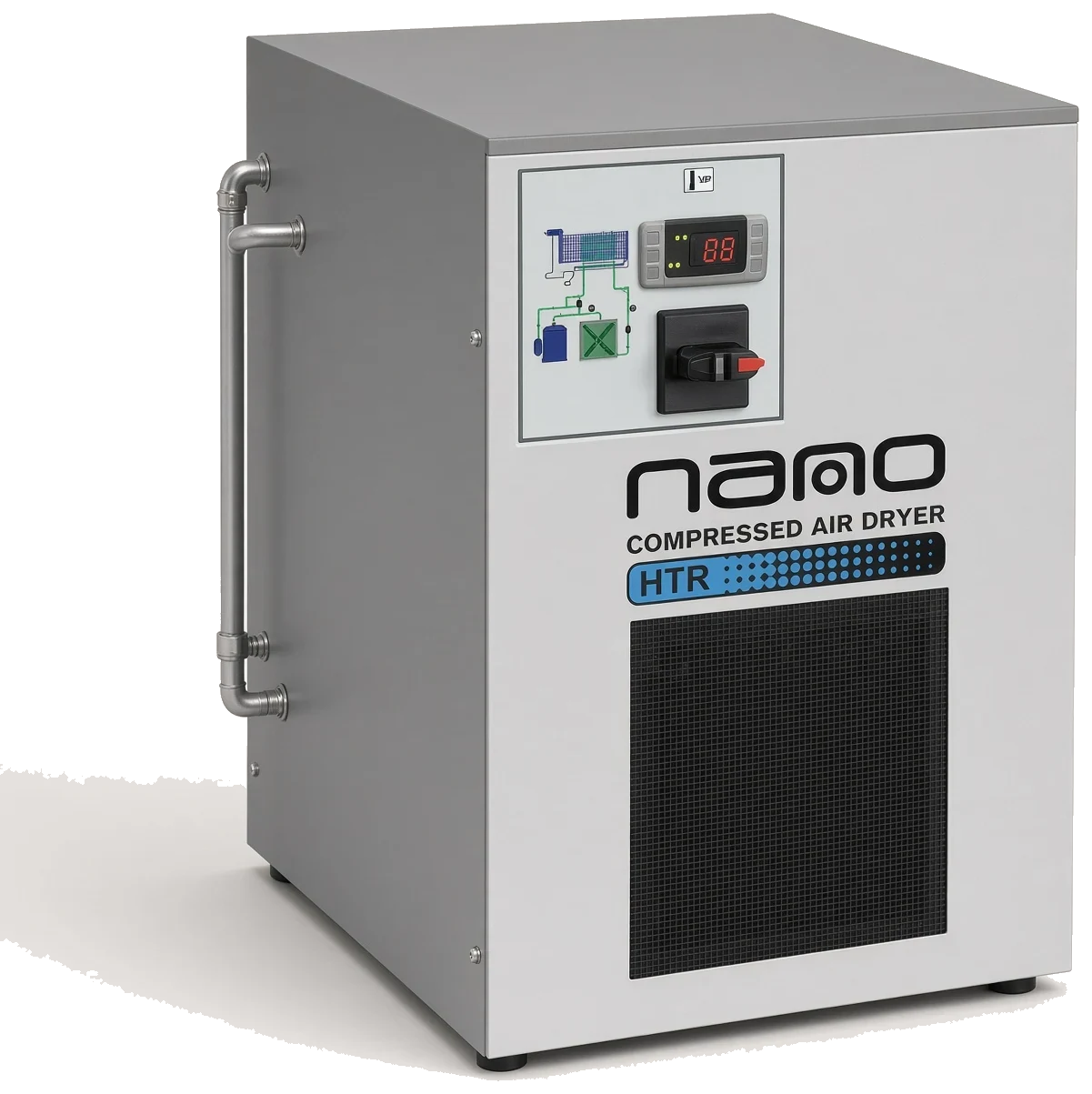
| 180 to 200°F, no aftercooler | not rated | — | high inlet temperature dryer | HTR 0100 (180°F), HRHT100A (200°F) |
Dryers for hot inlet air
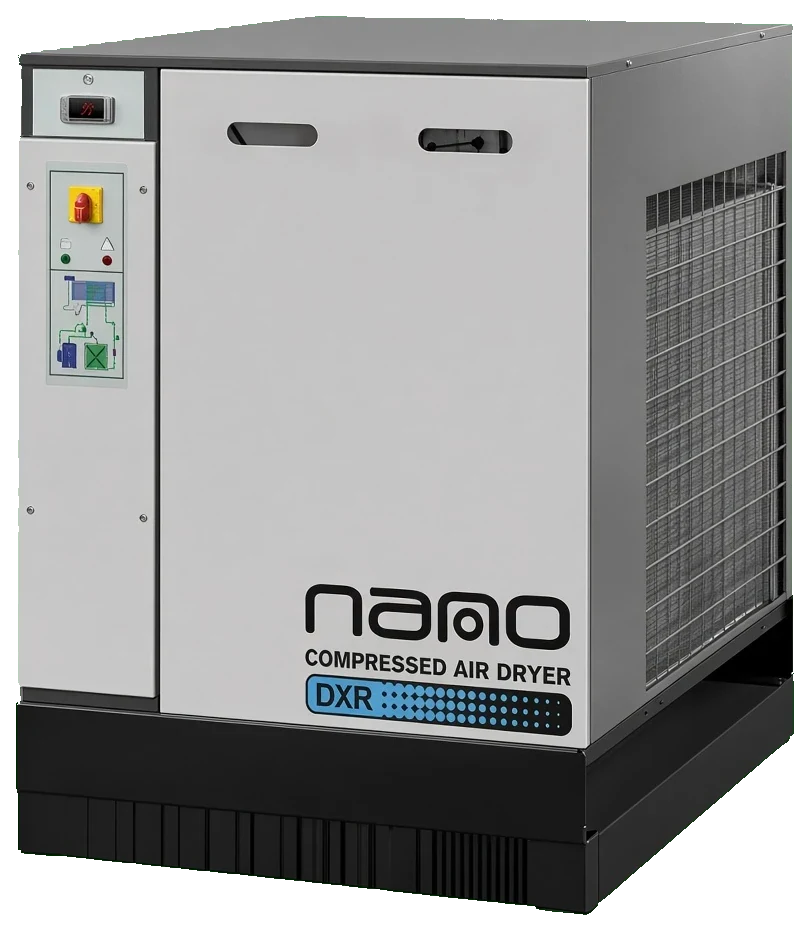
Measuring it and applying the factor
Put a thermometer well or a strap-on probe on the pipe at the dryer inlet, after the receiver, and read it mid-afternoon in the hottest month. If the reading falls between two factors, use the lower one; 115°F is sized at 0.65, not 0.80. Divide the compressor's delivered SCFM by that factor, apply the ambient and pressure factors from their own pages, and pick the first model at or above the result.
Lowering the inlet instead of enlarging the dryer
Every 10°F taken off the inlet is worth a frame size. Clean the aftercooler; a package aftercooler blocked with lint or oil mist is the commonest cause of 120°F air. Ventilate the compressor room so the aftercooler breathes outside air rather than its own discharge. Where the compressor has no aftercooler, adding one costs less than the larger dryer it would otherwise demand.
Mistakes that show up in summer
Taking the inlet reading in April. Reading the room thermostat instead of the pipe. Assuming a package aftercooler delivers 100°F air because the brochure said it could. Sizing for a piston compressor at 100°F when the air leaves the cylinder head at 190°F. Each produces a dryer that carries its load through the cool months and passes water from June to September.
Above 130°F: the high inlet temperature dryers
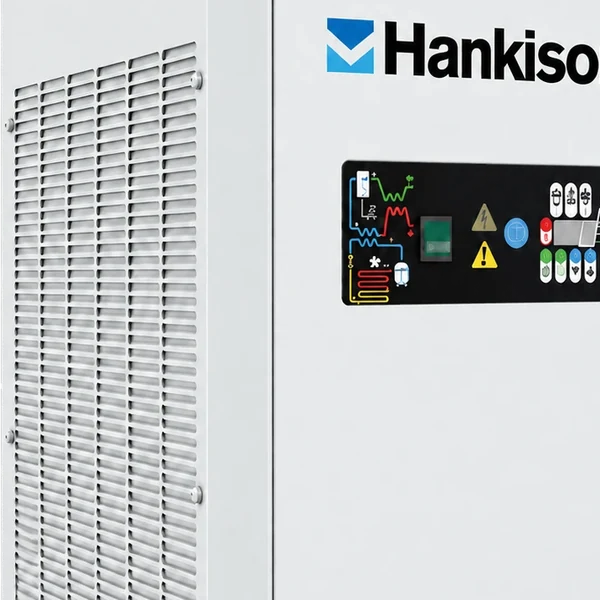
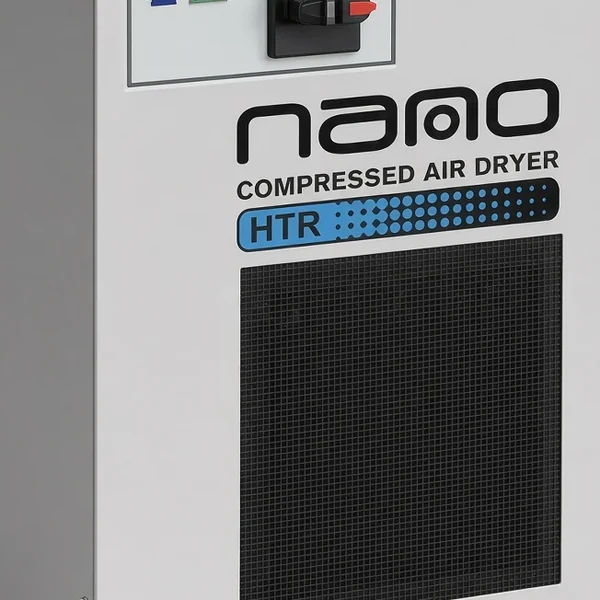
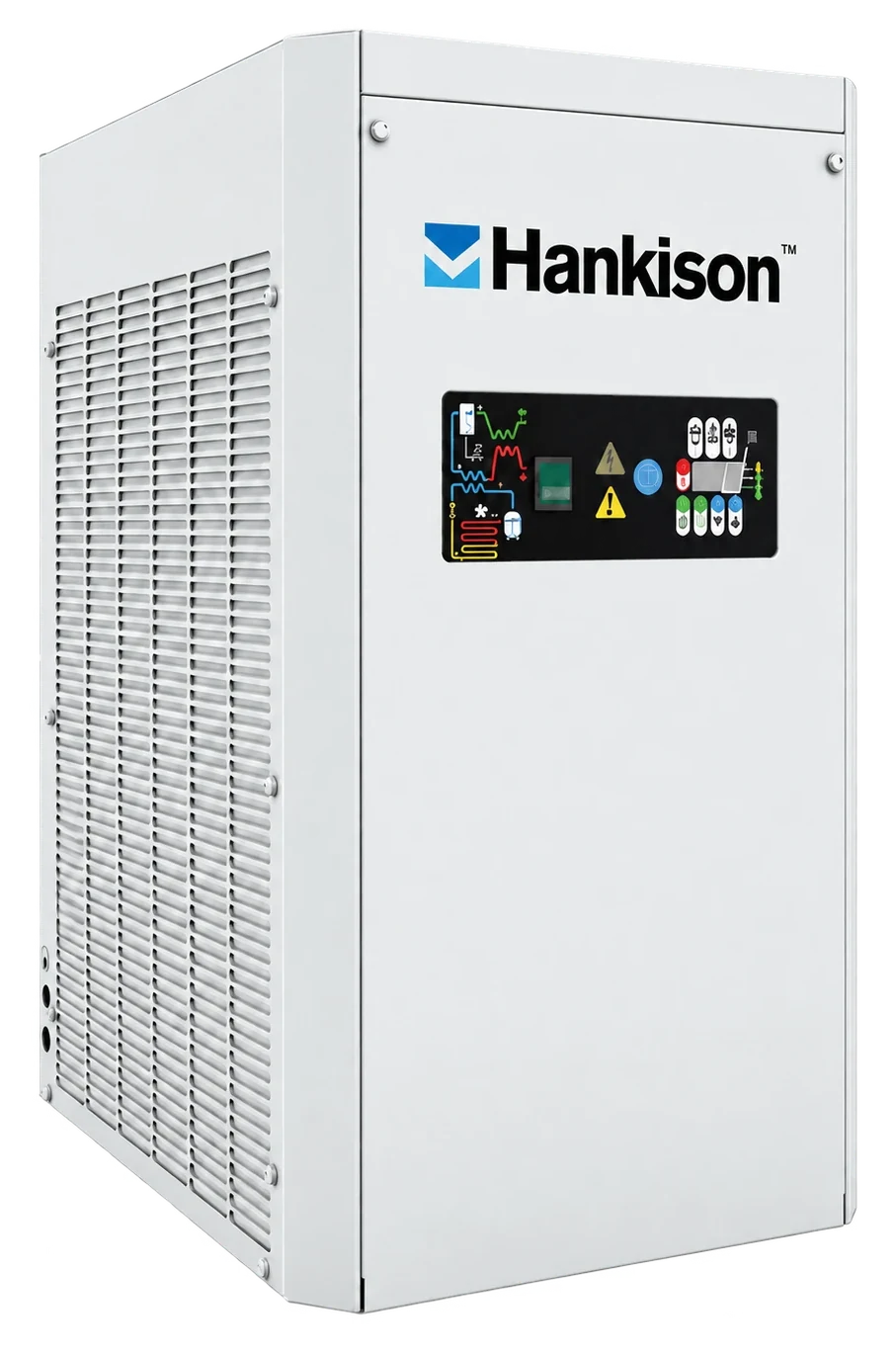
Standard dryers here accept inlet air to 120°F on the HPRB and FLXA Series, 131°F on the smaller DXR sizes, 140°F on the larger DXR sizes and the TMC Series, and 158°F on the NXC and VDR Series, all derated by the factors above. Past that the HRHT Series takes 200°F air and the HTR Series takes 180°F, from 25 to 125 SCFM, with an aftercooling stage built in. They deliver a 50°F dew point, ISO 8573-1 class 6, which suits shop and service-bay air, and the 450°F GHTN filter goes ahead of them.
Inlet temperature questions
Because an air-cooled aftercooler can only bring the air to within 15 to 20°F of the air blowing through it, and that air is the compressor room at 95°F or more in summer. A fouled core or a room that recirculates its own discharge pushes the approach wider still. Clean the core and ventilate the room before buying a bigger dryer.
Only a series that lists 140°F or more as its maximum, such as the larger DXR sizes, the TMC Series or the NXC and VDR Series, and only derated. There is no published factor at 140°F on this site, so treat it as a duty to lower with an aftercooler or to hand to a high inlet temperature dryer rather than a number to correct for.
A little. A wet receiver gives the air time and surface to lose heat to the room and drops out the bulk water that has already condensed, which is why the dryer belongs after it. It is worth a few degrees, not the 20°F an aftercooler delivers.
Both, in sequence. Up to the corrected capacity the dryer still holds 38°F; past it the refrigeration circuit cannot keep up, the dew point climbs to 45 or 50°F and liquid water reaches the header. The factor tells you where that line is.
50°F pressure dew point, ISO 8573-1 class 6, on the HRHT and HTR Series, against 38°F on a standard dryer. That is dry enough for tools, tire shops and service bays, which is where piston compressors without aftercoolers are found. A process that needs 38°F is better served by an aftercooler and a standard dryer.