
1-805-484-2992
Quotes - Engineering - SalesAir Dryers for Pneumatic HVAC Controls
A pneumatic building control system is the smallest compressed air plant in this section and the most sensitive to what is in the air. A duplex piston compressor of 1 to 5 hp in the mechanical room fills a tank to 80 to 100 psig; a pressure-reducing station drops it to 18 to 20 psig of main air; and that main air feeds thermostats, receiver-controllers, damper and valve actuators, relays and transducers all over the building through 1/4 in tube, each device metering its branch signal at 3 to 15 psig through a restrictor a few thousandths of an inch across. The whole system draws 5 to 20 SCFM.
Water in the main air condenses wherever the tube runs cold, in a ceiling plenum in winter or a shaft along an outside wall, and a drop of it in a thermostat's restrictor blocks the signal: the room overheats or freezes, a damper drifts open, a valve hunts. Oil aerosol from a lubricated compressor is worse because it never leaves; it gums restrictors and diaphragms one by one across the building. A refrigerated dryer with fine filtration ahead of the pressure-reducing valve is what stands between the compressor and a thousand small orifices.
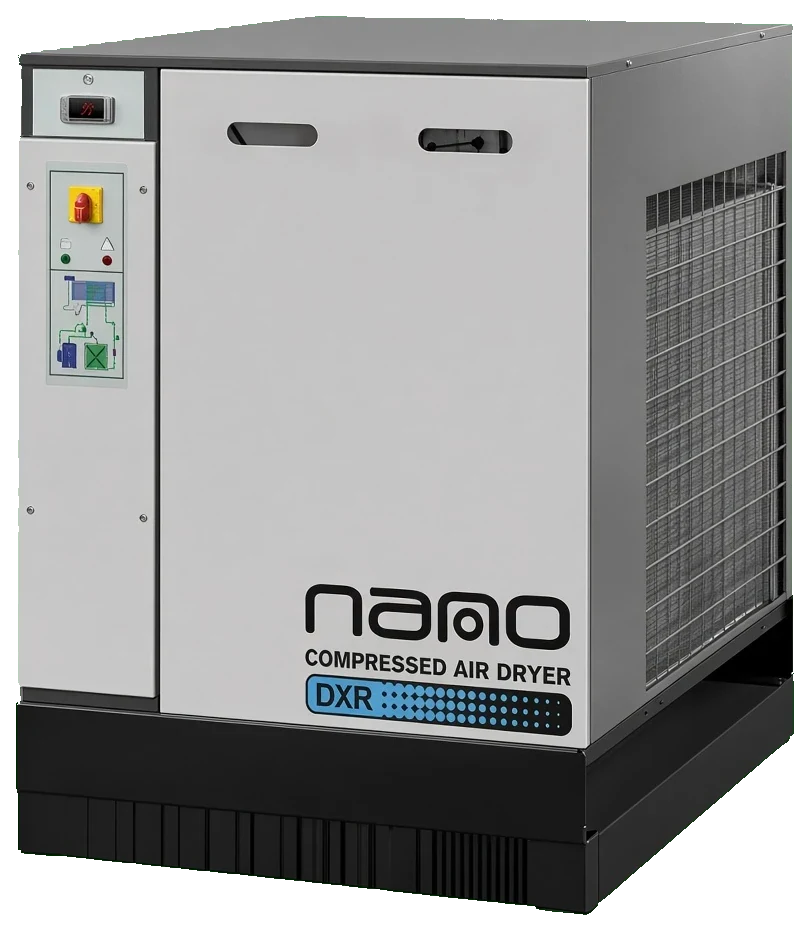
Dry the air at tank pressure, ahead of the PRV, where the dryer works at the 80 to 100 psig it is rated for. A refrigerated dryer at a 38°F pressure dew point there becomes roughly a 12°F dew point once the pressure is reduced to 20 psig, which covers every run in a heated building. The flow is small, so the dryer is one of the smallest on the site: the HPRB Series at 7 to 25 SCFM or the DXR Series at 10 to 30 SCFM, wall-mounted beside the tank with a 1701 bypass valve so it can be isolated for service without dropping the main air.
The filter train matters as much as the dryer: a 1 micron prefilter, the dryer, a 0.01 micron coalescing filter and an activated carbon filter for oil vapor, all sized for the compressor and each with a drain. A control compressor cycles a third of the time and runs cool through its tank, so a standard dryer is fine; the non-cycling type draws about 0.2 kW, and at this flow no cycling dryer can pay back. The one case that moves the answer is main air that runs outdoors or through an unheated space in winter, where a class 2 desiccant stage downstream of the refrigerated unit is needed on that branch.
Request a control-air dryer quote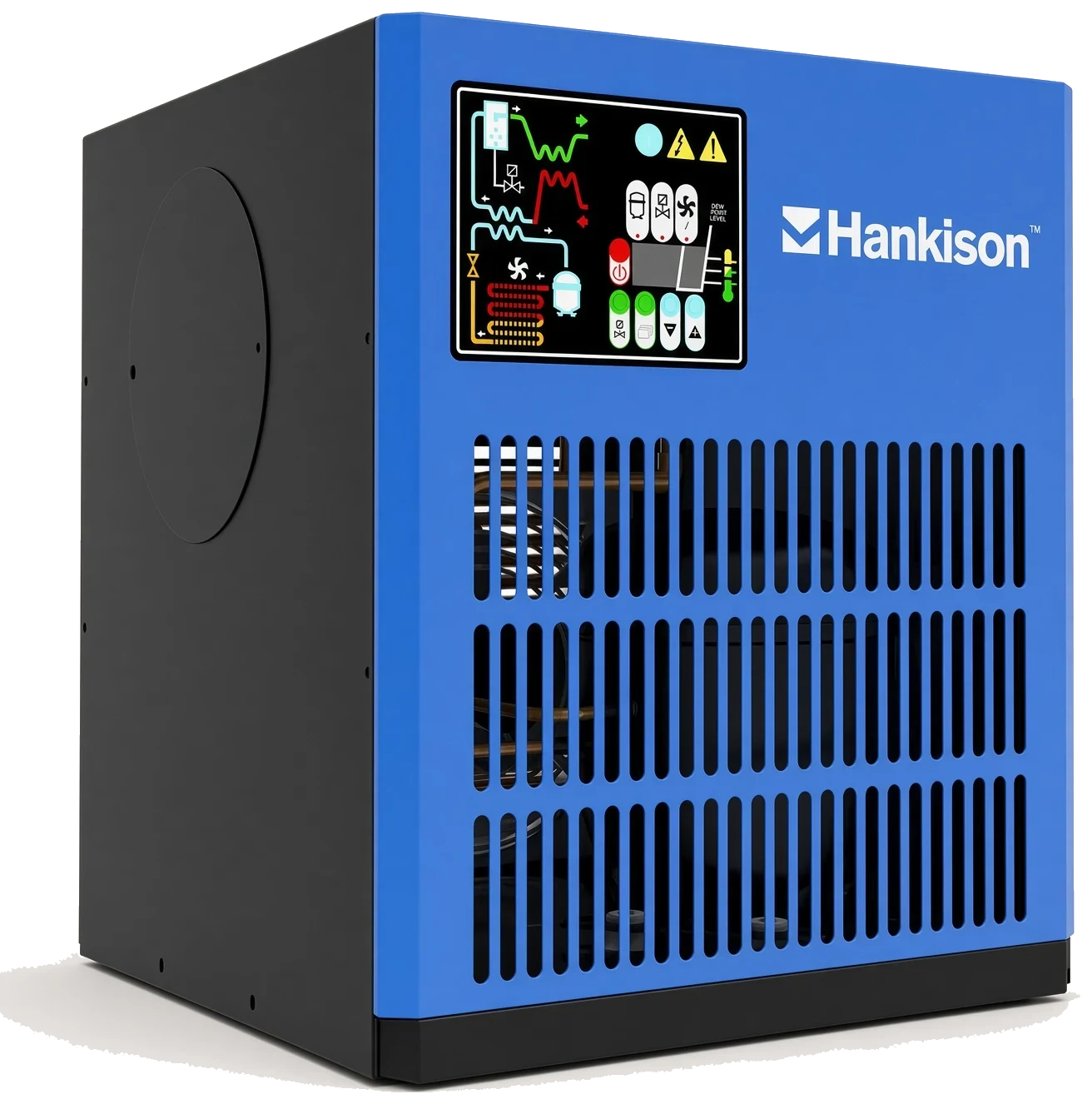
What wet or oily air does to pneumatic controls
The service calls that trace back to the compressor room
- Thermostat restrictors blocked by a drop of condensate, rooms drifting hot or cold
- Damper and valve actuators hunting or stuck as water collects in the branch line
- Diaphragms and relays gummed by oil aerosol, replaced one by one across the building
- Rusted main air tube and PRV internals after a winter of wet air in a cold plenum
The control-air specification
What the mechanical room needs
- Refrigerated dryer ahead of the PRV at tank pressure: 38°F pressure dew point, about 12°F at 20 psig main air
- 1 micron prefilter, 0.01 micron coalescer and activated carbon filter, sized for the compressor with a drain on each
- Wall-mounted 7 to 30 SCFM dryer with a 1701 bypass valve for service
- Desiccant stage on any branch that crosses unheated space; an oil-free compressor at replacement
Dryers and filters that fit a control-air system
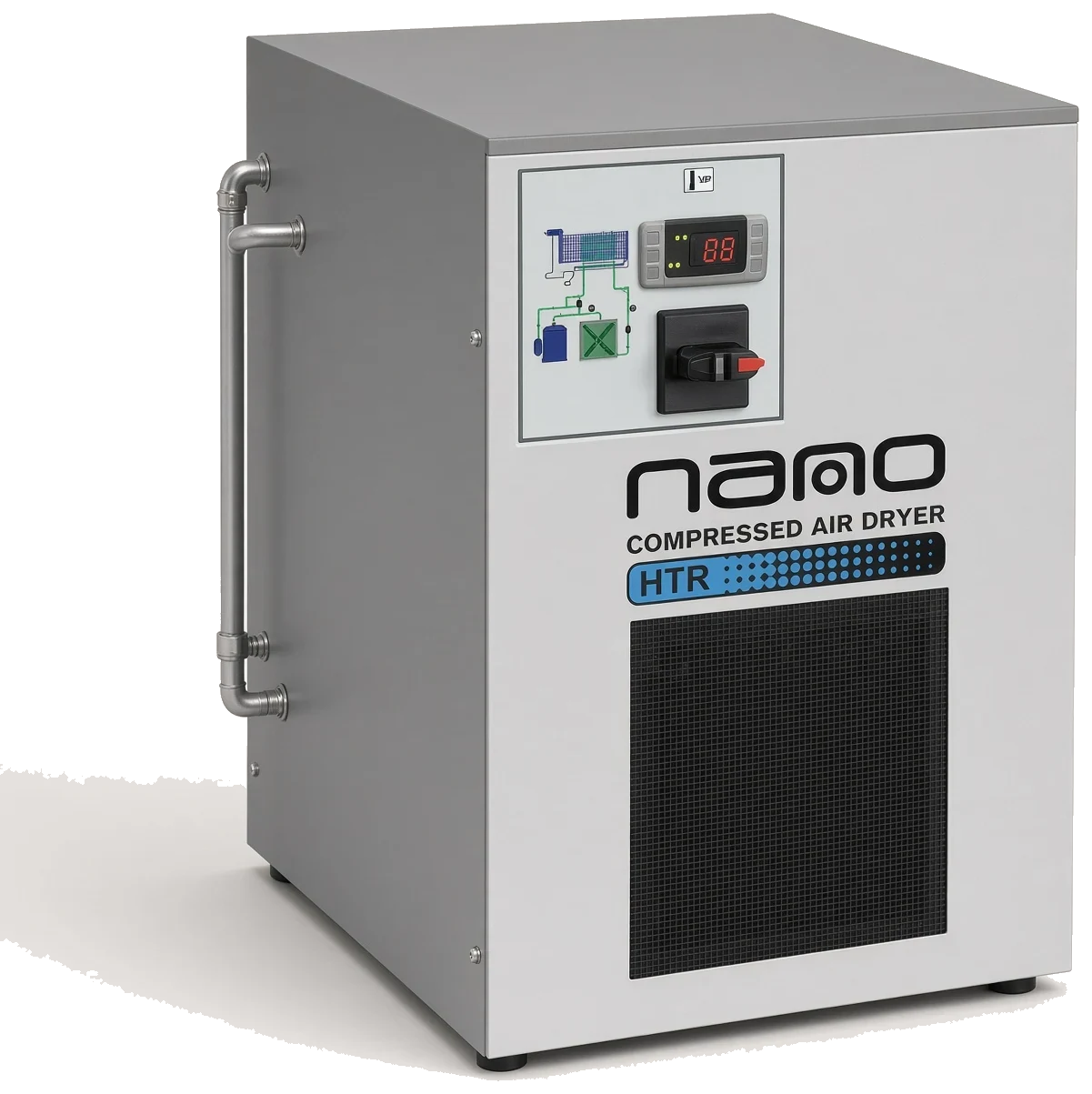
Ratings at 100 psig and 100°F inlet. A 2 to 5 hp control compressor delivers 7 to 18 SCFM, so the 7 to 25 SCFM dryers cover it; the HTR Series takes 180°F air where a dryer is close-coupled to a compressor without a tank.
| SERIES | TYPE | FLOW RANGE | MAX INLET | MAX PRESSURE |
| HPRB Series | Non-Cycling | 7 to 50 SCFM | 120°F | 200 psig |
| DXR Series | Non-Cycling | 10 to 4,200 SCFM | 131°F | 203 psig |
| HTR Series | High Inlet Temperature | 25 to 125 SCFM | 180°F | 232 psig |
| GFN Series Filters | Compressed Air Filter | 6 to 1,500 SCFM | — | 232 psig |
| NGF Series Filters | Compressed Air Filter | 20 to 1,500 SCFM | — | 250 psig |
| 1701 Bypass Valves & Mounting Brackets | Bypass & Mounting | 5 to 35 SCFM | — | 200 psig |
| Snap-Trap & Trip-L-Trap Drains | Condensate Drain | Call for sizing | — | 175 psig |
| PDM Dew Point Monitor | Dew Point Monitor | Call for sizing | — | 145 psig |
Send the compressor horsepower, the main air flow and whether any tube runs through unheated space; we size the dryer, the filters and the bypass.
Converting to DDC does not retire the compressor
Many buildings that converted their controls to direct digital control kept pneumatic actuators on the dampers and valves, driven by electronic-to-pneumatic transducers, because replacing every actuator was the expensive part of the job. The compressor, the dryer and the filters still serve those actuators, and the transducers are as sensitive to oil and water as the thermostats they replaced. A DDC front end also makes the dryer's alarm contact useful: wire it and the dew point monitor's relay into the automation system and the mechanical room reports a wet dryer before the first actuator sticks. When the control compressor is finally replaced, an oil-free unit with a tank, a small dryer and a two-stage filter train is the whole specification.
- Keep the dryer and filters in service for pneumatic actuators after a DDC conversion
- Wire the dryer alarm and the dew point monitor relay into the building automation system
- Specify an oil-free compressor at replacement so the carbon filter can be dropped
Where the dryer goes: before the PRV
Compressor, tank, 1 micron prefilter, dryer, 0.01 micron coalescer, carbon filter, then the pressure-reducing station and the main air. Drying at tank pressure does two things: the dryer works at the pressure it is rated for, and the dew point falls with the pressure when the PRV lets the air down. A 38°F pressure dew point at 100 psig is about 12°F at 20 psig, below any ceiling plenum in a heated building. Put the dryer after the PRV and it works at 20 psig, where its capacity is a fraction of its rating, and the 38°F it delivers is at main-air pressure, which is not enough in a cold plenum.
Sizing the smallest dryer on the site
A 3 hp control compressor delivers about 10 to 12 SCFM and a 5 hp unit about 18, so the 15 or 25 SCFM dryer covers nearly every building, and the 2 to 5 hp reciprocating page matches the sizes. Size to the compressor's delivery rather than the system's average draw, because the dryer sees full compressor flow whenever the tank is being filled.
Oil, filters and oil-free compressors
Pneumatic controls tolerate less oil than almost any other application, since a restrictor orifice a few thousandths across gums shut on a film a machine tool would never notice. On a lubricated compressor the 0.01 micron coalescing filter behind the dryer stops the aerosol and the activated carbon filter behind it stops the vapor; the carbon element is changed on hours, since a saturated bed shows no pressure drop. An oil-free compressor removes the source and leaves only the particle filters to maintain. The filter placement page sets out the order.
Main air in unheated spaces
Main air that runs to a rooftop unit or through an unconditioned attic sees temperatures below any refrigerated dew point in winter, and water condenses in the tube and freezes at the actuator. The refrigerated dryer still does the bulk of the work; a small desiccant cartridge or membrane dryer downstream on that branch takes the dew point to class 2 for the part of the system that needs it. The refrigerated versus desiccant page explains where the line falls.
Pneumatic control air questions
Because the dryer's 38°F is a pressure dew point at 100 psig. When the PRV drops the main air to 20 psig the same water vapor is spread through more than three times the volume, and the dew point falls to about 12°F. A dryer placed after the PRV delivers its 38°F at 20 psig, which is worse.
For a heated building with the tube inside the conditioned envelope, yes: 12°F at main-air pressure is below any plenum temperature. Where a branch runs to a rooftop unit or through an unheated attic in a northern winter, add a desiccant stage on that branch; the refrigerated dryer still protects the rest of the system.
Each 3 hp head delivers 10 to 12 SCFM, so a 25 SCFM dryer covers both running together and a 15 SCFM dryer covers the usual single-head duty. Size to the compressor's delivery, not the building's average control-air draw, since the dryer sees full compressor flow whenever the tank is being filled.
You still need the 1 micron prefilter and the 0.01 micron coalescer, because an oil-free piston compressor sheds ring wear particles and the intake pulls in whatever the mechanical room air carries. The activated carbon stage can usually be left out, which removes the one element that has to be changed on a schedule.
Measure it. The PDM dew point monitor samples the line through a quick-connect at up to 145 psig and reads pressure dew point on a display, so it can be carried to the mechanical room for an annual check or mounted on the wall with an alarm contact wired to the building automation system.
More on control-air drying
Dryers for 2 to 5 hp reciprocating compressors
The control-air compressor class, matched to the 7 to 25 SCFM dryers that fit it.
Learn More
Woodworking
Refrigerated air drying for cabinet and millwork shops: nailers, edgebanders, sanders, spray finishing and dust collector pulse valves.
Learn More
Textiles
Refrigerated air drying for air-jet looms, texturing, winders and dye houses: loom stops from wet air, oil class and central plant sizing.
Learn More