
1-805-484-2992
Quotes - Engineering - SalesAir Dryers for Rotary Screw Compressors
A rotary screw is the easiest compressor to size a dryer for. It delivers a steady 4.3 to 4.6 SCFM per horsepower at 100 to 125 psig, its aftercooler brings the discharge down to room temperature plus 15 to 20°F, and it runs loaded for long stretches. Horsepower therefore maps almost directly onto a flow band: 5 to 10 hp is the 5 to 50 SCFM band, 15 to 50 hp is 65 to 250 SCFM, 60 to 250 hp is 300 to 1,250 SCFM, and 300 hp and up is 1,600 SCFM and beyond.
What the horsepower does not tell you is the compressor room temperature, the state of the aftercooler and the hours a day the machine is loaded. Those decide the correction factor and whether a cycling or non-cycling dryer pays.
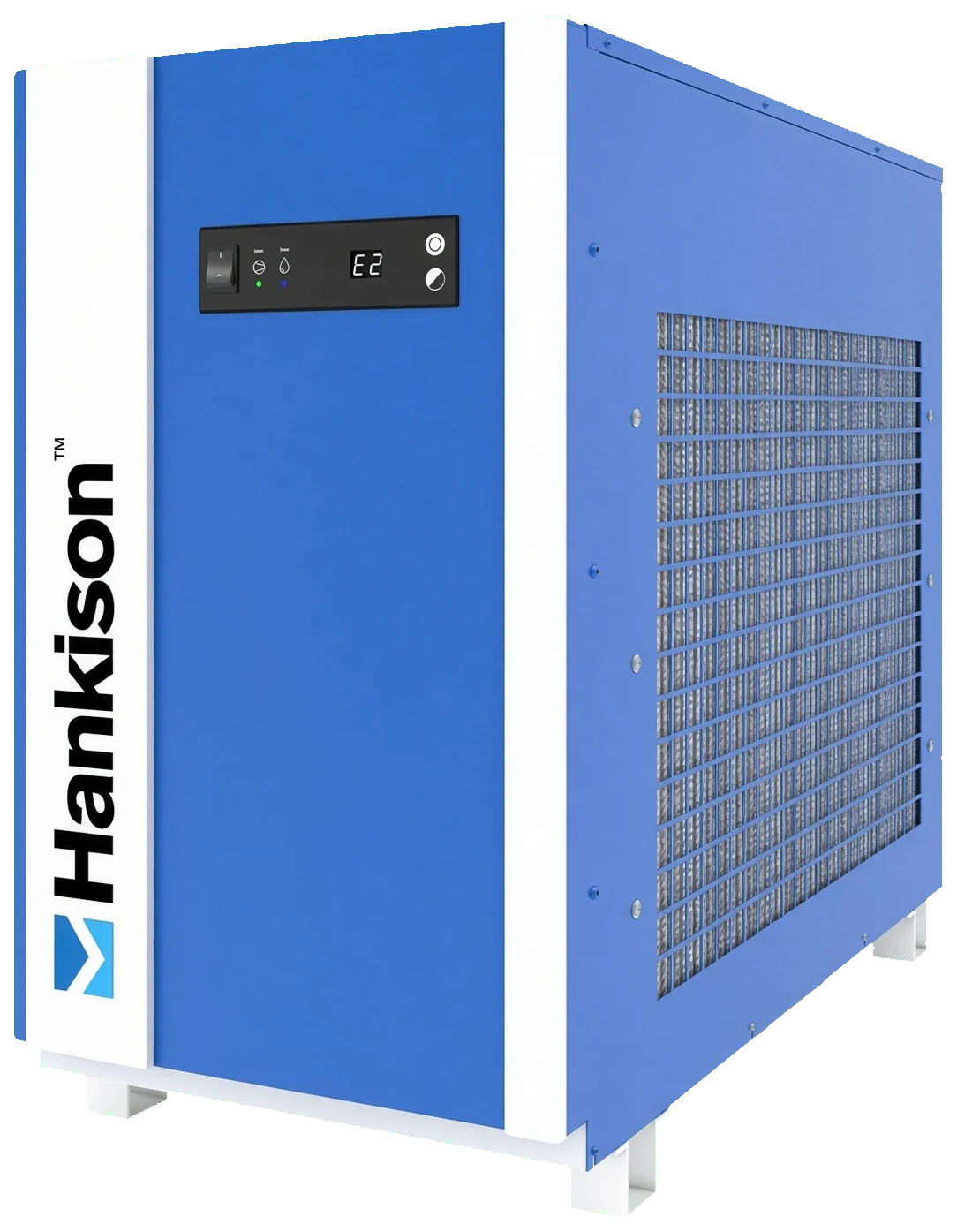
Pick the horsepower band
Each page turns nameplate horsepower into a dryer size, a flow band and the series that cover it
5 to 10 HP: Small tank-mounted screws delivering 21 to 46 SCFM. Plug-in 115 V dryers from 25 to 50 SCFM cover them, with the 65 SCFM size held back for hot rooms.
15 to 50 HP: The most common industrial compressor sizes, 65 to 230 SCFM, all inside the 65 to 250 SCFM band. Where a 25 hp screw becomes a 125 SCFM dryer and a 50 hp a 250.
60 to 250 HP: Plant compressors delivering 260 to 1,150 SCFM into the 300 to 1,250 SCFM band, where non-cycling, cycling and water-cooled start to matter to the power bill.

300 HP and Up: Single 300 to 500 hp machines and multi-compressor rooms from 1,600 SCFM up: large non-cycling units, modular skids and modulating dryers.
Three numbers
What a screw compressor hands its dryer
1.
Flow: 4.3 to 4.6 SCFM per horsepower
A 25 hp screw delivers 108 to 115 SCFM, a 100 hp machine 430 to 460. The data sheet beats the rule; two 50 hp compressors from different builders can differ by 20 SCFM.
At 125 psig the dryer carries 8 percent more than its 100 psig rating, at 80 psig 8 percent less.
2.
Temperature: room plus 15 to 20°F
The aftercooler leaves the air 15 to 20°F above the room, so a 95°F compressor room delivers 110 to 115°F air and derates a standard dryer to about 80 percent.
A fouled aftercooler pushes the inlet to 120°F and the factor to 0.65.
3.
Hours: loaded, unloaded, stopped
A screw loaded 60 percent of the shift or more on two or three shifts is non-cycling territory.
One shift, idle nights or a variable-speed compressor at half output favor a cycling dryer, which stops its refrigeration compressor as the load drops and cuts dryer power 50 to 80 percent.
Reading a rotary screw package before choosing the dryer
Three things on the package matter more than the nameplate horsepower: the delivered flow and pressure on the data plate, the temperature of the air leaving the aftercooler, and the controller's load history. Most screw controllers log loaded hours against run hours, and that ratio is the cycling-versus-non-cycling decision made for you.
Then look at the room. A screw throws its motor and oil-cooler heat into the space around it, and a dryer parked beside it breathes that air through its condenser, often 10°F above the plant floor.
Non-cycling or cycling behind a screw
A non-cycling dryer runs its refrigeration compressor continuously and holds the evaporator just above freezing with a hot-gas bypass: lowest first cost, fewest parts, a steady 38°F dew point. Behind a screw loaded most of the day its power is simply part of the base load.
A cycling dryer stores cold in a thermal mass, a glycol loop or the exchanger itself and shuts its refrigeration compressor off until the mass warms, so behind a screw that unloads at night, dryer power falls with the missing load.
Piping the dryer into a screw package
The order that works is compressor, aftercooler, receiver, 1 micron prefilter, dryer, 0.01 micron oil-removal afterfilter, header. The receiver smooths the load steps of a load/no-load screw and drops the bulk water; the prefilter keeps compressor oil and rust out of the dryer's exchanger.
Match the connections to the compressor discharge, and fit a bypass so the dryer can be isolated for service with the compressor still running.
Rotary screw compressor dryer questions
Between 4 and 5 SCFM per horsepower at 100 to 125 psig; 4.3 to 4.6 is the safe planning range for a single-stage oil-flooded machine. Use the delivered flow on the data sheet when it exists, because it already accounts for the airend and the discharge pressure.
The dryer matches the compressor's delivered SCFM after correction for inlet and ambient temperature, not the horsepower. A 30 hp screw in a cool room is a 150 SCFM dryer; the same compressor in a 110°F mezzanine needs the 185 or 200 SCFM size.
A separate dryer is sized to the compressor's real inlet conditions, can be serviced with the compressor running through a bypass, and stays when the compressor is replaced. Integrated dryers win only where floor space decides.
A cycling dryer sized for the compressor's maximum output. The VSD spends most of its life below full flow, and a cycling dryer's power falls with the load while a non-cycling unit draws the same at 40 percent flow as at 100.