
1-805-484-2992
Quotes - Engineering - SalesFilter Placement Around a Refrigerated Air Dryer
A refrigerated dryer removes water. It does not remove oil, and it does not remove the rust and scale that come down the pipe from the receiver, so the filters around it do two separate jobs: the prefilter protects the dryer, and the afterfilter cleans the air the dryer has cooled. The order is fixed by physics: oil aerosol is easiest to coalesce when the air is cold, which is directly after the dryer, and the exchanger stays clean only if the dirt is taken out before it.
Every filter costs pressure drop, so each one has to earn its place, and each element has to be changed when its differential says so rather than when someone remembers.
Prefilter, afterfilter and the vapor stage
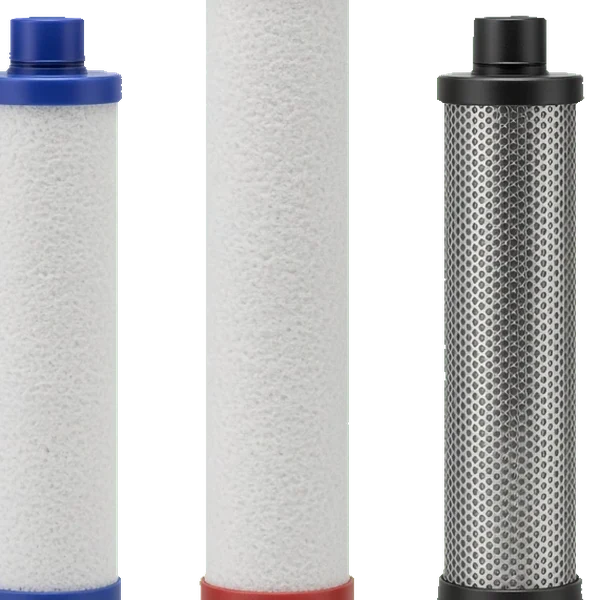
The prefilter sits between the receiver and the dryer and carries a 1 micron coalescing element: the M1 grade in the GFN Series, the PF grade in the NGF Series, Grade 7 in the HF Series. It takes out rust, scale, liquid water and the bulk of the compressor oil, bringing the oil to ISO 8573-1 class 3. Where the aftercooler has no separator, a GF WS centrifugal separator or an HF Grade 11 separator ahead of the prefilter takes the bulk liquid off it.
The afterfilter sits directly after the dryer and carries a 0.01 micron coalescing element, the GFN M01, NGF HF or UF, or HF Grade 5 or 3, which takes the oil to class 2 and the particles to class 1 or 2. Where the process needs class 1 oil, an activated carbon element, GFN AC, NGF CF or HF Grade 1, follows the coalescer; it must never see liquid, and the GFN AC grade is limited to 122°F.
Filter and separator series
Sizing, pressure drop and the hot-air case
Filters are rated in SCFM at 100 psig like the dryer and derate at lower pressure in the same way. Size each housing at the compressor's delivered flow at line pressure, and go up a size where the plant runs below 90 psig; a clean element drops 1 to 2 psi and a loaded one 6 to 10, and every 2 psi is about 1 percent of compressor power. Change elements at the differential the series specifies, 5 psid on the GHTN and 6 to 10 psid on the HF, or after a year, and carbon elements after 1,000 hours regardless of differential.
A piston compressor with no aftercooler delivers 180 to 200°F air that would destroy a 150°F filter housing. The 450°F GHTN Series takes that position, ahead of an HRHT or HTR high inlet temperature dryer, with a 1 micron element formulated for hot air.
Related installation pages
Worked example: 30 hp screw, 130 SCFM at 100 psig
The dryer is corrected; the filters are sized to the compressor
- Inlet 110°F: dryer duty 130 / 0.80 = 163 SCFM, the DXR 0185 NA
- Filters at the compressor's 130 SCFM with margin: GF 0175 WS separator, GFN 0175 M1 prefilter
- GFN 0175 M01 afterfilter directly after the dryer; GFN 0175 AC only if class 1 oil is specified
- NGF equivalents: F08 PF and F08 HF at 157 SCFM; HF equivalents: HF7-28 and HF5-28 at 170 SCFM
Reading a filter housing rating
What the label and the part number tell you
- Rated SCFM at 100 psig; derate at lower line pressure
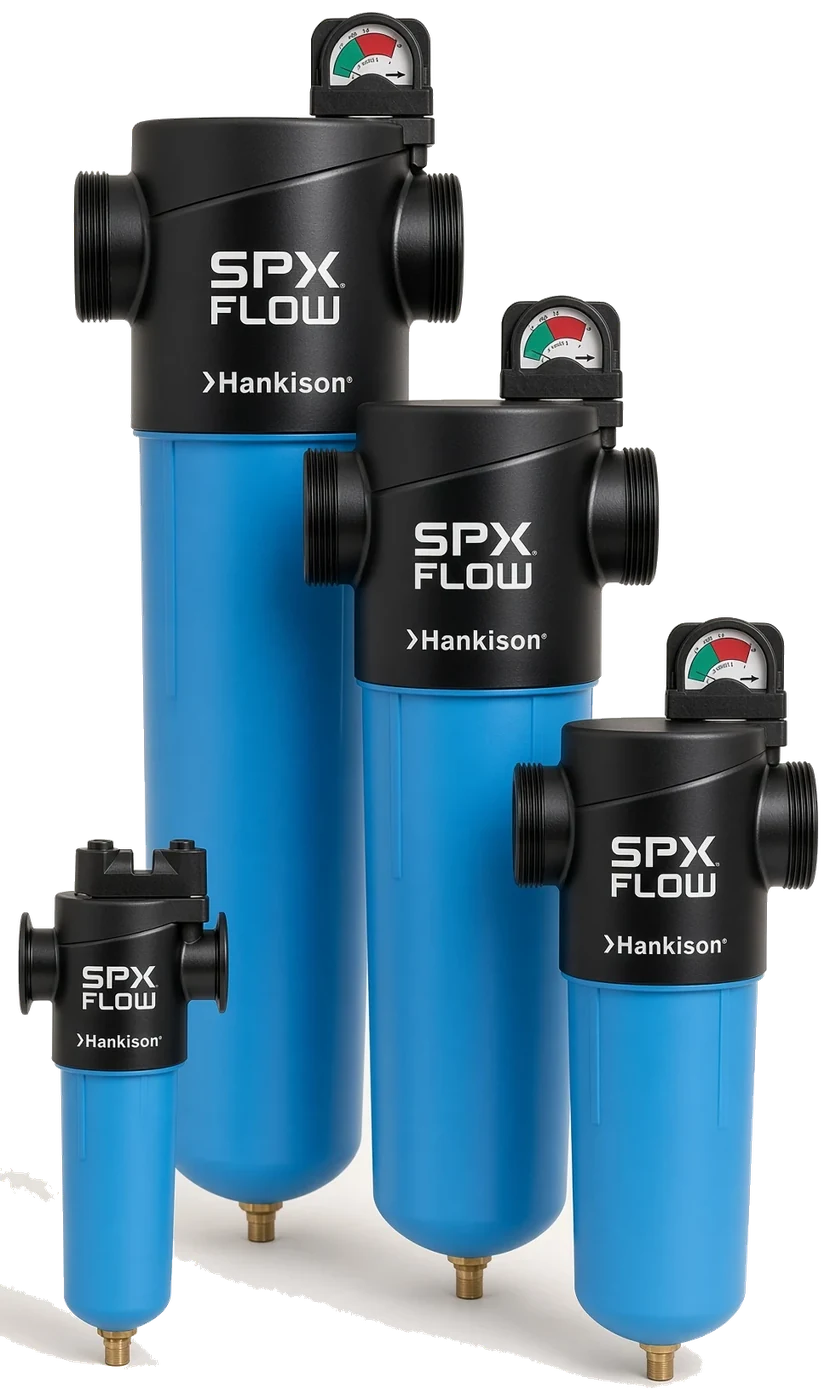
- Maximum pressure and temperature: 232 psig and 176°F on the GFN, 250 and 150°F on the NGF, 300 and 150°F on the HF
- Element grade: 1 micron, 0.01 micron or activated carbon, coded in the part number
- Drain and indicator options: float drain, differential slide indicator or gauge
Filter positions, grades and change points
Each position in the train, the element grade that belongs there and the part-number grades that supply it.
| POSITION | ELEMENT | REMOVES | GFN / NGF / HF GRADES | CHANGE AT |
| Separator, after the aftercooler or receiver | Centrifugal or impaction, no media | Bulk liquid | GF WS; HF Grade 11 | No element; check the drain |
| Prefilter, before the dryer | 1 micron coalescing | Rust, scale, water, oil to class 3 | M1; PF; Grade 7 | 6 to 10 psid or 12 months |
| Afterfilter, after the dryer | 0.01 micron coalescing | Oil aerosol to class 2, particles to class 1 or 2 | M01; HF or UF; Grade 5 or 3 | 6 to 10 psid or 12 months |
| Vapor stage, after the afterfilter | Activated carbon | Oil vapor to class 1 | AC; CF; Grade 1 | 1,000 hours |
| Hot air, after a piston compressor with no aftercooler | 1 micron, 450°F | Scale and carbon ahead of an HRHT or HTR dryer | GHTN M1 | 5 psid or 12 months |
| After a desiccant dryer | 1 micron dry particulate | Desiccant dust | Grade 6; M1 | 6 to 10 psid |
Filters for either side of the dryer
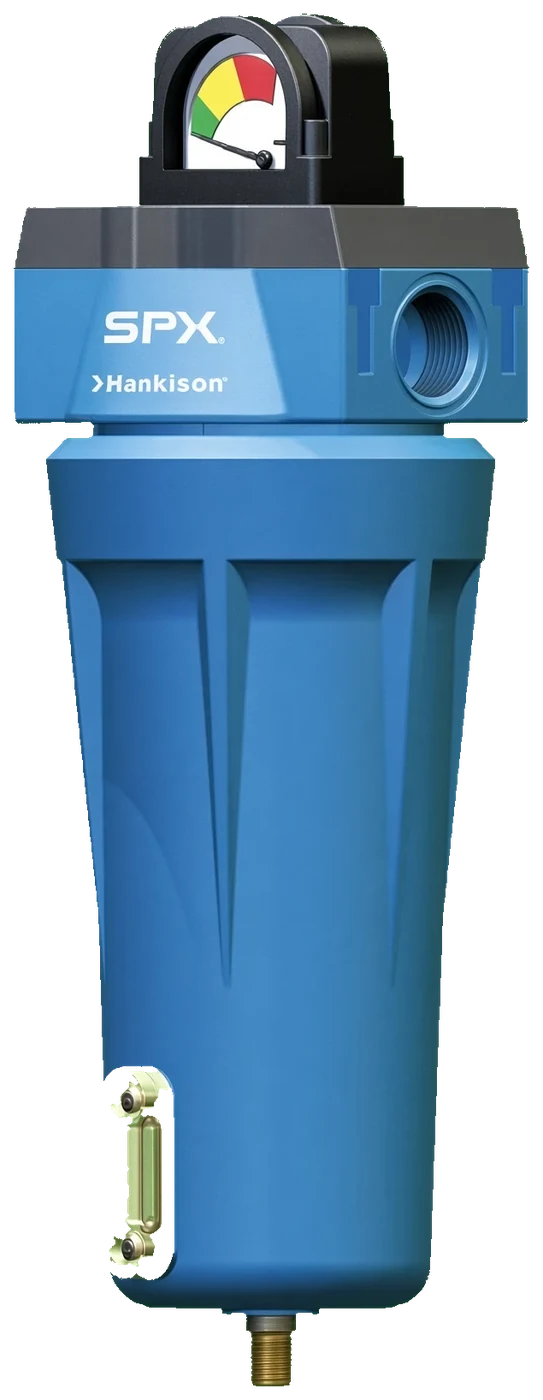
The order, and why it cannot be swapped
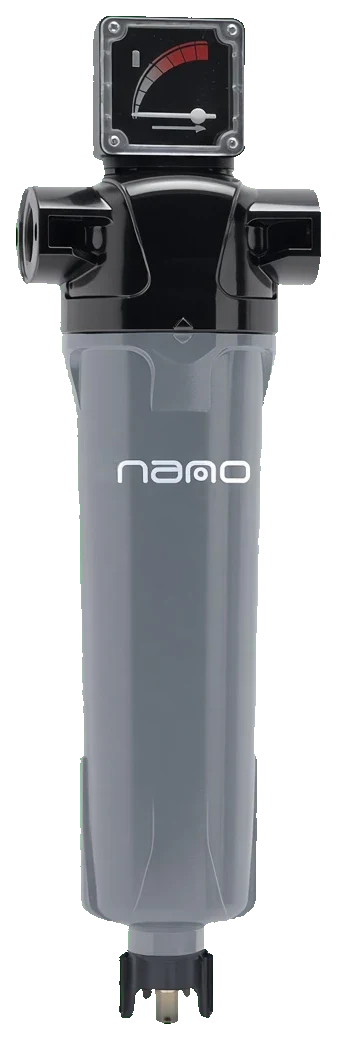
Receiver, separator if there is one, prefilter, dryer, afterfilter, carbon stage, header. The prefilter comes first because oil and rust on the exchanger surfaces insulate them and cut capacity, and because the dryer's own separator is designed for water, not sludge. The afterfilter comes after the dryer because the cold air has condensed the oil vapor into aerosol the coalescer can hold, and because its bowl then catches any condensate that gets past the dryer separator on a bad day. A carbon stage comes last because liquid of any kind ruins it.
Changing elements
Fit the differential indicator or gauge the series offers and read it weekly. A prefilter left past its limit lets oil through to the dryer; an afterfilter left past its limit costs compressor power and, once saturated, lets oil through to the plant. Keep a spare element for each housing on the shelf.
Mistakes in filter placement
The 0.01 micron filter ahead of the dryer, where the warm air carries its oil as vapor straight through it. No prefilter at all, so the exchanger fouls in a year. A carbon filter with no coalescer ahead of it, dead in a week. Filters sized to the dryer's corrected duty rather than the compressor's actual flow, a size larger than needed. And a prefilter housing without a drain, collecting a pint of water a day.
Desiccant and separator cases
A desiccant dryer adds two requirements: a 0.01 micron coalescer ahead of it, because oil ruins the beds, and a 1 micron particulate afterfilter behind it, the HF Series Grade 6 element, to catch desiccant dust. Where a compressor package has no separator and the receiver is far away, a GF WS Series centrifugal separator or an HF Grade 11 separator ahead of the prefilter takes the bulk water off it and lengthens the element's life several times over.
Filter placement questions
It can be piped there, but it will not do its job. Upstream of the dryer the air is warm and much of the oil is vapor, which passes a coalescer; after the dryer the air is at 38°F and the oil has condensed into droplets the element can hold. Put the 1 micron element before and the 0.01 micron element after.
Yes. A separator removes bulk liquid by spinning or impaction and does nothing to oil aerosol, rust or fine scale, which are what foul the dryer's exchanger. The separator makes the prefilter's life easier; it does not replace it.
By the differential pressure indicator or gauge on the housing, read against the limit for the series, and by the calendar at twelve months if the differential has not got there first. Carbon elements load up without any rise in differential, so those go on hours.
Usually not. A 0.01 micron coalescer after the dryer gives class 2 oil, which is clean enough for most coatings. Carbon is specified where the coating supplier calls for class 1, or where an odor or vapor problem has been traced to the air supply.
To the compressor's delivered flow at line pressure, with a size step of margin for pressure drop. The dryer is sized to a corrected duty that can be far above the compressor flow in a hot room; the filters see only the real flow and need not follow it up.