
1-805-484-2992
Quotes - Engineering - SalesCompressed Air Dryers for Injection Molding
An injection molding machine uses compressed air at the mold and around it: core-pull and ejector-assist valves, air poppets under deep parts, valve-gate actuators on hot-runner manifolds, sprue pickers and robots with venturi vacuum cups, hopper loaders, and blow-off nozzles at the parting line. None of them consumes much on its own; a floor of 20 presses on a 100 hp rotary screw draws 400 to 450 SCFM with everything running.
Water in that air lands on the tooling. A mold running on 45 to 55°F chilled water is the coldest surface in the building, so wet air blown across it condenses on the cavity, leaves water marks and splay on the next shot, and rusts core pins, ejector plates and vent lands. Valve-gate actuators bolted to a 450°F manifold flash any water in their supply to steam, and venturi vacuum generators lose pull as their nozzles scale.
A refrigerated dryer at the compressor room holding a 38°F pressure dew point stops all of this, because 38°F is below the chilled-water temperature of every mold in the plant. It is sized to the compressor, not the presses: a 75 hp screw delivering 330 SCFM into a 100°F room takes a 400 SCFM dryer, a 150 hp screw at 650 SCFM the 800 or 850 size. Only molds run below 40°F, and clean-room cells with a class 2 specification, call for desiccant drying.
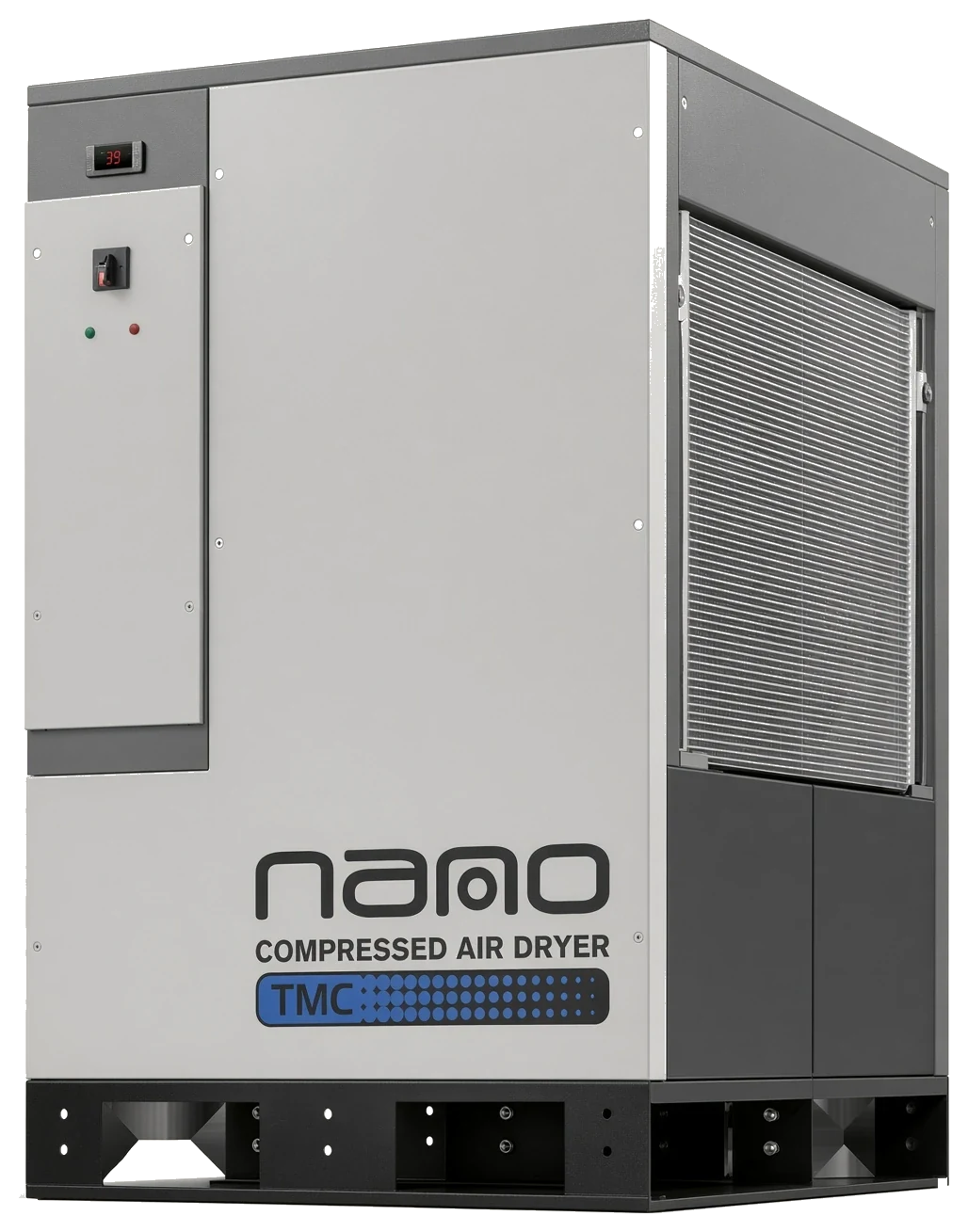
Molding plants run three shifts with the compressor loaded most of the time, so the non-cycling DXR Series is the usual choice. A plant that idles presses between jobs, or holds pressure overnight on one shift, gets its cycling premium back with the TMC Series or FLXA Series. Either way a 1 micron prefilter and a 0.01 micron oil-removal afterfilter bracket the dryer and keep compressor oil off clear lenses and medical parts.
Request a molding-plant dryer quote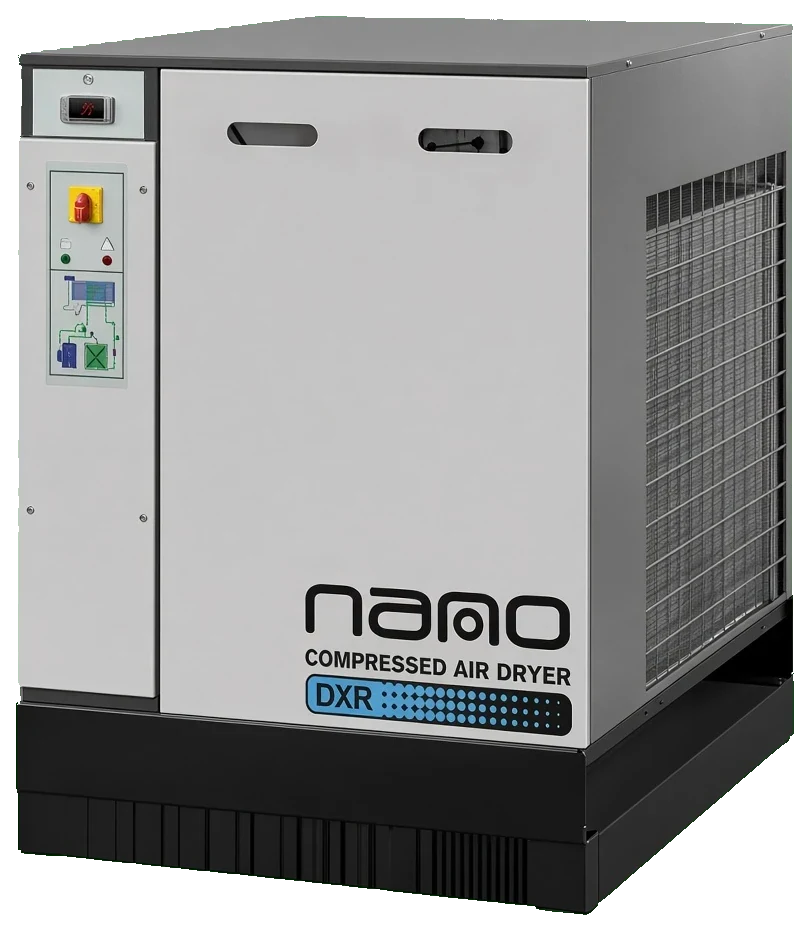
What wet air does on a molding floor
The defects and failures that trace back to the air line
- Water marks, splay and haze where condensate on the cavity meets the melt
- Rusted core pins, ejector plates and vent lands on molds that run cold
- Valve-gate and core-pull cylinders sticking as water washes out their lubricant
- Robot vacuum cups dropping parts as venturi nozzles scale and corrode
The dryer specification for a molding plant
What to ask for and what to leave out
- 38°F pressure dew point, ISO 8573-1 class 4, sized to the compressor's delivery at the compressor room temperature
- 1 micron prefilter ahead of the dryer, 0.01 micron oil-removal afterfilter behind it; a carbon filter for medical and food-contact parts
- Non-cycling for three-shift plants, cycling where presses idle for hours at a time
- Zero-loss drains on the receiver, separator, dryer and filter bowls
Dryers that fit a molding plant
Flow ratings at 100 psig and 100°F inlet. A 25 to 50 hp screw lands in the 65 to 250 SCFM band; a 75 to 150 hp plant uses the 300 to 850 SCFM sizes.
| SERIES | TYPE | FLOW RANGE | MAX INLET | MAX PRESSURE |
| DXR Series | Non-Cycling | 10 to 4,200 SCFM | 131°F | 203 psig |
| FLXA Series | Cycling | 75 to 2,000 SCFM | 120°F | — |
| TMC Series | Thermal Mass Cycling | 30 to 635 SCFM | 140°F | 210 psig |
| NXC Series | Cycling | 20 to 2,000 SCFM | 158°F | 232 psig |
| AES Series | Digital Scroll Cycling | 600 to 10,000 SCFM | 120°F | 232 psig |
| GFN Series Filters | Compressed Air Filter | 6 to 1,500 SCFM | — | 232 psig |
| NGF Series Filters | Compressed Air Filter | 20 to 1,500 SCFM | — | 250 psig |
| ND Series Zero-Loss Drains | Condensate Drain | Call for sizing | — | 290 psig |
Send the compressor horsepower, the number of presses and the mold water temperature; we size the dryer and the filter pair for the plant.
The receiver does half the dryer's work
A refrigerated dryer is rated for a steady flow at 100°F. Hopper loaders, air poppets and blow-off nozzles do not draw steadily; they pull in bursts that can run 50 percent above the compressor's delivery for a few seconds at a time. A receiver of at least a gallon per SCFM ahead of the dryer flattens those bursts and drops out most of the aftercooler condensate, so the dryer's separator sees droplets rather than a slug. Where loaders and robots were added without receiver volume, the dew point climbs during every loader cycle, and adding receiver capacity is cheaper than adding dryer capacity.
- Size the receiver at a gallon per SCFM of compressor delivery, ahead of the dryer
- Fit a zero-loss drain on the receiver so it does not fill with water between drain cycles
- Add receiver volume before adding dryer capacity when the load has become burstier
Where the dryer and filters go
The order is compressor, aftercooler, receiver, prefilter, dryer and afterfilter, with the loop header around the press floor after that. The receiver ahead of the dryer matters more in a molding plant than most, because hopper loaders and air poppets pull air in short bursts that would otherwise pass through the dryer as flow spikes above its rating. A plant that grew press by press often has two compressors in different rooms; give each its own dryer rather than one large dryer on a header fed at two temperatures.
Sizing from the compressor
Read the compressor's delivery from its nameplate rather than the horsepower rule, then correct for the room. A 75 hp screw at 330 SCFM in a 110°F mezzanine compressor room needs 330 divided by 0.88, or 375 SCFM of dryer, so the 400 SCFM model. Sizing from the sum of press nameplates undercounts loaders, robots and leaks; the flow and SCFM page walks through the arithmetic.
Hot runners, loaders and clean rooms
Valve-gate actuators sit on a manifold at melt temperature, so the air reaching them must be dry enough that nothing flashes to steam inside the cylinder, and a 38°F dew point does that. Hopper loaders and venturi generators are the largest air users on the floor and the most sensitive to scale, so keep the 0.01 micron afterfilter close behind the dryer where the air is coldest. A clean-room medical cell that must meet a class 2 dew point gets a point-of-use desiccant unit and its own filter train off the plant header, with the refrigerated dryer still doing the bulk of the work upstream.
Cycling or non-cycling
A three-shift plant with the compressor loaded 70 percent of the hours has little to gain from a cycling dryer; the non-cycling unit is cheaper and simpler. A plant that shuts half its presses on weekends, or a custom molder whose load swings with the job mix, sees the refrigeration compressor of a cycling dryer resting most of that time, and the power saved pays the difference in a year or two. The cycling versus non-cycling page has the comparison.
Injection molding air drying questions
Usually because the dryer is undersized for the summer compressor room and letting warm wet air through, or because the air is reheated and re-cooled on the way to the press through an uninsulated line across a hot roof space. Check the dryer outlet dew point on a hot afternoon before looking at the mold.
No. The actuator runs hot, so the concern is water flashing to steam inside it rather than condensation, and air at a 38°F pressure dew point carries too little water for that to matter. The cylinders do need oil-free air, so keep the 0.01 micron afterfilter in service.
A mid-size press with core pulls, a sprue picker and a hopper loader averages 15 to 25 SCFM, with peaks of two to three times that during a loader cycle. Size the dryer from the compressor's delivery, since the compressor was already chosen to cover those peaks.
Only if the load swings. Three shifts on a steady job mix is the case where a non-cycling DXR Series dryer costs nothing extra to run; single-shift plants and job shops that idle presses save enough refrigeration power with a TMC or FLXA Series to justify the premium.
A 1 micron coalescing prefilter ahead of the dryer, a 0.01 micron oil-removal filter behind it, and an activated carbon filter after that where oil vapor must be held below 0.003 ppm. The carbon element goes last in line because it needs cold, dry, aerosol-free air to work.
More on drying molding-plant air
Dryers for 60 to 250 hp rotary screw compressors
The compressor sizes behind most molding plants, matched to the 300 to 1,250 SCFM dryer bands.
Learn More
PET Blow Molding
Drying 500 to 725 psig blow air for PET stretch blow molders: why bottles haze, the HHPR and APET high-pressure dryers, and plant air.
Learn More
Printing & Converting
Dry, oil-free compressed air for presses, laminators, slitters and gluers: register, air shafts, food packaging film and dryer sizing.
Learn More