
1-805-484-2992
Quotes - Engineering - SalesAir Dryers for Extrusion & Thermoforming
An extrusion line uses compressed air along its whole length: the pneumatic cutter or traveling saw that flies with the pipe or profile, the haul-off belt tensioners, the die-lip and calibrator blow-offs, the expanding air shafts, core chucks and brakes on a film or sheet winder, and the pelletizer's knife clamps. A thermoformer adds the largest single user in the building, forming air, which presses the 300°F sheet into a 50°F aluminum mold at 60 to 120 psig in a burst of a second or two, then drives the plug assist, the sheet clamps, the trim press and the stacker.
Forming air is where water does the most visible damage. It enters the cavity between a hot sheet and a chilled mold, and any water vapor it carries condenses on the mold and prints on the part as a water mark, a dull patch or a ripple in the wall, while over months it pits the aluminum tool. On the extruder, wet air scales the cutter's valves so the cut drifts, and lets the winder's air shafts leak down so cores slip. Oil aerosol reaching a film winder shows up as fisheyes when the film is printed or laminated later.
A refrigerated dryer at a 38°F pressure dew point is below the chilled-mold temperature on any thermoformer, so the forming air can carry nothing to condense. The dryer goes in the compressor room after the receiver and is sized to the compressor: a 60 hp screw delivering 265 SCFM into a 100°F room takes the 300 or 325 SCFM dryer, a 100 hp screw at 450 SCFM the 500 size. Pressure-forming machines that boost forming air to 150 psig keep the standard dryer on the plant air and take the booster from it.
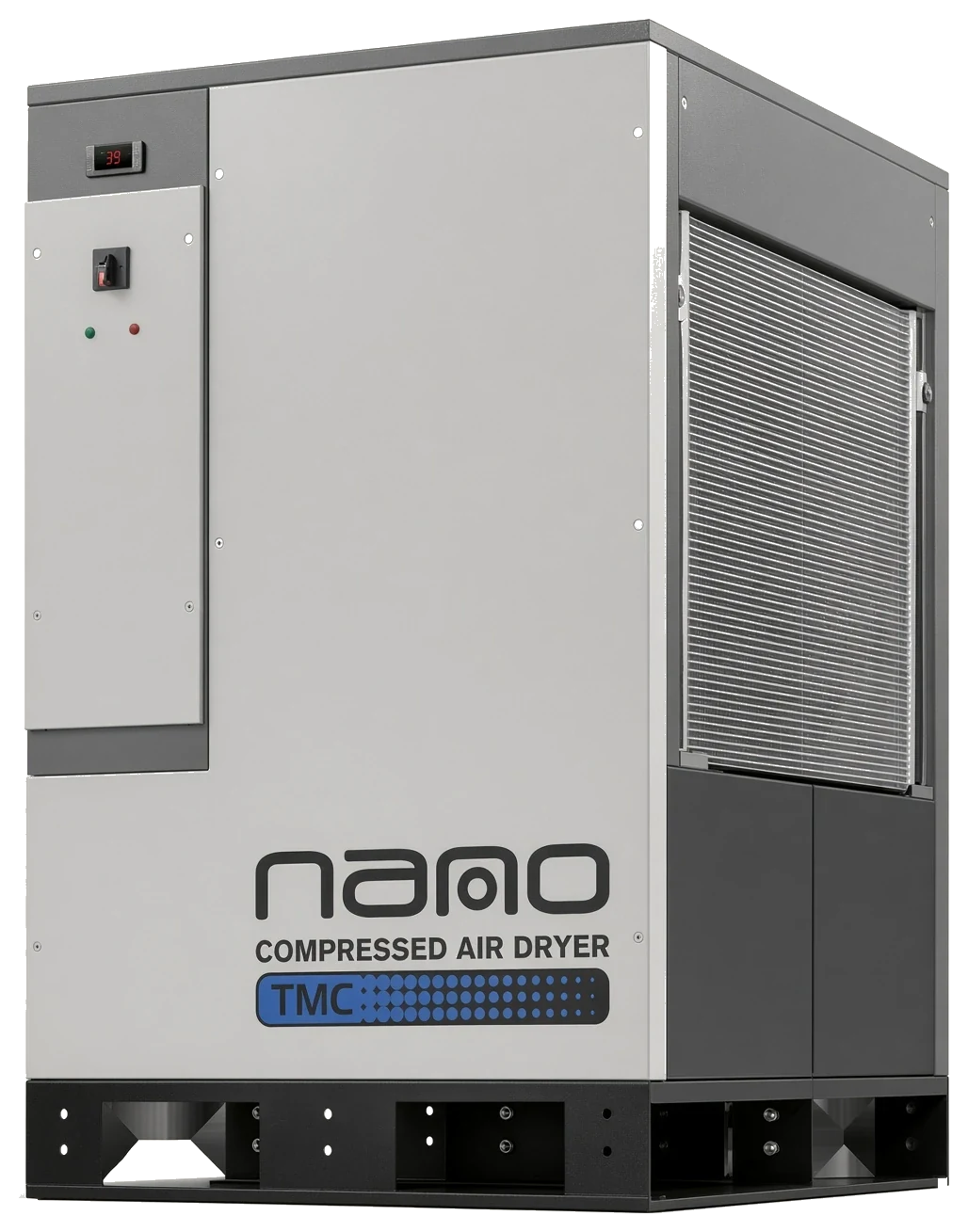
The two halves of the line want different dryers. An extruder runs for days at a steady rate, which is the non-cycling DXR Series case: lowest first cost, no penalty at full load. A thermoformer pulls forming air in bursts and sits idle at tool changes and between orders, and a plant of formers on their own compressor does better with a FLXA Series or TMC Series cycling dryer that rests through the gaps. On a shared header the steady extruder load decides it, and the non-cycling dryer wins.
Request an extrusion-line dryer quote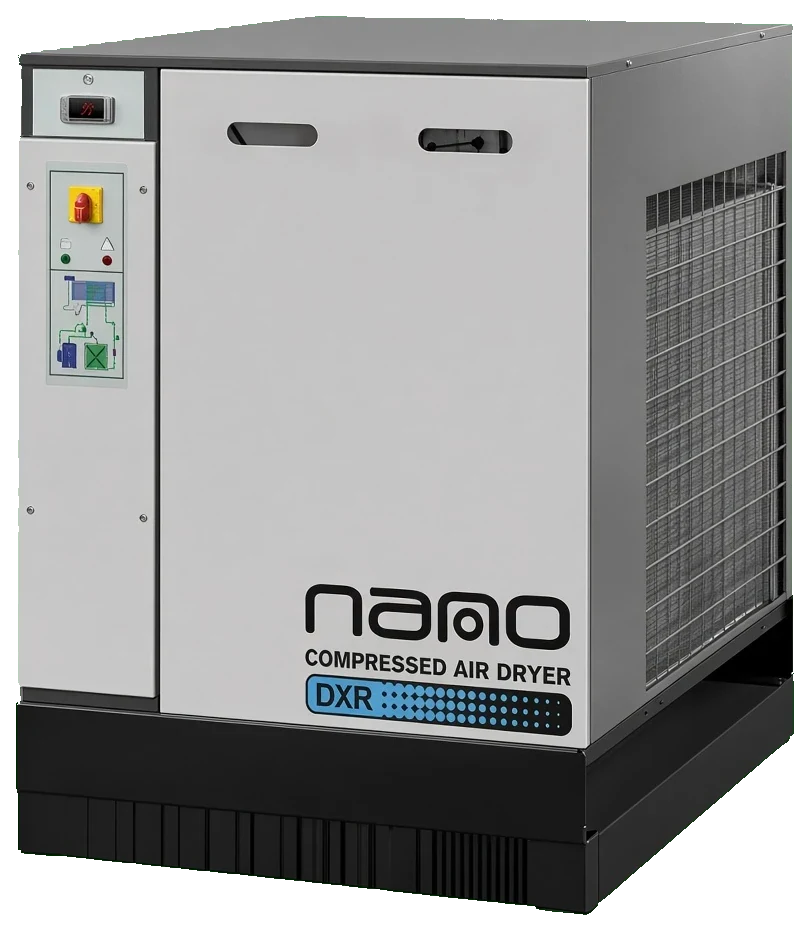
What wet or oily air does on the line
The defects that trace back to the compressor room
- Water marks, dull patches and wall ripples where condensate meets the sheet in the mold
- Pitted aluminum forming tools after a season of wet forming air
- Cutter and saw valves scaling so the cut length drifts through the shift
- Air shafts leaking down on the winder, and fisheyes on film that is printed later
The dryer specification for an extrusion or forming plant
What to specify and what to check
- 38°F pressure dew point, ISO 8573-1 class 4, sized to the compressor at the summer compressor-room temperature
- Non-cycling for continuous extrusion; cycling where thermoformers dominate the load
- A receiver at the thermoformer sized for the forming burst, with a zero-loss drain
- 1 micron prefilter ahead of the dryer and 0.01 micron oil-removal afterfilter behind it, carbon for food-contact film
Dryers that fit an extrusion or thermoforming plant
Ratings at 100 psig and 100°F inlet. A 25 to 50 hp screw uses the 105 to 250 SCFM sizes, a 75 to 100 hp screw the 325 to 500 SCFM sizes.
| SERIES | TYPE | FLOW RANGE | MAX INLET | MAX PRESSURE |
| DXR Series | Non-Cycling | 10 to 4,200 SCFM | 131°F | 203 psig |
| FLXA Series | Cycling | 75 to 2,000 SCFM | 120°F | — |
| TMC Series | Thermal Mass Cycling | 30 to 635 SCFM | 140°F | 210 psig |
| AES Series | Digital Scroll Cycling | 600 to 10,000 SCFM | 120°F | 232 psig |
| GFN Series Filters | Compressed Air Filter | 6 to 1,500 SCFM | — | 232 psig |
| NGF Series Filters | Compressed Air Filter | 20 to 1,500 SCFM | — | 250 psig |
| GF WS Series Separators | Water Separator | 6 to 3,000 SCFM | — | 232 psig |
| ND Series Zero-Loss Drains | Condensate Drain | Call for sizing | — | 290 psig |
Send the compressor horsepower, the forming pressure and the number of extruders and formers on the header; we size the dryer, the receiver and the filter pair together.
Where the second receiver goes decides whether the dryer works
A dryer is rated for a steady flow, and a thermoformer does not draw one. With only the compressor-room receiver upstream, the forming burst comes through the dryer as a spike of two or three times its rating; the separator cannot hold the water at that velocity and it goes down the pipe. With a second receiver downstream of the dryer at the former, the burst is served from stored dry air while the dryer refills the receiver at the compressor's steady rate. The same logic covers a traveling saw or a large trim press on an extrusion line: store dry air at the burst, dry at the average.
- Keep the compressor-room receiver ahead of the dryer for cooling and bulk water
- Add a second receiver downstream of the dryer at any machine that draws in bursts
- Fit zero-loss drains on both receivers; the wet one collects water, the dry one should stay empty
Where the dryer goes, and where the receiver goes
The order at the compressor room is the usual one: compressor, aftercooler, receiver, prefilter, dryer, afterfilter, header. The second receiver is the one a thermoforming plant forgets. A forming burst of a second or two into a large mold can momentarily draw two or three times the compressor's output, and without a receiver of 60 to 120 gallons at the machine that burst comes through the dryer as a flow spike far above its rating. Put that receiver downstream of the dryer, close to the former, and the dryer only ever sees the compressor's steady output refilling it.
Sizing to the compressor
Take the compressor's nameplate delivery and correct for the compressor room, which in an extrusion plant sits next to barrel heaters and a chiller and often runs 105 to 110°F in summer. A 75 hp screw at 330 SCFM in a 110°F room needs a 375 SCFM dryer, so the 400 model. The ambient conditions page gives the factors, and the DXR Series inlet rating of 131 to 140°F leaves margin for a hot aftercooler.
Forming air above 100 psig
Most thermoformers form at 60 to 100 psig and run on plant air. Pressure-forming machines that need 120 to 150 psig for fine detail usually take a small booster off the plant header, and that booster draws air the plant dryer has already dried, so its own aftercooler and a drain on its receiver are all the extra drying it needs. Where a whole header runs at 125 psig the dryer's capacity rises about 8 percent, and the DXR Series is rated to 203 psig and the TMC Series to 210 psig, so the standard units apply. The operating pressure page has the corrections.
Blown film and sheet winders
Film and sheet lines feed printing, laminating and food packaging, so the oil in the air matters as much as the water. A lubricated screw carries oil aerosol past its separator, and the 0.01 micron coalescing afterfilter behind the dryer is what keeps it off the web at the winder's air shafts and blow-offs; add an activated carbon filter for film that will contact food. A centrifugal GF WS Series separator ahead of the prefilter takes the bulk water out first and extends the element life.
Extrusion and thermoforming air questions
Because the dryer is running out of capacity when the compressor room is hottest. At 110°F ambient a refrigerated dryer loses about 12 percent, and with a fouled compressor aftercooler pushing the inlet to 120°F it loses a third, so the afternoon forming air arrives above its rated dew point. Check both temperatures before resizing.
No. The mold runs at 45 to 55°F on chilled water, and a refrigerated dryer holds the air at a 38°F pressure dew point, so nothing condenses in the cavity. Desiccant drying is reserved for lines whose piping runs outdoors in winter or for a customer specification that names class 2.
Enough that a forming burst does not pull the header down or spike the flow through the dryer: 60 to 120 gallons at the machine for a mid-size former, downstream of the dryer. The receiver stores dry air, the dryer only ever sees the compressor's steady output, and the burst never reaches it.
Non-cycling when the extruders set the load, since they run flat out for days and a DXR Series dryer at full load costs nothing extra to run. Cycling when thermoformers or a single-shift schedule leave the compressor idling for hours, where the TMC or FLXA Series turns that idle time into refrigeration power not used.
Both depend on small valves and seals that water reaches first: the cutter's solenoid valves scale and lag, and the air shaft's bladder seals leak once the lubricant is washed out. A dryer sized for the compressor at summer room temperature, with a 1 micron prefilter and a 0.01 micron afterfilter, stops both.
More on drying air for forming and extrusion
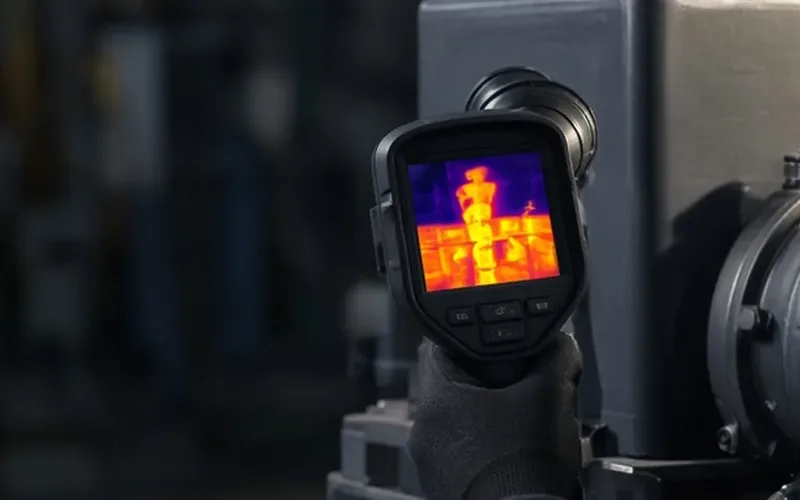
Sizing a dryer by flow and SCFM
How compressor delivery, peaks and receivers set the flow figure a dryer must be sized to.
Learn More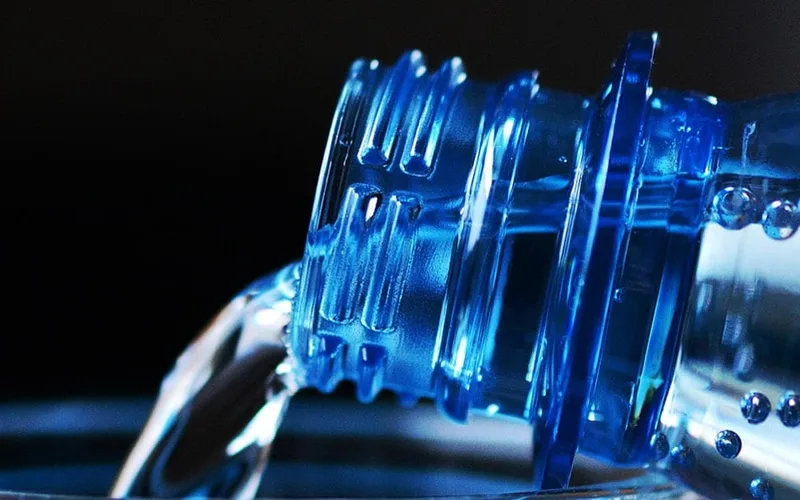
PET Blow Molding
Drying 500 to 725 psig blow air for PET stretch blow molders: why bottles haze, the HHPR and APET high-pressure dryers, and plant air.
Learn More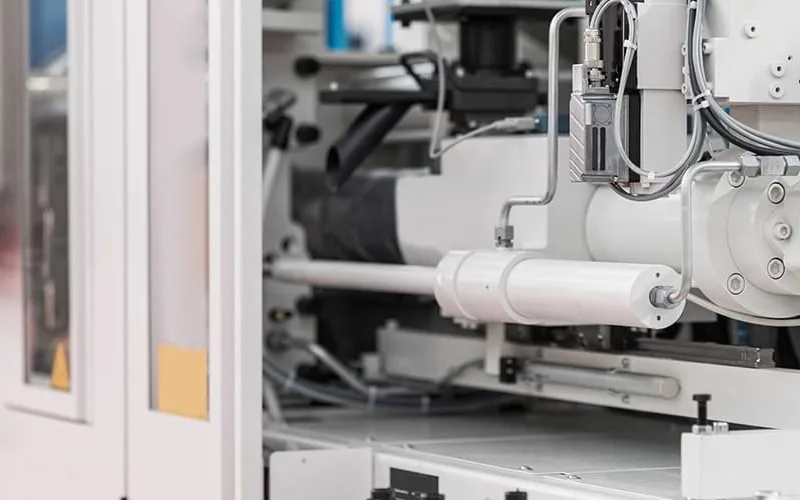
Injection Molding
Refrigerated air drying for injection molding: core pulls, valve gates, robots and hopper loaders, sizing by compressor, and filtration.
Learn More