
1-805-484-2992
Quotes - Engineering - SalesHigh Pressure Refrigerated Air Dryers, 500 to 725 psig
Dryers for PET blow molding boosters and high-pressure process air
A stretch-blow molding line runs its booster compressor at 500 to 600 psig, and the air that inflates the preform must be dry or the bottle walls carry water marks and the molds corrode. A plant-air dryer rated 200 psig cannot go there. The dryers on this page are built for 680 and 725 psig service, with stainless steel exchangers designed for the pressure, and sit downstream of the booster where the air is at its densest.
Two current series cover 45 to 2,410 SCFM. One is rated 680 psig in eleven sizes from 115 to 2,410 SCFM, threaded through 612 SCFM and on Class 300 flanges above, with an electronic controller and dew point display. The other is rated 725 psig in ten sizes from 45 to 1,000 SCFM with a stainless tube-in-tube exchanger, and publishes a capacity at 500 psig as well as at 725. The retired 725 psig series, 30 to 3,000 SCFM, is listed with its successor.
Air at 725 psig occupies about a sixth of the volume it fills at 100 psig, so the exchangers are compact for the SCFM they handle and the pressure drop across them is small. Every model delivers a 38 to 41°F pressure dew point at its rated pressure and 100°F inlet.
- 680 and 725 psig maximum working pressure; capacities published at 500 psig too
- 45 to 2,410 SCFM current, 30 to 3,000 SCFM including the retired series
- Stainless steel tube-in-tube or brazed-plate exchangers built for the pressure
- 1/2 in NPT to 4 in Class 300 flanges; 115 V single phase to 460 V three phase
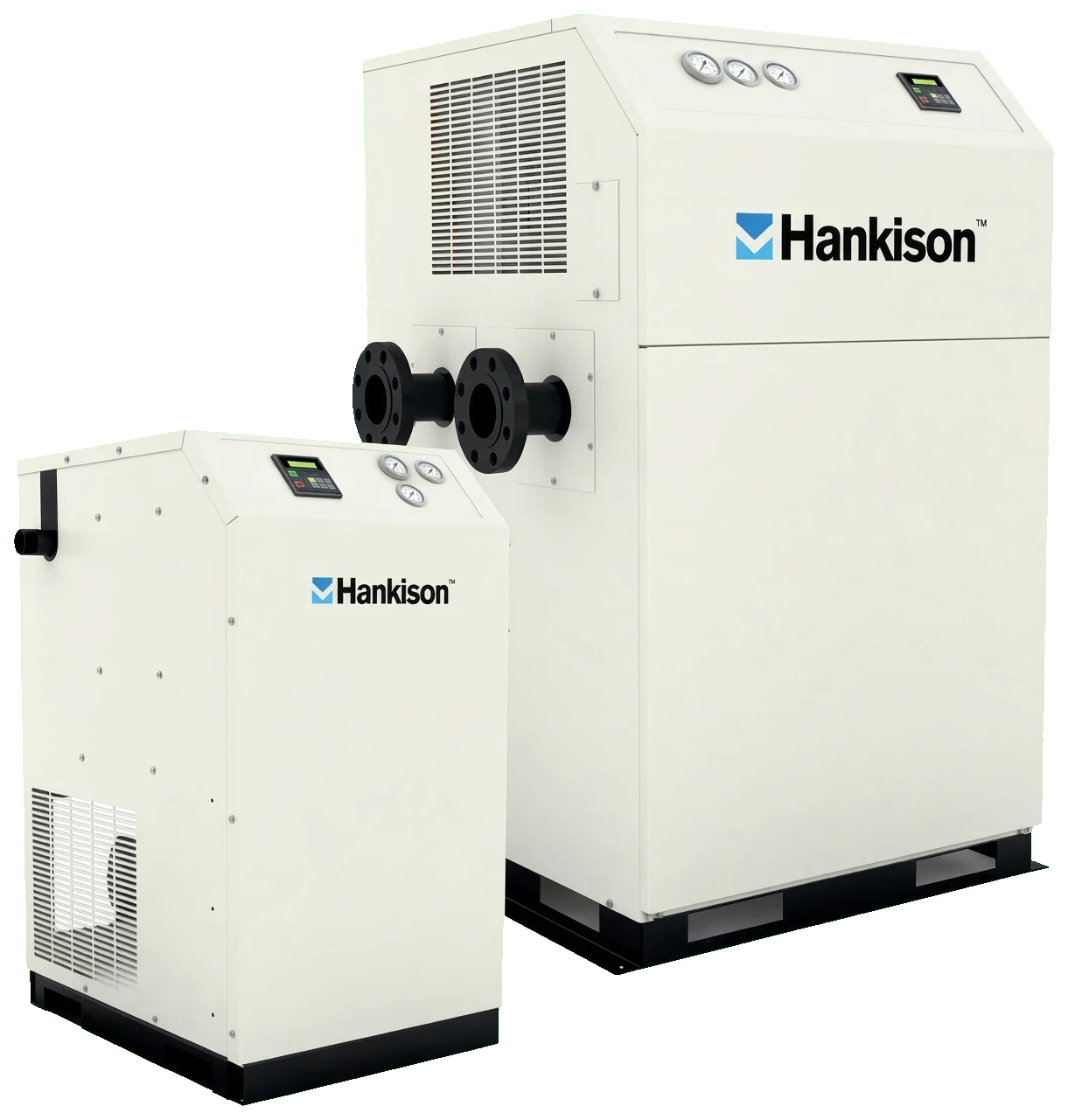
Every 500 to 725 psig model
Thirty-five models with their rated capacity, connection and voltage; a high-pressure dryer is selected on SCFM at the line pressure, so confirm which pressure the capacity is quoted at. Current series first, the retired series and its replacement after.
| PART NUMBER | SERIES | SCFM | CONNECTION | VOLTAGE | STATUS |
| APET-45 | APET Series | 45 | 1/2 in NPT | 115/1/60 | Current |
| APET-65 | APET Series | 65 | 1/2 in NPT | 115/1/60 | Current |
| APET-80 | APET Series | 80 | 1/2 in NPT | 115/1/60 | Current |
| APET-125 | APET Series | 125 | 1/2 in NPT | 115/1/60 | Current |
| APET-200 | APET Series | 200 | 1 in NPT | 115/1/60 | Current |
| APET-260 | APET Series | 260 | 1 in NPT | 230/1/60 | Current |
| APET-415 | APET Series | 415 | 1 in NPT | 460/3/60 | Current |
| APET-570 | APET Series | 570 | 1 in NPT | 460/3/60 | Current |
| APET-860 | APET Series | 860 | 1 in NPT | 460/3/60 | Current |
| APET-1000 | APET Series | 1,000 | 1 in NPT | 460/3/60 | Current |
| HHPR-115 | HHPR Series | 115 | — | 115/1/60 | Current |
| HHPR-150 | HHPR Series | 150 | — | 115/1/60 | Current |
| HHPR-200 | HHPR Series | 200 | — | 115/1/60 | Current |
| HHPR-300 | HHPR Series | 371 | 1-1/2 in MNPT | 460/3/60 | Current |
| HHPR-600 | HHPR Series | 612 | 2 in MNPT | 460/3/60 | Current |
| HHPR-750 | HHPR Series | 768 | 3 in Class 300 RF flange | 460/3/60 | Current |
| HHPR-1000 | HHPR Series | 1,000 | 3 in Class 300 RF flange | 460/3/60 | Current |
| HHPR-1200 | HHPR Series | 1,237 | 3 in Class 300 RF flange | 460/3/60 | Current |
| HHPR-1600 | HHPR Series | 1,610 | 4 in Class 300 RF flange | 460/3/60 | Current |
| HHPR-2000 | HHPR Series | 2,000 | 4 in Class 300 RF flange | 460/3/60 | Current |
| HHPR-2400 | HHPR Series | 2,410 | 4 in Class 300 RF flange | 460/3/60 | Current |
| HPET-0.17 | HPET Series | 30 | 1/2 in NPT | 115/1/60 | Replaced by HHPR |
| HPET-0.2 | HPET Series | 45 | 1/2 in NPT | 115/1/60 | Replaced by HHPR |
| HPET-0.25 | HPET Series | 65 | 1/2 in NPT | 115/1/60 | Replaced by HHPR |
| HPET-0.33 | HPET Series | 95 | 1/2 in NPT | 115/1/60 | Replaced by HHPR |
| HPET-0.5 | HPET Series | 165 | 1-1/2 in NPT | 115/1/60 or 208-230/1/60 | Replaced by HHPR |
| HPET-0.75 | HPET Series | 200 | 1-1/2 in NPT | 115/1/60 or 208-230/1/60 | Replaced by HHPR |
| HPET-1.0 | HPET Series | 300 | 1-1/2 in NPT | 460/3/60 | Replaced by HHPR |
| HPET-1.5 | HPET Series | 500 | 1-1/2 in NPT | 460/3/60 | Replaced by HHPR |
| HPET-2.5 | HPET Series | 750 | 1-1/2 in NPT | 460/3/60 | Replaced by HHPR |
| HPET-3.5 | HPET Series | 1,000 | 1-1/2 in NPT | 460/3/60 | Replaced by HHPR |
| HPET-4 | HPET Series | 1,250 | 3 in NPT | 460/3/60 | Replaced by HHPR |
| HPET-6 | HPET Series | 1,750 | 3 in NPT | 460/3/60 | Replaced by HHPR |
| HPET-7.5 | HPET Series | 2,000 | 3 in NPT | 460/3/60 | Replaced by HHPR |
| HPET-10 | HPET Series | 3,000 | 3 in NPT | 460/3/60 | Replaced by HHPR |
Three series for high-pressure air
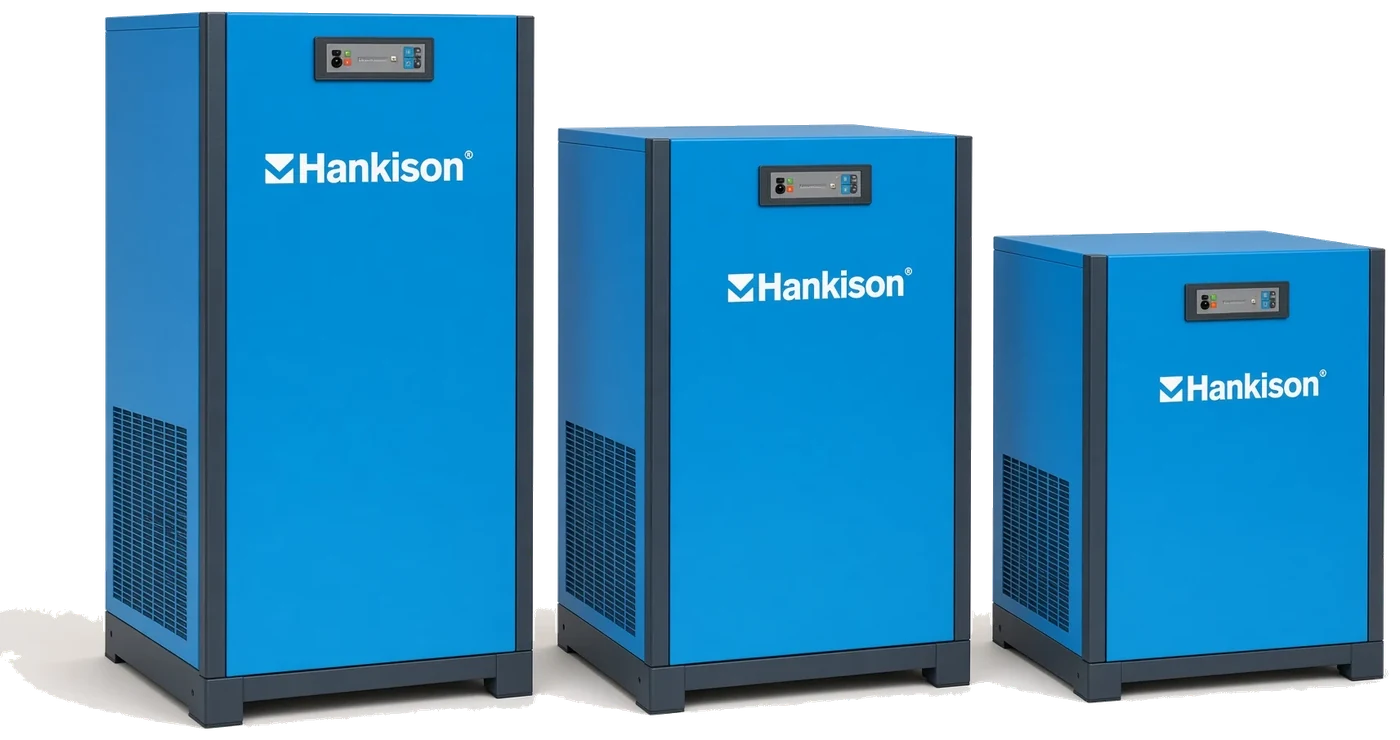

Sizing at 40 to 50 bar
A PET line is sized from the booster's delivery in SCFM and its discharge pressure. A booster delivering 300 SCFM at 580 psig takes the 371 SCFM model of the 680 psig line or the 415 SCFM model of the 725 psig line; the capacity published at 500 psig is the safer figure for a booster that runs at 500 to 550 psig, because capacity falls with pressure. Add the usual derates for inlet temperature: a booster aftercooler that discharges at 110°F costs 20 percent of the rating, and boosters on a hot mold-shop mezzanine often do.
Where the dryer goes in a PET system
The usual layout is a low-pressure compressor and dryer feeding the booster, then the high-pressure dryer after the booster's aftercooler and receiver, then the high-pressure filters and the blow molder. Drying only at low pressure is not enough: the booster compresses the air five times further, the water that was vapor at 100 psig condenses at 580 psig, and it arrives at the mold as liquid. The high-pressure dryer takes that condensate out at the pressure where it forms.
What is in the machine
The 680 psig line pairs a hermetic refrigeration circuit with pressure-rated exchangers, a solenoid drain on the 115 to 200 SCFM sizes and a timed electric drain from 300 SCFM up, and an electronic controller that shows dew point; it is air-cooled throughout and built to UL standards. The 725 psig line uses a corrosion-resistant stainless tube-in-tube exchanger with better than 98 percent moisture separation, an initial pressure drop of about 5 psi, and NEMA 1 electricals in 115 V, 230 V and 460 V builds by size. The retired series used 316 stainless brazed-plate exchangers and a filter-separator with a timed drain; its model numbers are the refrigeration compressor horsepower.
Beyond PET
The same dryers serve any line running between 200 and 725 psig: pneumatic presses and clamps at 250 psig, test benches, high-pressure blow-off and cleaning, and engine starting-air systems. Filters, drains and bypass valves must carry the same pressure rating as the dryer; the drains page lists timed drains to 6,000 psig and the PET blow molding page covers the complete air system. Pressures above 725 psig move to the ultra-high-pressure dryers.
High pressure dryer questions
Because SCFM is measured at standard conditions while the exchanger sees actual volume, and at 725 psig a given SCFM occupies less space and moves more slowly through the dryer than at 500 psig. The 725 psig line publishes both figures; size on the one that matches the booster's real discharge pressure.
Yes. A standard refrigerated dryer on the low-pressure side keeps the booster's cylinders and valves dry and takes most of the water out where it is cheapest to remove. The high-pressure dryer then removes the water that condenses as the booster raises the pressure.
The current 680 psig series is air-cooled throughout, and the 725 psig series is air-cooled as well. The retired series was offered in both; a plant replacing a water-cooled unit should allow for condenser airflow and room heat when it selects the current model.
1/2 in NPT on the small sizes, 1 in and 1-1/2 in NPT through the middle of the range, 2 in MNPT at 612 SCFM, and 3 in and 4 in Class 300 raised-face flanges from 768 SCFM up on the 680 psig line. Threaded connections are rated for the dryer's pressure; check that the pipe and fittings are too.
The 680 psig series, matched by capacity: the 30 to 95 SCFM sizes map to the 115 SCFM model, and the larger sizes map across at the same or the next flow. The rating drops from 725 to 680 psig, which still covers a 580 psig blow-molding booster with margin.