
1-805-484-2992
Quotes - Engineering - SalesCompressed Air Dryers for Woodworking Shops
A woodworking shop uses compressed air at the bench and inside the machines: nailers, staplers and clamps at every assembly station, the edgebander's pressure rollers and glue pot, the wide-belt sander's tracking and platen loading, the CNC router's tool changer, the finishing room's spray guns and, biggest of all on a plant scale, the pulse-jet valves that clean the bags in the dust collector. A two-person cabinet shop runs a 5 or 7.5 hp piston compressor; a millwork plant with a dust collector and a finishing line runs a 25 to 50 hp screw at 110 to 230 SCFM.
Water in that air is easy to see in a woodshop. A nailer that spits rusty water onto a maple panel leaves a stain the finish will not cover, a spray gun with water in the line throws fisheyes and blushing into lacquer, an edgebander's pressure rollers rust and mark the tape, and a dust collector's pulse valves on the roof fill with condensate and freeze shut in the first cold snap, so the bags blind. Oil aerosol from a lubricated compressor does the same damage to a finish as the water, and it is harder to wipe off.
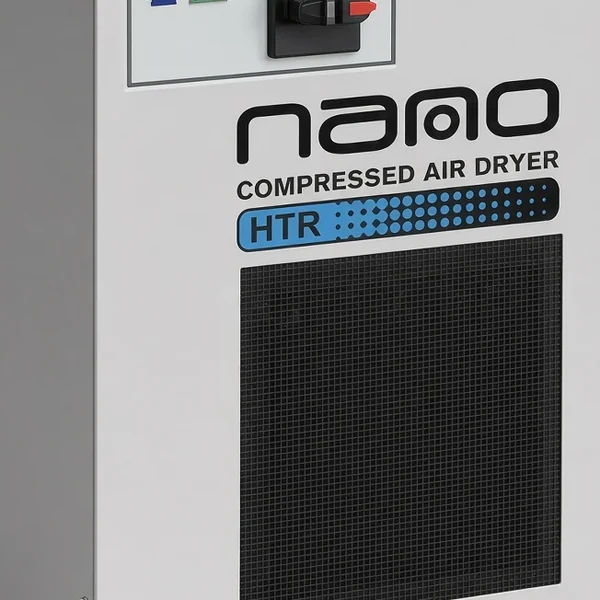
A refrigerated dryer holding a 38°F pressure dew point covers everything inside a shop kept above 50°F. The catch is the compressor: a two-stage piston unit with no aftercooler discharges 180°F air, and a standard dryer rated for 100°F inlet loses most of its capacity on it. On that compressor use the HTR Series or HRHT Series, built for 180 and 200°F inlet air with the separator and drain inside, or pipe the compressor to a receiver first and let the tank cool the air before a standard dryer. A screw compressor with its own aftercooler feeds a standard dryer directly.
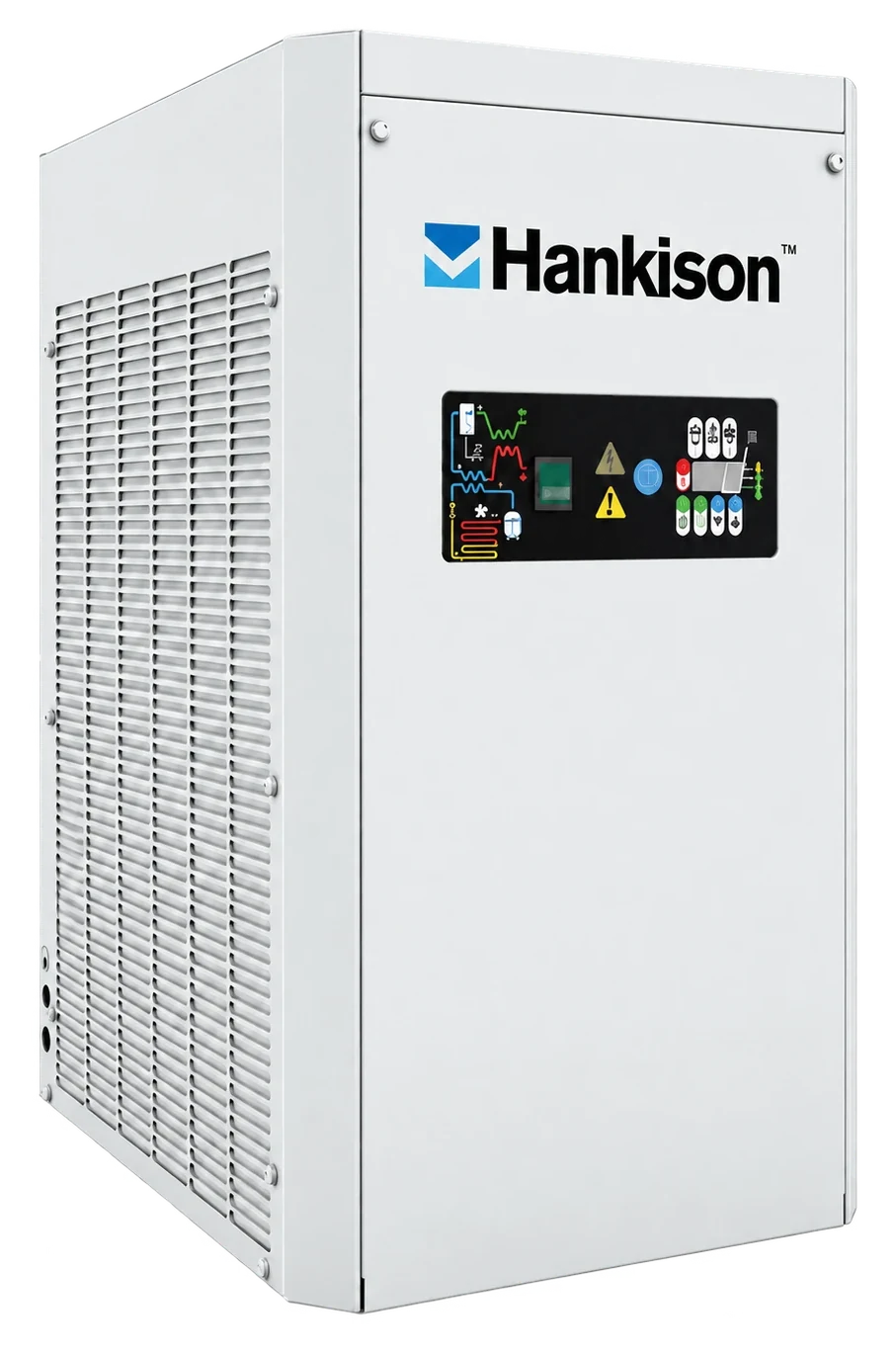
Woodshops run one shift, and the compressor spends the other 16 hours holding pressure for the dust collector's pulse valves. Below 50 SCFM a non-cycling dryer draws so little power that a cycling one cannot pay back; at 100 SCFM and up a TMC Series thermal-mass dryer that stops its refrigeration compressor overnight and through lunch does pay, especially on a demand-charge tariff. Fit a 1 micron prefilter and a 0.01 micron afterfilter, and put the dryer where sawdust cannot reach its condenser.
Request a woodshop dryer quote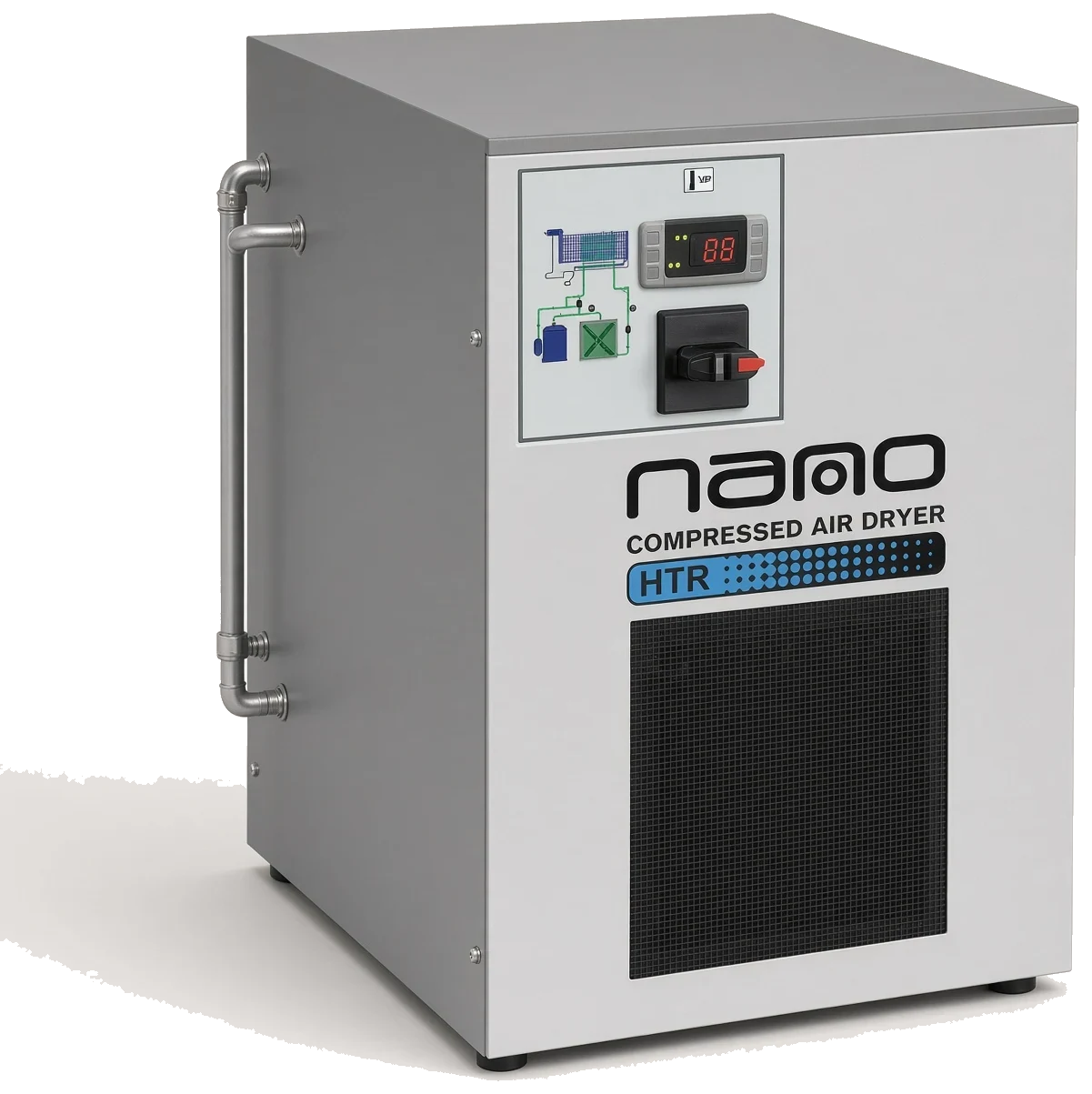
What wet or oily air does in a woodshop
The damage a tank full of water does before anyone notices
- Rust stains from nailers and staplers on panels headed for a clear finish
- Fisheyes and blushing in lacquer and conversion varnish from water and oil in the gun line
- Rusted edgebander pressure rollers marking the tape, and glue pots pressurized with wet air
- Dust collector pulse valves frozen shut on the roof, bags blinding, suction lost
The dryer specification for a woodworking shop
Match the dryer to the compressor first
- High-inlet-temperature dryer (180 to 200°F rated) on a piston compressor without an aftercooler; standard dryer on a screw
- 38°F pressure dew point, ISO 8573-1 class 4, from a standard dryer; 50°F class 6 from the high-inlet type
- 1 micron prefilter and 0.01 micron oil-removal afterfilter; carbon filter on the finishing room drop
- Dryer sited away from sawdust, condenser cleaned monthly, wall bracket where floor space is short
Dryers that fit a woodworking shop
The high-inlet-temperature dryers are rated at 180 and 200°F inlet, the standard dryers at 100°F, all at 100 psig. A 5 to 10 hp piston compressor delivers 18 to 40 SCFM, a 25 to 50 hp screw 110 to 230 SCFM.
| SERIES | TYPE | FLOW RANGE | MAX INLET | MAX PRESSURE |
| HTR Series | High Inlet Temperature | 25 to 125 SCFM | 180°F | 232 psig |
| HRHT Series | High Inlet Temperature | 25 to 100 SCFM | 200°F | — |
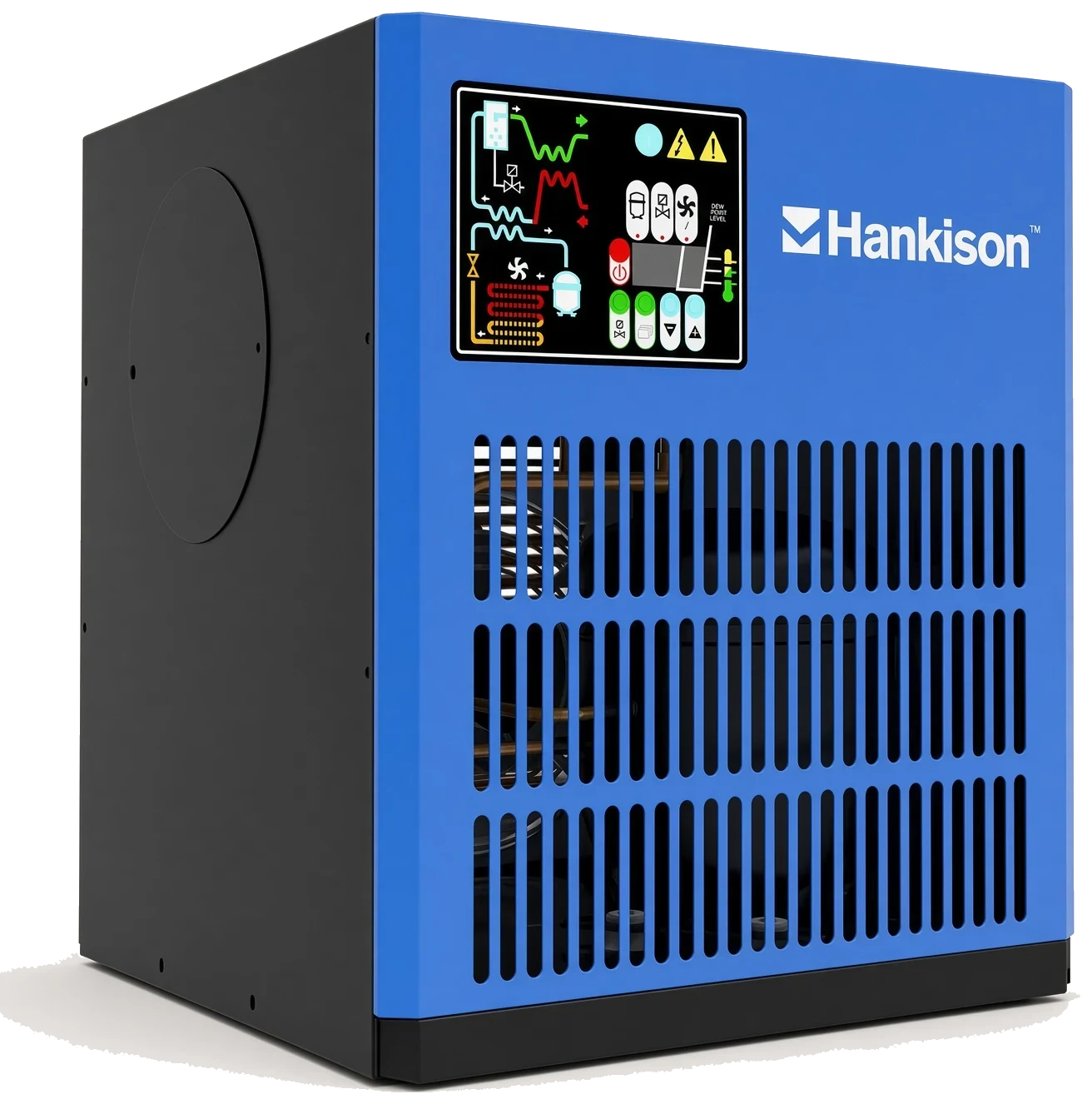
| HPRB Series | Non-Cycling | 7 to 50 SCFM | 120°F | 200 psig |
| DXR Series | Non-Cycling | 10 to 4,200 SCFM | 131°F | 203 psig |
| TMC Series | Thermal Mass Cycling | 30 to 635 SCFM | 140°F | 210 psig |
| GFN Series Filters | Compressed Air Filter | 6 to 1,500 SCFM | — | 232 psig |
| GHTN High-Temperature Filters | Compressed Air Filter | 15 to 1,600 SCFM | — | 150 psig |
| Snap-Trap & Trip-L-Trap Drains | Condensate Drain | Call for sizing | — | 175 psig |
Tell us the compressor size and type, whether it has an aftercooler, and whether the shop sprays finish; we size the dryer and filters in one pass.
The tank drains first, then the dryer drains, and both need attention
A piston compressor's receiver collects most of the water in a woodshop, and a receiver that is never drained fills until it sends slugs of water down the line that no dryer can handle. Fit a zero-loss drain on the tank, a pneumatic Snap-Trap or Trip-L-Trap on a small system, and the dryer only sees vapor and mist. The dryer's own drain is the second point: a float drain with sawdust in its seat holds water in the separator until the outlet air carries it out. Check both on the day the compressor's oil is changed.
- Fit a zero-loss drain on the receiver so water never reaches the dryer as a slug
- Test the dryer's drain monthly; a stuck float shows up as water at the nailer
- Pipe drain discharge to an oil-water separator, not the floor drain
Where the dryer goes in a woodshop
Compressor, receiver, prefilter, dryer, afterfilter, then the shop loop, with the finishing room on its own drop carrying a carbon filter. Keep the dryer out of the sawdust. Its air-cooled condenser pulls room air through a fin pack, and in a shop that pack blinds with fine dust in weeks, after which the dryer runs hot, loses capacity and eventually trips on high pressure. A compressor closet with a filtered louver, or a corner upstream of the dust collector's intake, is the right spot, and the condenser gets a blow-down at the same time as the compressor's own cooler.
Sizing to a piston compressor
A two-stage piston compressor delivers about 3.5 to 4 SCFM per hp, so a 7.5 hp unit makes 26 to 30 SCFM and a 10 hp unit 35 to 40. The HTR Series covers 25 to 125 SCFM and the HRHT Series 25 to 100 SCFM at their rated inlet temperatures, so a 10 hp compressor lands on the HTR 50 or the HRHT 60. The 7.5 to 10 hp reciprocating page matches each compressor size to a dryer.
The dust collector on the roof
Pulse-jet baghouses sit outdoors, and the compressed air line that feeds their diaphragm valves runs outside with them. Air dried to 38°F still condenses in a pipe at 20°F, and the valves are the low point where it collects and freezes. Where the run is short and the climate mild, insulating and heat-tracing the outdoor pipe and fitting a drain at its low point is enough; in a northern winter the collector's header wants a small desiccant dryer at the roof, fed by the shop's refrigerated dryer so the desiccant sees little water. Either way, the refrigerated dryer at the compressor is the first line.
Finishing room air
Spray finishing is the one place in a woodshop where the air touches the product, and lacquer, conversion varnish and waterborne finishes all show water and oil as fisheyes, blushing or poor flow-out. Run the finishing room on a dedicated drop from the dried header, with a 0.01 micron coalescing filter at the booth and an activated carbon filter behind it, and a regulator after the filters rather than before. The paint spraying page covers the booth in more detail.
Woodworking shop air questions
In a woodshop the usual cause is a condenser blinded with sawdust. As the fin pack blocks, the refrigeration circuit runs hotter, the dew point climbs and the dryer eventually trips on high pressure. Blow the condenser down monthly and site the dryer away from the dust, and the capacity comes back.
If the compressor has no aftercooler and the dryer is piped close to it, yes: the discharge is 180°F and a standard dryer cannot take it. If a receiver sits between them and the compressor runs a light shop duty, the air cools in the tank and a standard 25 or 32 SCFM dryer is fine.
For a shop kept above 60°F, yes; nothing the air touches is colder than the room, so nothing condenses. For a finishing room that wants the lowest practical dew point, or a line that runs outdoors to a dust collector, route the compressor through a receiver to a standard 38°F dryer instead.
A 30 hp screw delivers about 130 SCFM, so the 130 or 150 SCFM dryer at a normal room temperature. If the compressor room is a loft that reaches 105°F in summer, take the 170 or 185 SCFM size; the ambient correction costs more capacity than most shops expect.
Below about 50 SCFM, no; the non-cycling dryer draws a few hundred watts and the premium never pays back. From 100 SCFM up, a shop that idles 16 hours a day saves most of the dryer's power with a thermal-mass TMC Series, and the payback is usually inside two years.
More on drying woodshop air
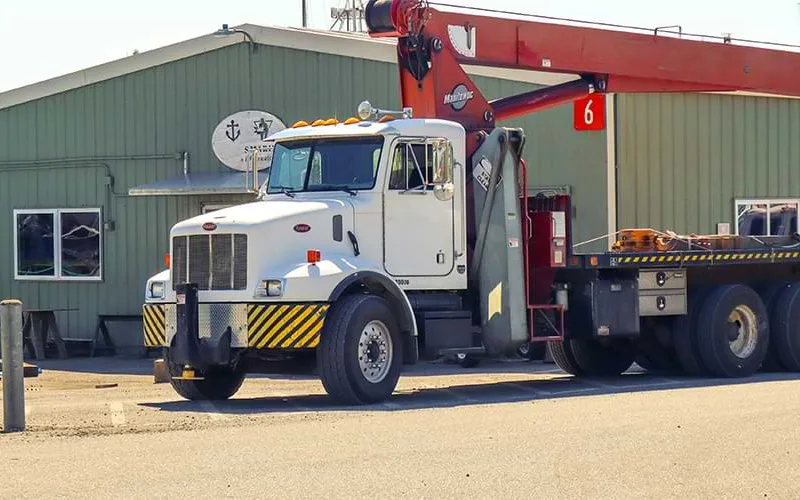
Dryers for 7.5 to 10 hp reciprocating compressors
The compressor most woodshops run, matched to the high-inlet-temperature and 5 to 50 SCFM dryers that fit it.
Learn More
Textiles
Refrigerated air drying for air-jet looms, texturing, winders and dye houses: loom stops from wet air, oil class and central plant sizing.
Learn More
HVAC Controls
Refrigerated drying and filtration for pneumatic building controls: thermostats, damper and valve actuators, and 5 to 20 SCFM compressors.
Learn More