
1-805-484-2992
Quotes - Engineering - SalesCompressed Air Dryers for Packaging Lines
A packaging line is a long chain of small pneumatic actions: the case erector's vacuum cups and folding cylinders, the cartoner's tuckers, the labeler's tamp pad and blow-on jet, the form-fill-seal machine's jaw cylinders and film clamps, the checkweigher's reject blast, the case sealer's tape heads, the stretch wrapper's clamp and cutter, and the palletizer's gripper. Add hot-melt tanks pressurized with air and the venturi generators behind every vacuum cup, and a single line draws 30 to 80 SCFM, while a hall with four lines on a 40 hp screw runs 170 to 180 SCFM.
Water in that air attacks the cheapest parts first. Valve manifolds corrode from the inside and stick, cylinder seals wash out and the actuator drags, and a reject blast that sprays condensate onto a carton wets the flap the glue is about to land on. Vacuum cups lose grip as their venturis scale. Where the air touches the package or the product, as it does on a blow-on labeler or a bagger, oil aerosol from a lubricated compressor is the contaminant a food or pharmaceutical customer's audit will find.
A refrigerated dryer holding a 38°F pressure dew point covers a packaging hall at normal room temperature, since nothing on the line runs colder than the room. It sits in the compressor room after the receiver and is sized to the compressor: a 40 hp screw at 175 SCFM takes the 185 or 200 SCFM dryer, a 20 hp screw at 90 SCFM the 105 size, and a 10 hp piston unit without an aftercooler takes a high-inlet-temperature dryer that accepts its 180°F discharge. The 0.01 micron oil-removal afterfilter goes behind the dryer, with an activated carbon filter after it where the air touches food.
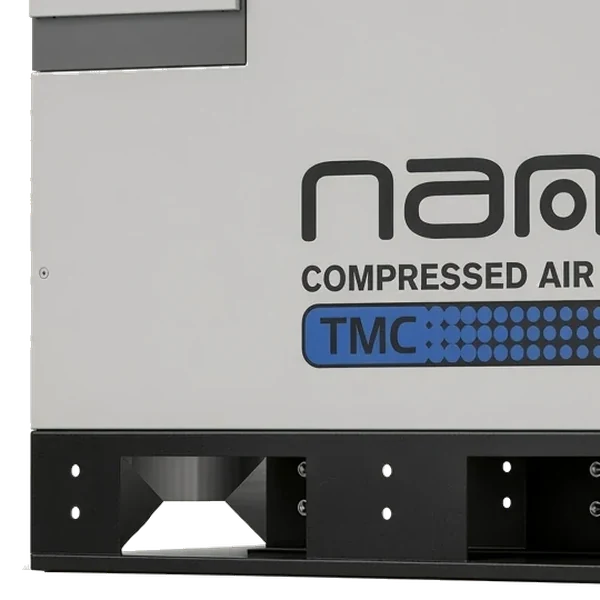
Packaging lines are the textbook case for a cycling dryer. They stop for changeovers, run in batches, wait on upstream production and sit idle on the night shift while the compressor holds the header up, so the load on the dryer averages 30 to 50 percent of the compressor's output. A thermal-mass TMC Series or an NXC Series cycling dryer shuts its refrigeration compressor off through those gaps and returns most of its premium in the first year.
Request a packaging-line dryer quote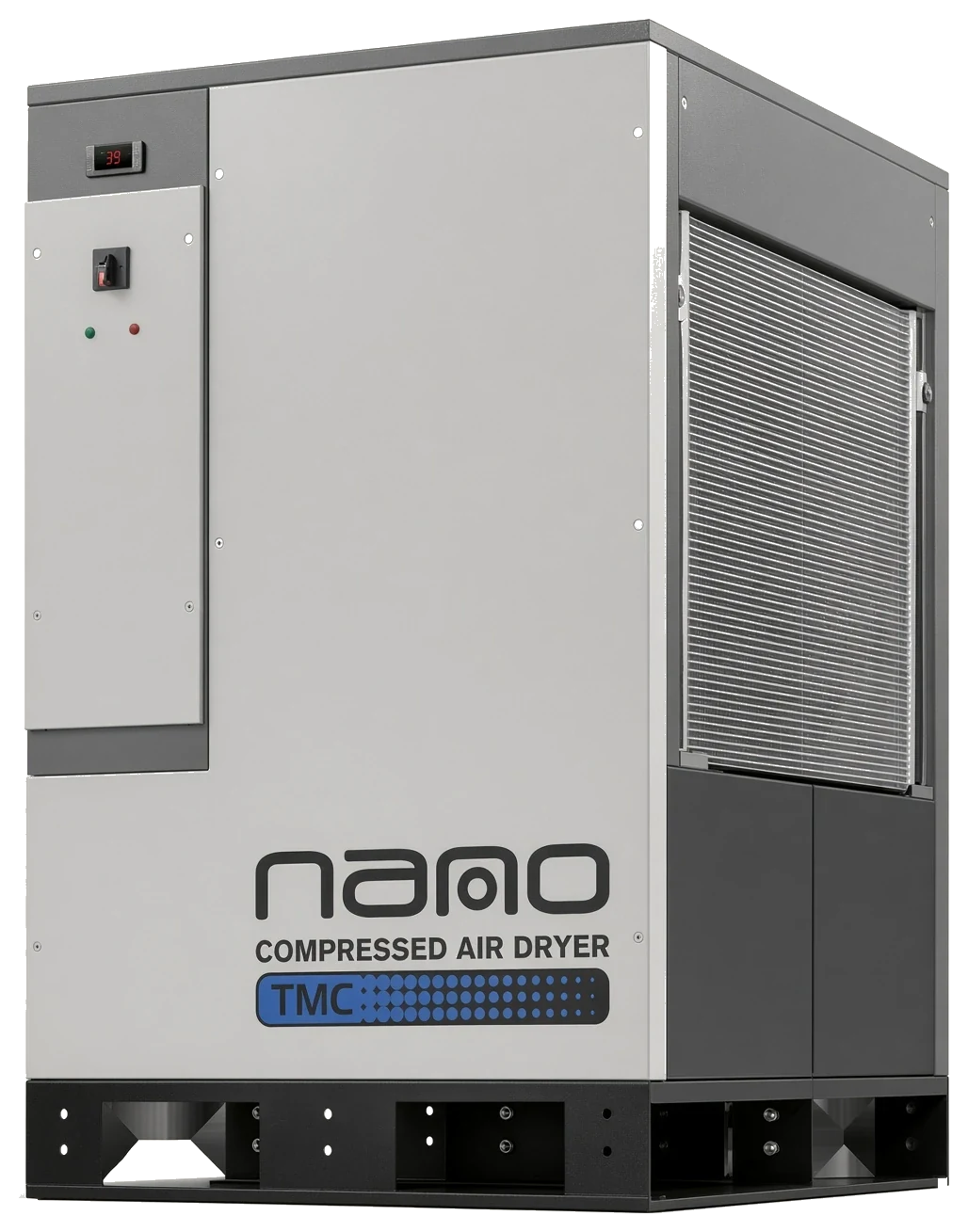
What wet air does on a packaging line
Where the downtime comes from
- Solenoid valve manifolds corroding and sticking, one station at a time
- Cylinder seals washed of lubricant, actuators dragging and missing their timing window
- Reject jets and blow-on labelers spraying condensate onto cartons and film
- Vacuum cups losing grip as venturi generators scale and clog

The dryer specification for a packaging hall
What to put on the requisition
- 38°F pressure dew point, ISO 8573-1 class 4, sized to the compressor rather than to the line count
- Cycling dryer for batch and single-shift duty; non-cycling where the lines run three shifts flat out
- 1 micron prefilter, 0.01 micron oil-removal afterfilter, activated carbon where the air touches food
- A high-inlet-temperature dryer where the compressor is a piston unit with no aftercooler
Dryers that fit a packaging line
Ratings at 100 psig and 100°F inlet. A single line on a 10 to 20 hp compressor uses the 30 to 105 SCFM sizes; a multi-line hall on a 40 to 60 hp screw the 185 to 265 SCFM sizes.
| SERIES | TYPE | FLOW RANGE | MAX INLET | MAX PRESSURE |
| TMC Series | Thermal Mass Cycling | 30 to 635 SCFM | 140°F | 210 psig |
| NXC Series | Cycling | 20 to 2,000 SCFM | 158°F | 232 psig |
| HPRB Series | Non-Cycling | 7 to 50 SCFM | 120°F | 200 psig |
| DXR Series | Non-Cycling | 10 to 4,200 SCFM | 131°F | 203 psig |
| HTR Series | High Inlet Temperature | 25 to 125 SCFM | 180°F | 232 psig |
| GFN Series Filters | Compressed Air Filter | 6 to 1,500 SCFM | — | 232 psig |
| NGF Series Filters | Compressed Air Filter | 20 to 1,500 SCFM | — | 250 psig |
| ND Series Zero-Loss Drains | Condensate Drain | Call for sizing | — | 290 psig |
Send the compressor size and type, the number of lines and whether the product is food or pharmaceutical; we size the dryer and the filter train in one pass.
Timer drains cost a packaging line more than the dryer does
A timed solenoid drain opens on a schedule whether there is condensate to discharge or not, and a 5-second blow every 2 minutes on the receiver, the dryer and two filter bowls adds up to several SCFM of compressed air wasted around the clock. On a 40 hp compressor that is a few percent of the output bought and thrown away, and on a packaging line that idles half the time, a larger share still. A zero-loss drain opens only when its float or level sensor sees liquid, so nothing but water leaves the system.
Fit zero-loss drains on the receiver, the dryer's separator and every filter bowl, and check them monthly with the test button rather than by listening for a discharge you may never hear.
- Replace timer drains with zero-loss drains on the receiver, dryer and filters
- Test each drain monthly; a stuck float shows up as water at the line, not at the drain
- Pipe drain discharge to an oil-water separator where compressor oil is present
Where the dryer and filters go
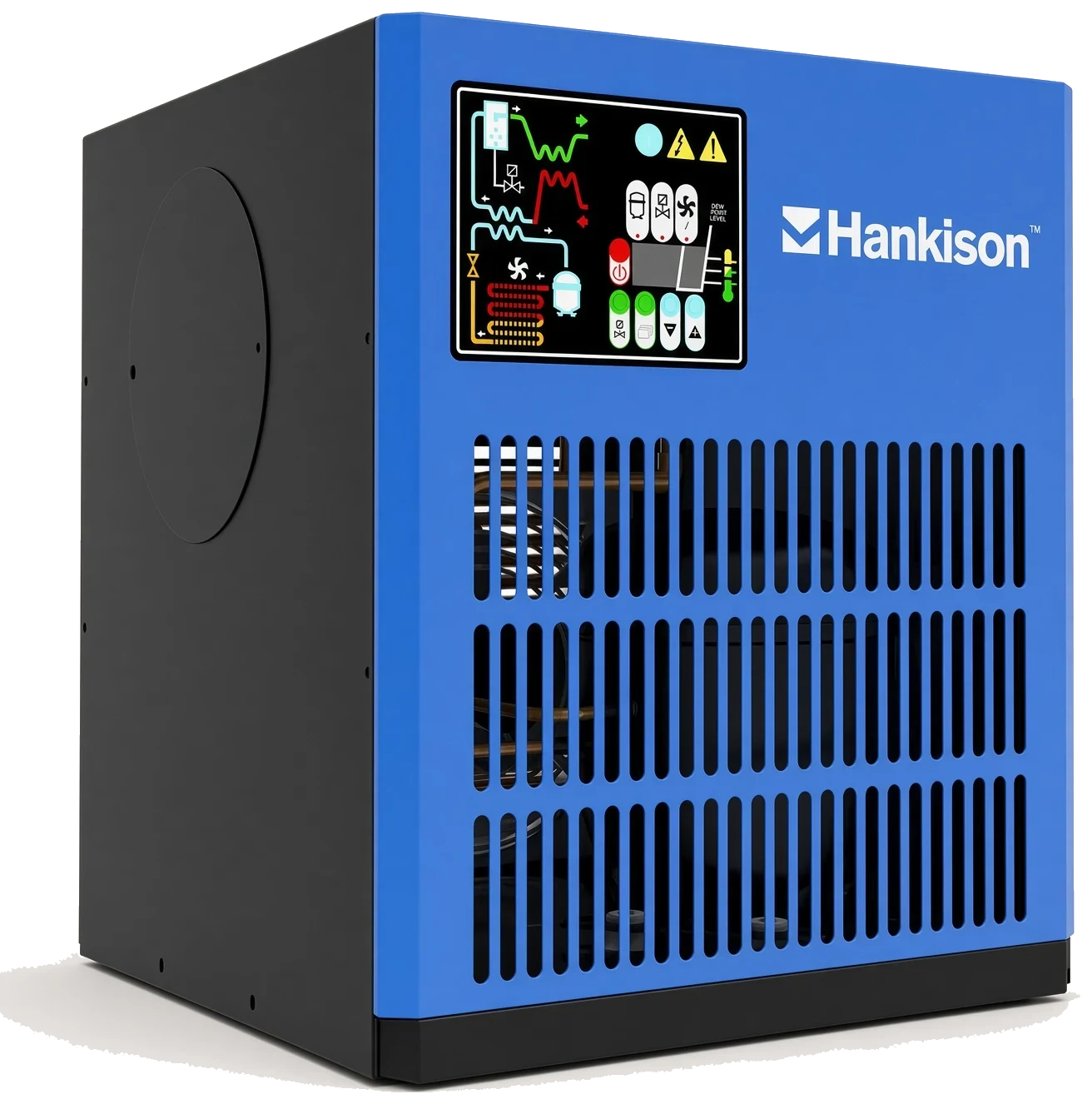
Compressor, aftercooler, receiver, 1 micron prefilter, dryer, 0.01 micron afterfilter and then the header, with the carbon filter as the last stage on lines that need it. Packaging halls are often at the far end of a plant from the compressor room, fed by a long main through a warehouse that is not heated in winter. Air dried to 38°F and then chilled to 30°F in that pipe condenses, so either insulate the main or fit a small point-of-use dryer at the hall and let the central dryer carry the rest of the plant. A drip leg and drain at the end of the main is the minimum.
Sizing for a batch load
Size the dryer to the compressor's full delivery even though the line averages half of it, because the dryer sees the full flow whenever the compressor is loaded. The averaging is what the cycling dryer exploits, not a reason to buy a smaller unit. A 30 hp screw delivering 130 SCFM into a 100°F compressor room takes the 130 SCFM cycling dryer; the same compressor in a 110°F mezzanine takes the 170. The flow and SCFM page has the method.
Piston compressors on a single line
A stand-alone packaging line in a small plant often runs on a 7.5 or 10 hp two-stage piston compressor with no aftercooler, which discharges 180°F air that a standard refrigerated dryer cannot take. The HTR Series and HRHT Series are built for that inlet, with the separator and zero-loss drain inside, and deliver a 50°F pressure dew point (ISO 8573-1 class 6) that is still 20°F below a 70°F packaging hall. Pair one with a GHTN high-temperature prefilter if the compressor runs hard, and pipe the compressor discharge to it by the shortest route.
Food and pharmaceutical lines
Where the air touches product or primary packaging, the customer audit will look for ISO 8573-1 class 1 oil and often a stated particle class. A lubricated screw meets that with the 0.01 micron coalescing afterfilter and an activated carbon filter downstream of the dryer, plus a point-of-use filter at the machine. The food packaging page goes further into the classes.
Packaging line air questions
A cartoner, case erector, sealer and labeler together average 30 to 80 SCFM, with peaks during vacuum pick and reject bursts well above that. The compressor was sized for those peaks, so size the dryer to the compressor's delivery rather than adding up the machines.
Because the load averages 30 to 50 percent of the compressor's output over a shift, with long gaps at changeover and overnight. A thermal-mass cycling dryer stores cold during the gaps and shuts its refrigeration compressor off, which a non-cycling dryer running its compressor continuously cannot do.
Not on its own in winter. Air at a 38°F dew point condenses in a pipe that drops to 25°F, so insulate the main, add a drip leg and drain at the hall end, or fit a point-of-use dryer at the packaging hall. A desiccant unit is only needed where the pipe runs outdoors for a long distance.
Yes, if it is the high-inlet-temperature type. The HTR and HRHT Series accept 180 to 200°F inlet air from a piston compressor and deliver a 50°F pressure dew point, which is dry enough for a packaging hall at room temperature. A standard dryer rated for 120°F inlet would lose most of its capacity on that air.
You need class 1 oil where air touches the product or the inside of the package, and that is reached with a 0.01 micron coalescing filter and an activated carbon filter behind the dryer. Stations that only move cartons and pallets can run on the plant air with the coalescer alone.
More on drying packaging-line air
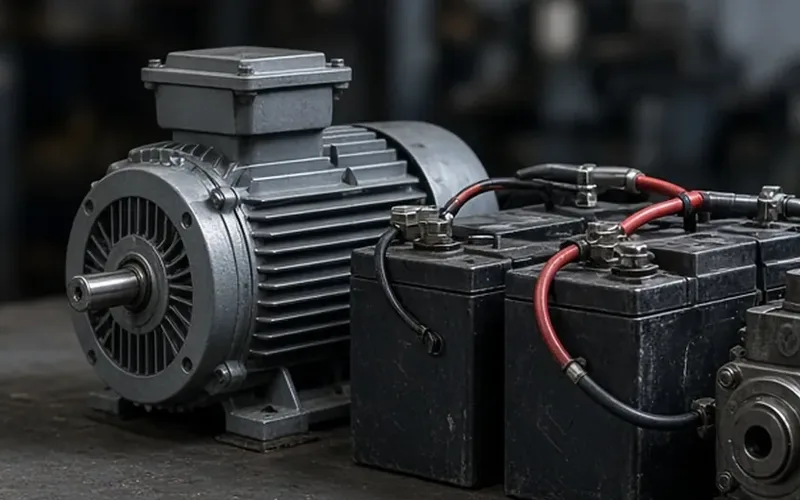
Cycling versus non-cycling dryers for a batch load
How a 40 percent average load turns into a real power saving, with the worked figures.
Learn More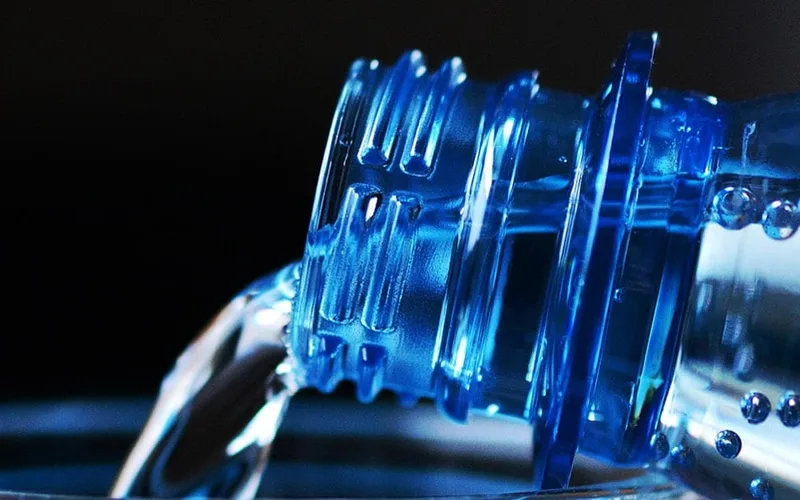
PET Blow Molding
Drying 500 to 725 psig blow air for PET stretch blow molders: why bottles haze, the HHPR and APET high-pressure dryers, and plant air.
Learn More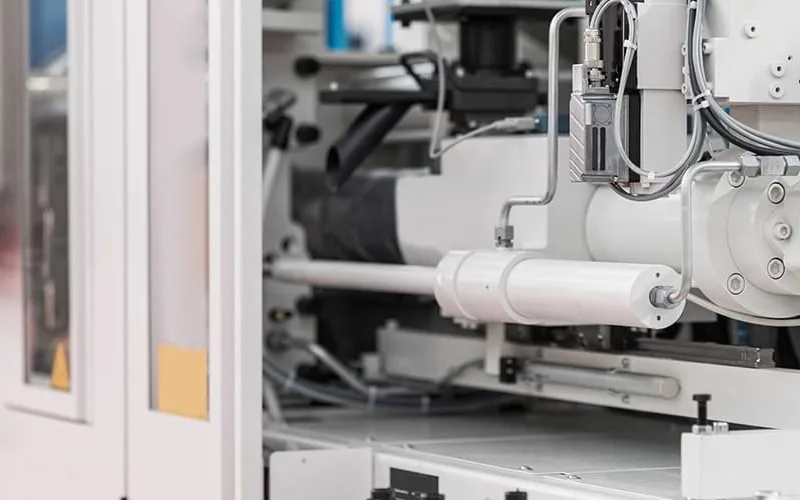
Injection Molding
Refrigerated air drying for injection molding: core pulls, valve gates, robots and hopper loaders, sizing by compressor, and filtration.
Learn More