
1-805-484-2992
Quotes - Engineering - SalesWater Separators for Compressed Air Dryers
Centrifugal and impaction separators that take the bulk water out before the dryer sees it
Between the aftercooler and the dryer the compressed air carries liquid water: the condensate the aftercooler produced, the water that fell out in the receiver and the pipe, and on a piston compressor a good deal of slug. A separator takes that liquid out mechanically, with no element to saturate, so the dryer's exchanger and the prefilter's coalescing element only have to deal with what is still vapor and aerosol. That cuts the dryer's refrigeration load and roughly doubles prefilter element life.
Two designs are catalogued. The centrifugal separator spins the air through a finned module so the water is flung to the housing wall and shielded from re-entrainment, removing 99 percent of bulk liquid across the flow swing of a variable-speed compressor; thirteen threaded housings cover 6 to 1,500 SCFM and a 4 in flanged unit reaches 3,000. The impaction separator fits a grade 11 element into the modular filter housing family, forcing the air through direction changes that throw out water and solids down to about 10 micron, from 20 to 21,250 SCFM.
Both are rated for the pressures and temperatures of plant air, 232 to 300 psig and 150 to 176°F, and both discharge through a float or automatic drain in the bowl. The separator is installed in the pipe run before the dryer, as close to the dryer inlet as the layout allows, so it catches the water that condenses in the line.
- Centrifugal separation, 99 percent of bulk liquid, no element to replace
- Impaction separation to 10 micron in 29 housing sizes to 21,250 SCFM
- 232 to 300 psig ratings, 150 to 176°F, automatic or float drains
- Installed after the aftercooler or receiver and ahead of the dryer prefilter
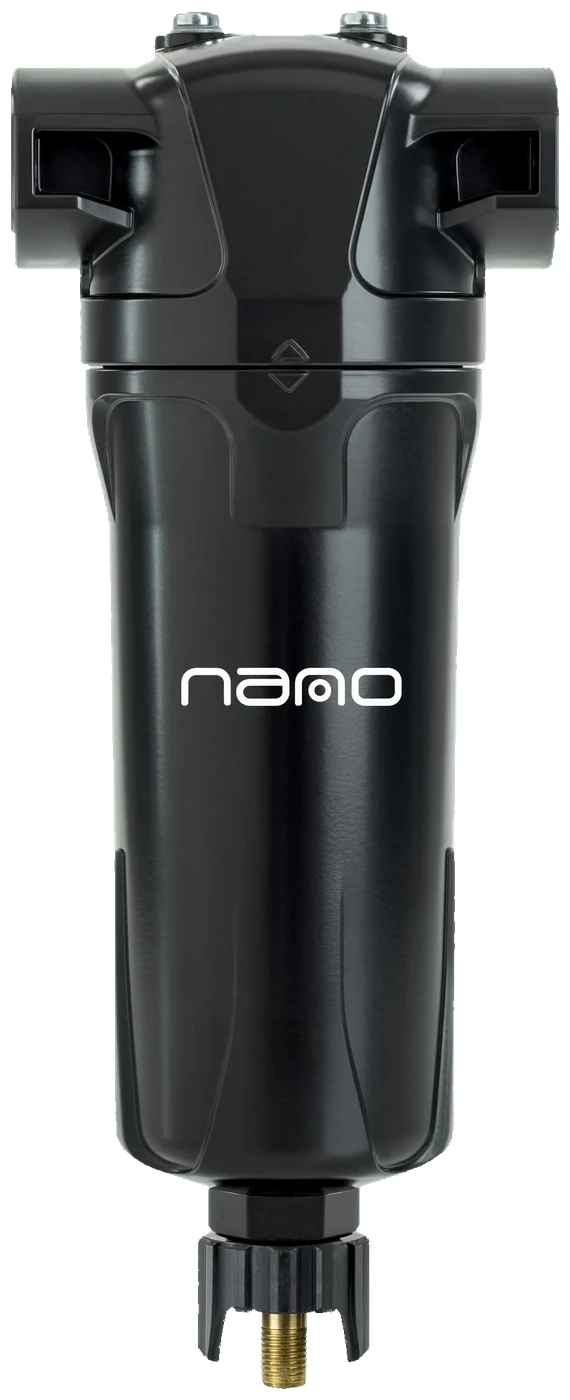
The two separator series
Flow range, pressure rating and the number of housing sizes in each series. Open a series page for the housings, connections and drain options.
| SERIES | TYPE | FLOW RANGE | PART NUMBERS | NOTES |
| GF WS Series Separators | Water Separator | 6 to 3,000 SCFM | 14 listed | 232 psig max |
| HF Grade 11 Separators | Water Separator | 20 to 21,250 SCFM | 29 listed | 300 psig max |
Separator series
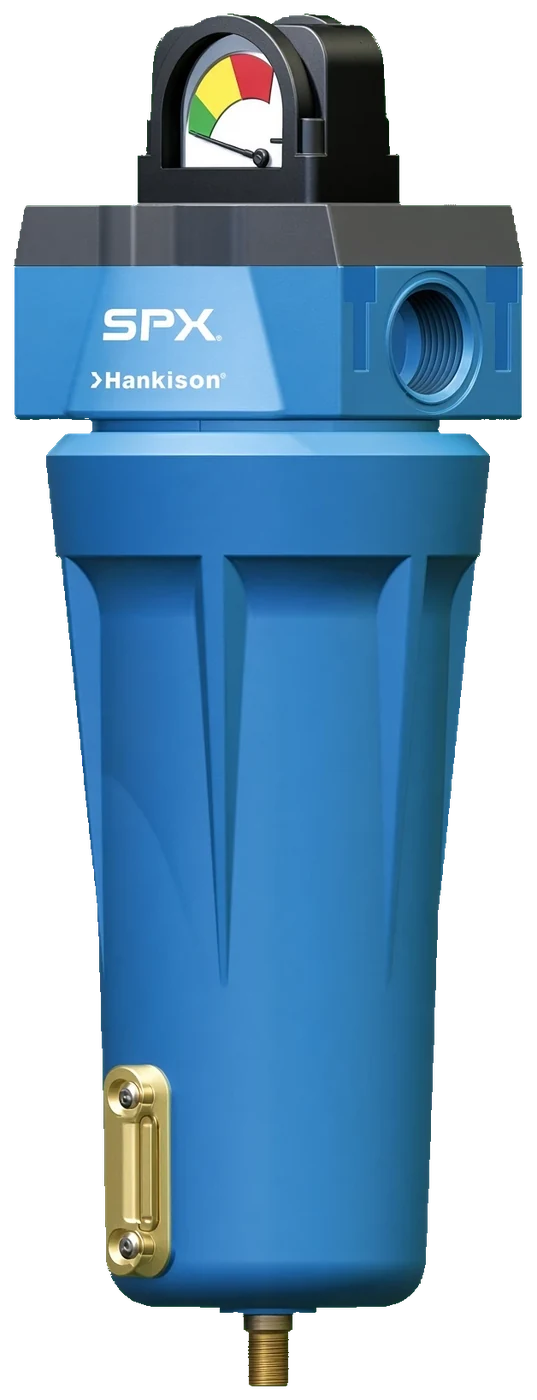
Centrifugal or impaction
The centrifugal separator has no internal parts to wear or change: the air enters tangentially, spins, and the water leaves through the drain. Its separation depends on velocity, so the housings are sized close to the actual flow, though the design keeps working across the wide flow range of a variable-speed compressor. The impaction separator uses a pair of stainless orifice tubes as its element, which does wear eventually and is replaced like a filter element, but it shares housings, connection codes, brackets and option letters with the modular filter family, so a plant already standardized on those housings keeps one set of spares. Both remove liquid; neither removes aerosol, which is the prefilter's job.
Sizing and pressure drop
Size the separator on the compressor's delivery at line pressure, the same figure used for the prefilter. A clean separator adds under 1 psi, and because there is no media to load, that figure does not climb with time. The centrifugal housings run from 1/8 in NPT at 6 SCFM to 3 in NPT at 1,500 SCFM, with the 3,000 SCFM unit on a 4 in flange; the impaction housings follow the filter family from 3/8 in NPT to 10 in ANSI flanges on the ASME vessels.
Where a separator earns its place
Every installation with a water-cooled aftercooler, because the aftercooler makes the most condensate on the coldest water. Every piston compressor with an aftercooler, because the pulsing flow carries slugs. Any long pipe run between compressor room and dryer, because the pipe is an aftercooler too, and any plant whose compressor package has no integral separator. A rotary screw package with its own moisture separator and a receiver ahead of the dryer may not need a second one, and the money is better spent on the next size of prefilter; raise it when the layout is being quoted.
Drains and installation
A separator that is never drained is a pipe fitting, so the drain matters as much as the housing. The centrifugal housings carry an automatic float drain; the impaction housings up to 170 SCFM ship with an automatic drain and liquid level indicator, the mid sizes with an indicator and a drain plug for a separate drain, and the large sizes with a drain plug. On a plant that runs continuously, fit a zero-loss drain so no compressed air is vented; a timed drain wastes air on every cycle. Mount the separator upright with the drain at the bottom and give it a short straight inlet run, and put the 1 micron prefilter immediately after it.
Water separator questions
The dryer's internal separator handles the condensate the dryer itself produces, at a flow it was designed for. Liquid arriving from upstream adds load the dryer's exchanger was not sized for and can flood its drain, so an inlet separator is still worthwhile wherever the pipe or the aftercooler delivers liquid water.
About 99 percent of the bulk liquid water and the larger solids that come with it, tested to the ISO 12500-4 method. It does not remove oil aerosol or fine particles; those need the coalescing prefilter that follows it.
The centrifugal separator does not; its finned module is permanent and the housing carries a ten-year warranty. The impaction separator uses a grade 11 element that is replaced when it wears, using the same element number scheme as the modular filters.
On the compressor's maximum delivery, as with any housing. The centrifugal design is not velocity sensitive, so it keeps separating as the compressor turns down, which is the case where a conventional baffle separator loses efficiency.
It can, immediately after the aftercooler, and on a piston compressor that is a good place for it. On most plants it goes after the receiver and just ahead of the dryer, where it also catches the water that condenses in the receiver and the pipe run.