
1-805-484-2992
Quotes - Engineering - SalesCycling Refrigerated Air Dryers, 20 to 250 SCFM
Thermal-mass and phase-change dryers for 5 to 50 hp compressors that do not run all day
A cycling dryer in this band sits behind the same 5 to 50 hp compressor as its non-cycling cousin, but it is bought for a different plant: the machine shop that runs one shift, the body shop whose compressor idles between jobs, the packaging line that stops at weekends. Where the compressor is loaded less than about 60 percent of the hours the dryer is powered, a cycling dryer earns its higher price back in electricity.
All three current series store cold and let the refrigeration compressor stop. One holds it in a glycol loop circulated by a small pump, one in a phase-change material packed around a brazed-plate exchanger, and one in the metal mass of the exchanger itself. When the stored cold is used up the refrigeration compressor restarts, so power tracks the air actually dried, with savings of up to 80 percent at light load.
Twenty-one current models cover 20 to 250 SCFM, most of them on a 115 V cord below 200 SCFM and on 230 V or 460 V at 200 SCFM, with 1/2 in to 2 in NPT connections. The previous-generation phase-change dryer is kept in the table beside its direct replacement.
- Rated 20 to 250 SCFM at 100 psig, 100°F inlet and 100°F ambient
- Refrigeration compressor stops on stored cold; power follows the air load
- 0.23 to 1.6 kW at full load, most sizes on a 115 V single-phase cord
- Dew point display and diagnostics on the panel of every current model
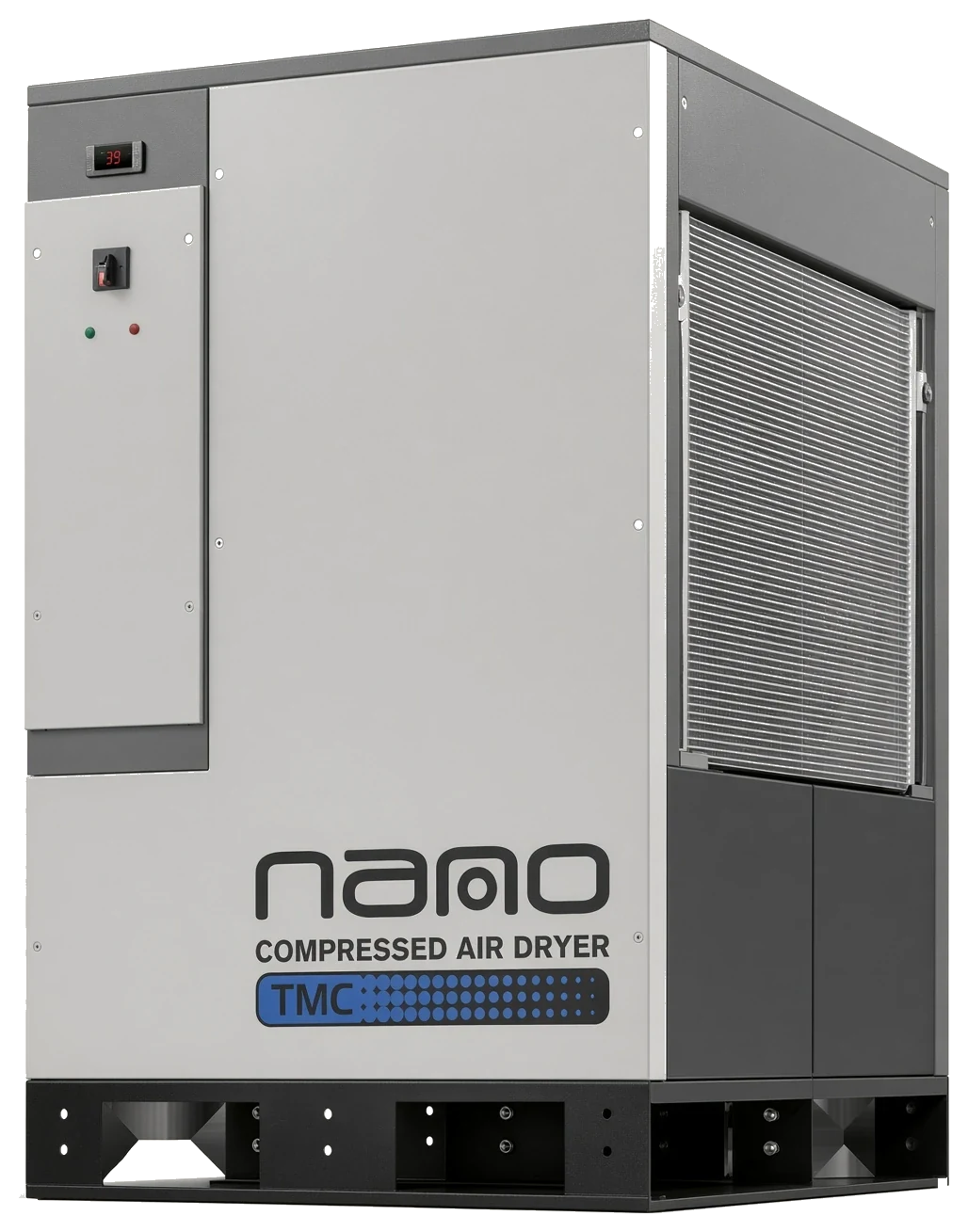
Every 20 to 250 SCFM cycling model
Capacities at the standard rating point of 100 psig, 100°F inlet and 100°F ambient. Current models are listed first with their connection and voltage; the previous generation follows with the series that replaces it.
| PART NUMBER | SERIES | SCFM | CONNECTION | VOLTAGE | STATUS |
| FLXA1.1-A | FLXA Series | 75 | 1 in NPT | 115/1/60 | Current |
| FLXA1.2-A | FLXA Series | 100 | 1 in NPT | 115/1/60 | Current |
| FLXA1.5-A | FLXA Series | 150 | 2 in NPT | 115/1/60 | Current |
| FLXA2.1-A | FLXA Series | 200 | 2 in NPT | 460/3/60 | Current |
| NXC 0020 | NXC Series | 20 | 1/2 in NPT | 115/1/60 | Current |
| NXC 0030 | NXC Series | 30 | 3/4 in NPT | 115/1/60 | Current |
| NXC 0045 | NXC Series | 45 | 3/4 in NPT | 115/1/60 | Current |
| NXC 0065 | NXC Series | 65 | 1 in NPT | 115/1/60 | Current |
| NXC 0090 | NXC Series | 90 | 1 in NPT | 115/1/60 | Current |
| NXC 0110 | NXC Series | 110 | 1 in NPT | 115/1/60 | Current |
| NXC 0130 | NXC Series | 130 | 1-1/2 in NPT | 115/1/60 | Current |
| NXC 0165 | NXC Series | 165 | 1-1/2 in NPT | 115/1/60 | Current |
| NXC 0200 (230 V) | NXC Series | 200 | 2 in NPT | 230/1/60 | Current |
| NXC 0200 (460 V) | NXC Series | 200 | 2 in NPT | 460/3/60 | Current |
| TMC 0030 N | TMC Series | 30 | 1/2 in FNPT | 115/1/60 | Current |
| TMC 0055 N | TMC Series | 55 | 1/2 in FNPT | 115/1/60 | Current |
| TMC 0075 N | TMC Series | 75 | 1-1/4 in FNPT | 115/1/60 | Current |
| TMC 0105 N | TMC Series | 105 | 1-1/4 in FNPT | 115/1/60 | Current |
| TMC 0130 N | TMC Series | 130 | 1-1/2 in FNPT | 115/1/60 | Current |
| TMC 0170 N | TMC Series | 170 | 1-1/2 in FNPT | 115/1/60 | Current |
| TMC 0200 N | TMC Series | 200 | 1-1/2 in FNPT | 230/1/60 | Current |
| FLX1.1 | FLEX Series | 75 | 1 in NPT | 115/1/60 | Replaced by FLXA |
| FLX1.2 | FLEX Series | 100 | 1 in NPT | 115/1/60 | Replaced by FLXA |
| FLX1.5 | FLEX Series | 150 | 2 in NPT | 115/1/60 | Replaced by FLXA |
| FLX2.1-4 | FLEX Series | 200 | 2 in NPT | 460/3/60 | Replaced by FLXA |
Four series, three ways of storing cold
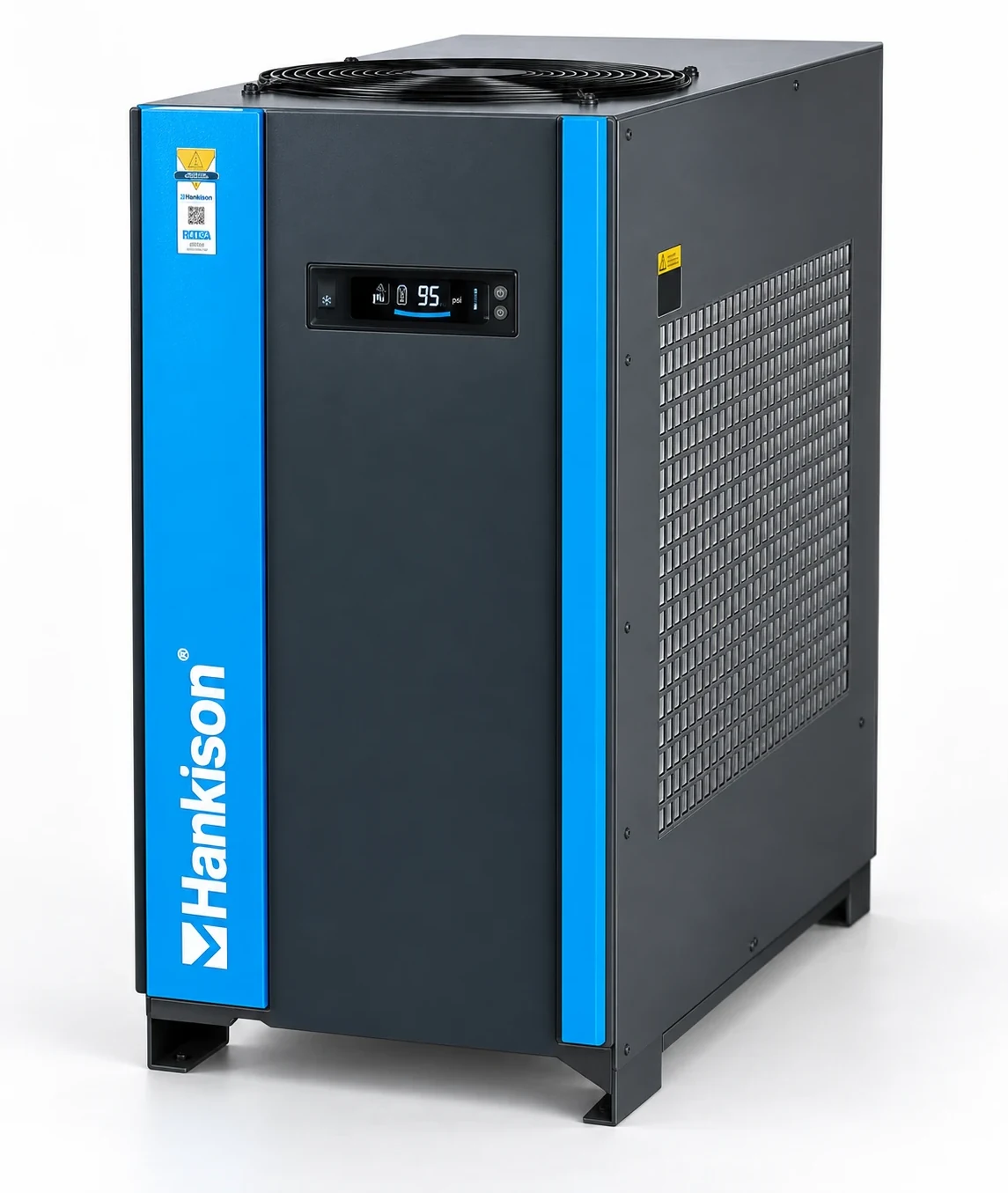
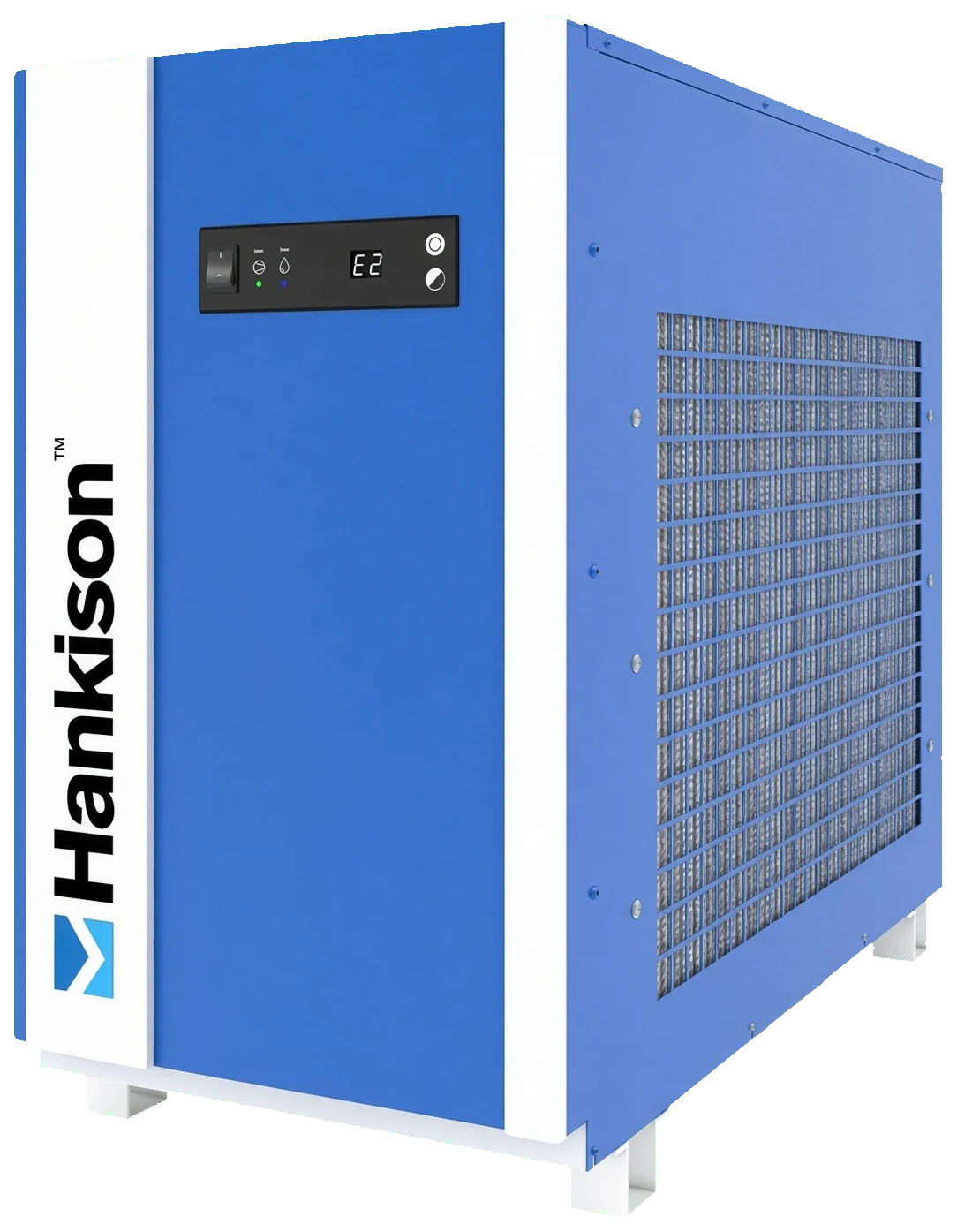
Three ways to store cold
The thermal-mass dryer circulates glycol through a tank with a permanent-magnet pump; the refrigeration compressor chills the glycol, the glycol chills the air, and the tank carries the load for minutes at a time with the compressor off. The phase-change dryer packs a material that freezes and melts around a stainless brazed-plate exchanger, so the compressor runs to freeze it and rests while it melts. The dry thermal-mass dryer stores the cold in an oversized aluminum exchanger with wide air paths and needs no hot-gas bypass valve at all. All three deliver a class 4 or class 5 pressure dew point of 38 to 41°F at rated flow.
Which compressor, which size
A 10 hp screw delivering 42 SCFM takes the 45 or 55 SCFM model; a 25 hp screw at 110 SCFM takes the 130 SCFM size once a warm room is allowed for; a 50 hp screw at 225 SCFM needs the 265 SCFM cycling unit in the next band. Piston compressors of 7.5 to 30 hp fit too, provided an aftercooler brings the inlet under the 140 to 158°F limits of the current lines; without one, the high-inlet-temperature dryers are the right call.
When cycling pays
Compare the hours the dryer is powered with the hours the compressor is loaded. A shop running 8 hours a day with the dryer left on all week has the compressor loaded perhaps 25 percent of the time, and a cycling dryer there uses about a third of the power of a non-cycling unit. A plant loaded 20 hours a day sees little difference and should buy the simpler non-cycling dryer. Utility rebates for cycling dryers exist in many service areas and can cover the price difference on their own.
Installing a small cycling dryer
The layout is the same as for any refrigerated dryer: receiver, 1 micron prefilter, dryer, 0.01 micron afterfilter, with a bypass around the three. The thermal-mass line publishes a matched prefilter and afterfilter for every size, and the phase-change line ships with its filter package fitted. Because a cycling dryer restarts its refrigeration compressor many times a day, give it a dedicated circuit rather than sharing the compressor's, and leave the condenser face clear. The non-cycling dryers of the same size are the comparison to make before ordering.
20 to 250 SCFM cycling dryer questions
It depends on how often the compressor is unloaded or off while the dryer is powered. A 130 SCFM cycling dryer draws about 1 kW at full load and next to nothing while it rides on stored cold, so a single-shift shop can see savings of 60 to 80 percent against a non-cycling unit left on all week.
It drifts a few degrees within the band the controller allows, typically between 35 and 45°F, and comes back down as soon as the compressor restarts. For plant air and paint lines that swing is invisible; a process that needs the dew point held within a degree should look at non-cycling control.
Yes for the 165 and 170 SCFM sizes, which draw about 1 kW on a 115 V circuit. A 40 hp screw makes 170 to 180 SCFM, so it sits between those units and the 200 SCFM models, which move to 230 V or 460 V.
Only with an aftercooler ahead of it. The current lines accept 140 to 158°F inlet air, and a piston compressor without an aftercooler discharges at 180 to 200°F. With an aftercooler and separator fitted, a 15 hp piston unit at 55 SCFM is a good match for the 65 or 75 SCFM size.
The current phase-change series replaces it size for size, from 75 to 200 SCFM in this band, with low-GWP refrigerant and a new controller. Connections and voltages carry over, so a swap needs no piping change.