
1-805-484-2992
Quotes - Engineering - SalesCycling Refrigerated Air Dryers, 2,500 to 12,500 SCFM
Central-plant dryers for 600 to 3,000 hp of installed compressors
Above 2,500 SCFM the dryer serves a central plant: four or six large screw compressors, or a centrifugal machine, on a sequencer that runs whatever the plant needs hour by hour. Demand in such a plant swings from a single machine on the night shift to every compressor loaded at the afternoon peak, which is precisely the profile that load-following refrigeration was built for.
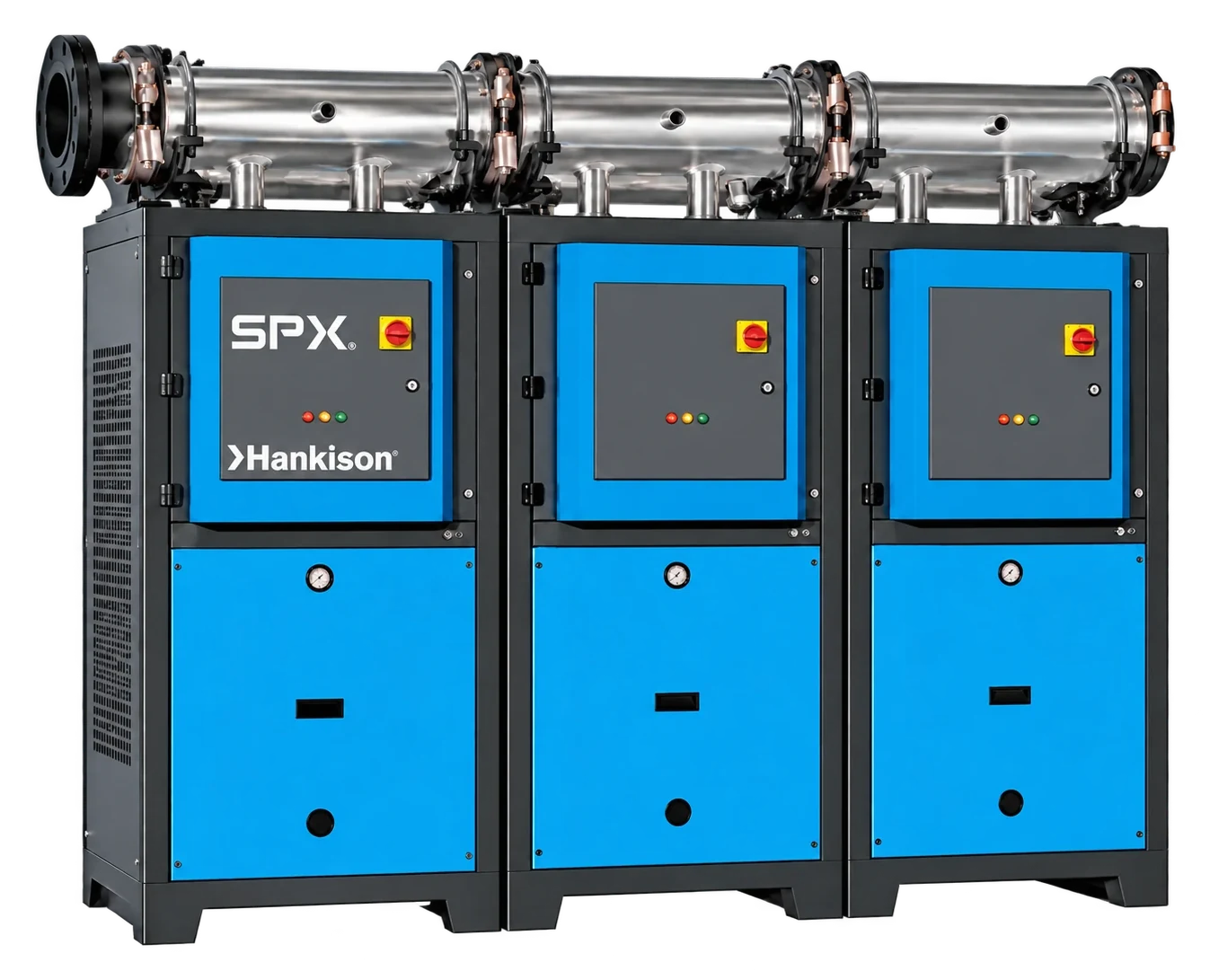
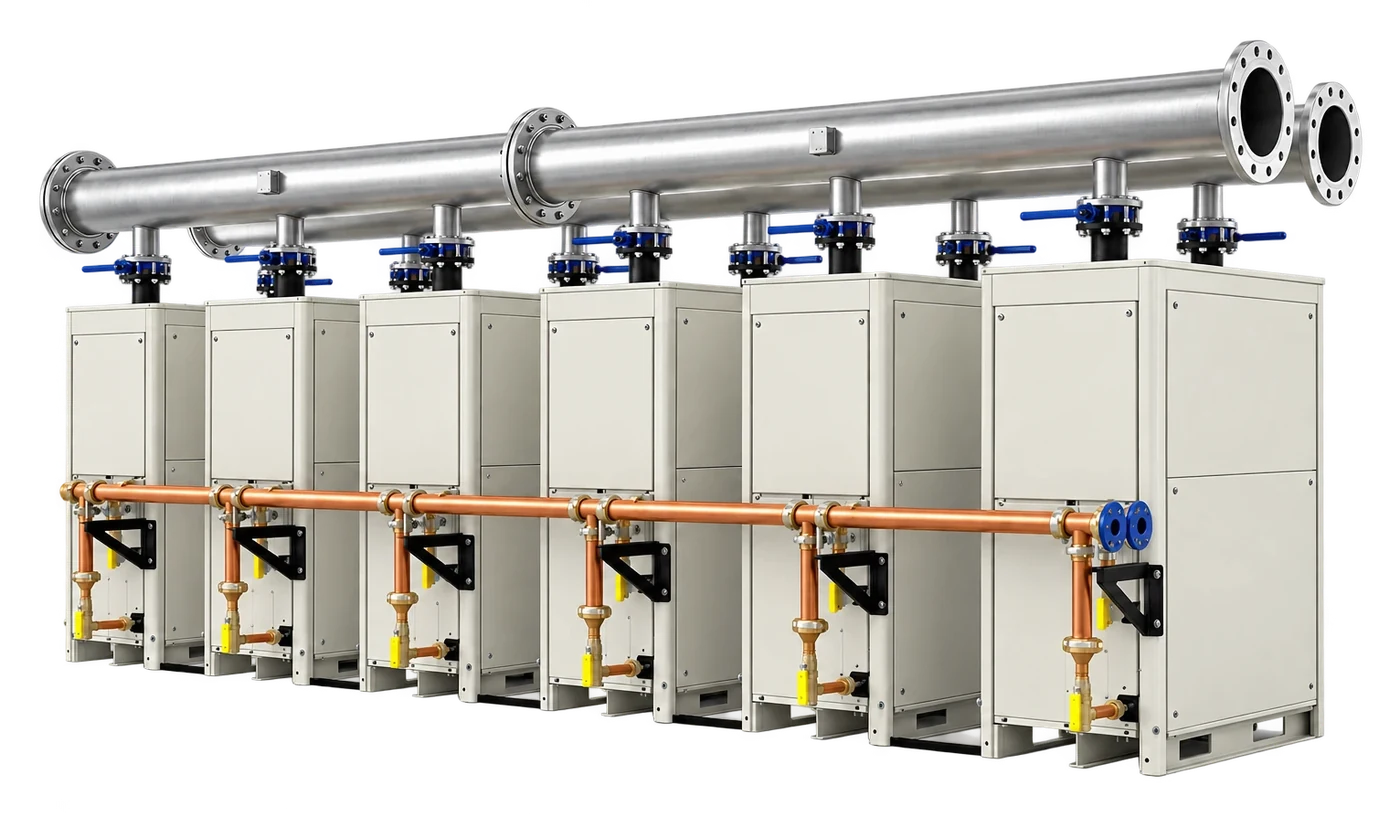
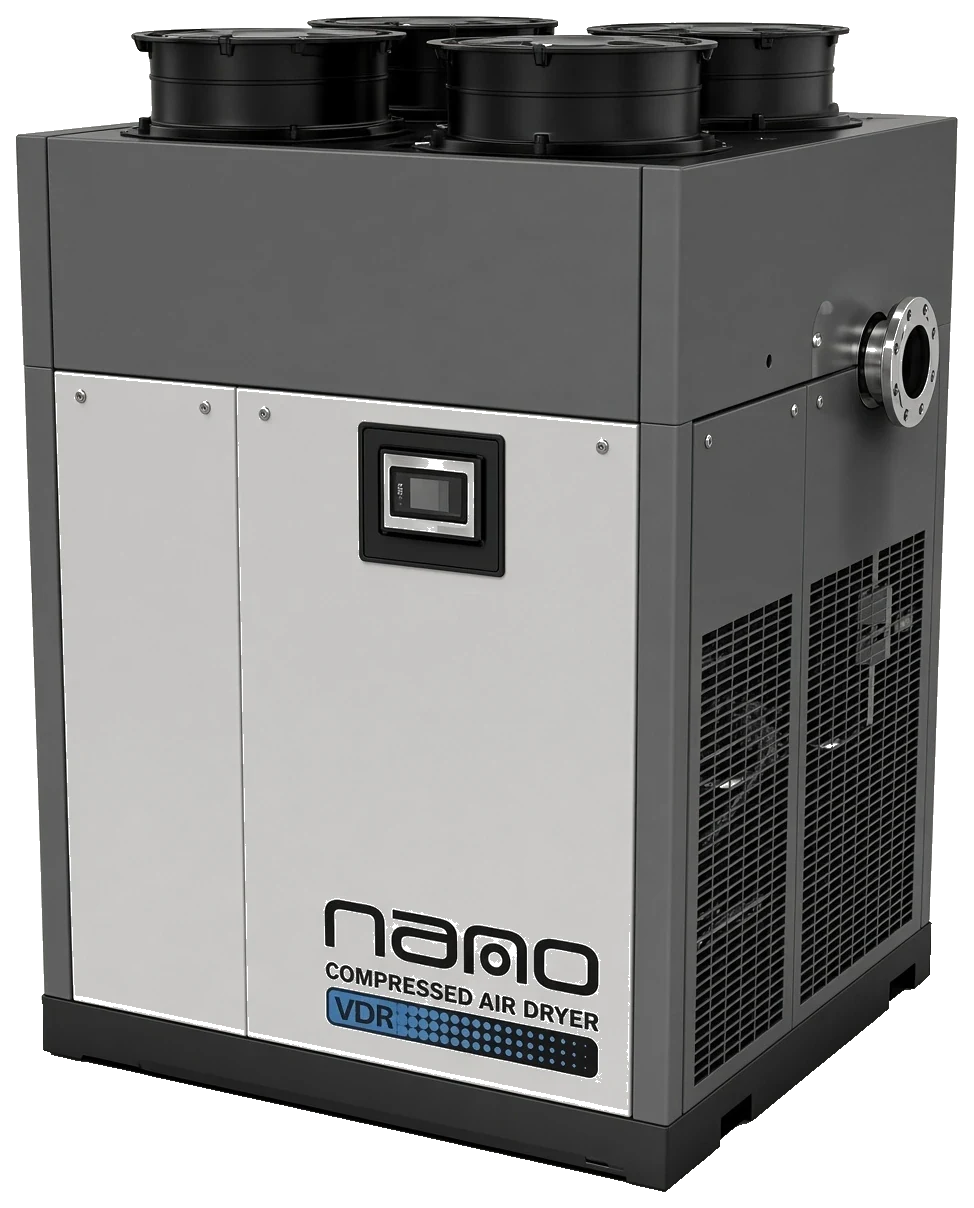
Four current series use three approaches. Digital-scroll dryers unload their scroll compressors for part of every cycle, and the larger sizes split the duty across two to five refrigeration circuits. The variable-speed dryer drives inverter scroll compressors so refrigeration output tracks the air load continuously. The modular skid gangs two to six water-cooled phase-change modules behind a common header, with the redundancy a multi-module system brings.
Every model is 460 V three phase on 6 in to 12 in flanges, and every series except the skid is offered air-cooled or water-cooled.
- Rated 2,500 to 12,500 SCFM at 100 psig, 100°F inlet and 100°F ambient
- Digital-scroll, inverter-driven and modular phase-change capacity control
- 6 in to 12 in flanged headers; 460/3/60 with other voltages on request
- Networked controllers with energy monitoring on the digital-scroll and skid lines
Every model from 2,500 to 12,500 SCFM
Fifty-two flanged models at 100 psig, 100°F inlet and 100°F ambient; a W in the part number marks a water-cooled build.
| PART NUMBER | SERIES | SCFM | CONNECTION | VOLTAGE | STATUS |
| AES-2500A | AES Series | 2,500 | 6 in flange | 460/3/60 | Current |
| AES-2500W | AES Series | 2,500 | 6 in | 460/3/60 | Current |
| AES-3000A | AES Series | 3,000 | 6 in flange | 460/3/60 | Current |
| AES-3000W | AES Series | 3,000 | 6 in | 460/3/60 | Current |
| AES-3500A | AES Series | 3,500 | 6 in flange | 460/3/60 | Current |
| AES-3500W | AES Series | 3,500 | 8 in | 460/3/60 | Current |
| AES-4000A | AES Series | 4,000 | 6 in flange | 460/3/60 | Current |
| AES-4000W | AES Series | 4,000 | 8 in | 460/3/60 | Current |
| AES-4500A | AES Series | 4,500 | 8 in flange | 460/3/60 | Current |
| AES-4500W | AES Series | 4,500 | 8 in | 460/3/60 | Current |
| AES-5250A | AES Series | 5,250 | 8 in flange | 460/3/60 | Current |
| AES-5250W | AES Series | 5,250 | 8 in | 460/3/60 | Current |
| AES-6000A | AES Series | 6,000 | 8 in flange | 460/3/60 | Current |
| AES-6000W | AES Series | 6,000 | 8 in | 460/3/60 | Current |
| AES-7000A | AES Series | 7,000 | 10 in flange | 460/3/60 | Current |
| AES-7000W | AES Series | 7,000 | 10 in | 460/3/60 | Current |
| AES-8000A | AES Series | 8,000 | 10 in flange | 460/3/60 | Current |
| AES-8000W | AES Series | 8,000 | 10 in | 460/3/60 | Current |
| AES-8750A | AES Series | 8,750 | 12 in flange | 460/3/60 | Current |
| AES-8750W | AES Series | 8,750 | 12 in | 460/3/60 | Current |
| AES-10000A | AES Series | 10,000 | 12 in flange | 460/3/60 | Current |
| AES-10000W | AES Series | 10,000 | 12 in | 460/3/60 | Current |
| FLX 3000 | FLX Series | 3,000 | 8 in RF flange | 460/3/60 | Current |
| FLX 4000 | FLX Series | 4,000 | 8 in RF flange | 460/3/60 | Current |
| FLX 6000 | FLX Series | 6,000 | 10 in RF flange | 460/3/60 | Current |
| FLX 8000 | FLX Series | 8,000 | 10 in RF flange | 460/3/60 | Current |
| FLX 10000 | FLX Series | 10,000 | 12 in RF flange | 460/3/60 | Current |
| FLX 12000 | FLX Series | 12,000 | 12 in RF flange | 460/3/60 | Current |
| HES2500 | HES Series | 2,500 | 6 in flange | 460/3/60 | Current |
| HES3000 | HES Series | 3,000 | 6 in flange | 460/3/60 | Current |
| HES3750 | HES Series | 3,750 | 8 in flange | 460/3/60 | Current |
| HES5000 | HES Series | 5,000 | 8 in flange | 460/3/60 | Current |
| HES6250 | HES Series | 6,250 | 10 in flange | 460/3/60 | Current |
| HES7500 | HES Series | 7,500 | 10 in flange | 460/3/60 | Current |
| HES8750 | HES Series | 8,750 | 12 in flange | 460/3/60 | Current |
| HES10000 | HES Series | 10,000 | 12 in flange | 460/3/60 | Current |
| HES11250 | HES Series | 11,250 | 12 in flange | 460/3/60 | Current |
| HES12500 | HES Series | 12,500 | 12 in flange | 460/3/60 | Current |
| VDR 2600 A | VDR Series | 2,600 | 6 in ANSI flange | 460/3/60 | Current |
| VDR 2600 W | VDR Series | 2,600 | 6 in ANSI flange | 460/3/60 | Current |
| VDR 3150 A | VDR Series | 3,150 | 6 in ANSI flange | 460/3/60 | Current |
| VDR 3150 W | VDR Series | 3,150 | 6 in ANSI flange | 460/3/60 | Current |
| VDR 3700 A | VDR Series | 3,700 | 6 in ANSI flange | 460/3/60 | Current |
| VDR 3700 W | VDR Series | 3,700 | 6 in ANSI flange | 460/3/60 | Current |
| VDR 4200 A | VDR Series | 4,200 | 6 in ANSI flange | 460/3/60 | Current |
| VDR 4200 W | VDR Series | 4,200 | 6 in ANSI flange | 460/3/60 | Current |
| VDR 5050 A | VDR Series | 5,050 | 6 in ANSI flange | 460/3/60 | Current |
| VDR 5050 W | VDR Series | 5,050 | 6 in ANSI flange | 460/3/60 | Current |
| VDR 6350 A | VDR Series | 6,350 | 8 in ANSI flange | 460/3/60 | Current |
| VDR 6350 W | VDR Series | 6,350 | 8 in ANSI flange | 460/3/60 | Current |
| VDR 8450 A | VDR Series | 8,450 | 8 in ANSI flange | 460/3/60 | Current |
| VDR 8450 W | VDR Series | 8,450 | 8 in ANSI flange | 460/3/60 | Current |
Four series for central plants
Sizing a plant, not a compressor
Sum the delivery of the compressors the sequencer can load at once and size the dryer to that, with margin for the summer inlet temperature. A plant with four 450 hp screws and one on standby is an 8,000 SCFM duty; if all five can run in August it is 10,000. Where the plant has grown in stages the dryer can too: the modular skid and the larger digital-scroll systems are built from modules, and the digital-scroll interface lets up to five cabinets share one header.
Modulate, invert or stop
Digital-scroll control unloads a running compressor for part of each cycle, which at 5,000 SCFM means several circuits sharing the load and no starts. Variable-speed control turns the compressor slower instead, and its inverter cuts power in proportion to load with the lowest part-load draw of the three. The modular skid stops and starts whole phase-change modules, so at 40 percent load only two of five modules run. All three hold a 37 to 38°F pressure dew point; the difference is in part-load power and in what happens when one circuit fails.
Air-cooled or water-cooled at this scale
A 5,000 SCFM air-cooled dryer rejects on the order of 100 kW into the compressor room and needs a fan deck and ducted exhaust to match. The water-cooled builds absorb roughly a third less power, stand in a smaller footprint, and use the tower loop a plant of this size already runs for its compressors; the modular skid is water-cooled only. Specify water-cooled wherever the loop exists and the water is below 85°F; specify air-cooled where the compressor room is a separate building with its own ventilation.
Redundancy and control
A single dryer on a central header is a single point of failure, so the multi-circuit machines can lose one refrigeration circuit and keep drying at reduced capacity, and the skid can have a module isolated for service while the rest run. Controllers on the digital-scroll and skid lines report energy use and dew point over Ethernet or RS485; the variable-speed dryer has a touch-screen controller with a standby mode on loss of airflow. The central plant section covers the header layout; the large non-cycling dryers are the alternative up to 4,200 SCFM for plants that never idle.
Central-plant cycling dryers, sized and piped
Full-flow, at header size, with the bypass valve normally closed and tagged. A partly open bypass is the classic fault at this scale: the dryer's own display reads a good dew point while wet air slips around it and water appears at the far end of the header. Put a dew point sensor downstream of the tie-in rather than at the dryer outlet, and on the 12 in sizes plan valve weight and pipe support before the pad is poured.
It will run, but it gives back most of what water cooling was bought for. Warmer supply water raises the condensing pressure, the power advantage over an air-cooled unit narrows, and capacity drops on the August afternoons when the plant draws the most air. If the tower runs warm in summer, check its approach temperature before choosing water cooling, or take the air-cooled build and give the room proper ducted exhaust.
In a plant this size, usually yes. The digital-scroll and skid controllers report energy use and dew point over Ethernet or RS485, which lets the plant prove the savings that justified the purchase. A rising power draw at the same load is also the early sign of a fouled condenser or a weak circuit. Tie the dryer into the compressor management system so dryers and compressors are trended on one screen.
A modular one. The skid gangs two to six water-cooled modules behind a common header, and as many as five digital-scroll cabinets can be networked on a single header, so capacity can follow the compressors instead of being bought in full on day one. Leave header connections, floor space and electrical capacity for the later modules, and size each stage for the machines that will run together once it is installed, with summer inlet margin.
Only a plant that never idles should. The non-cycling dryers reach 4,200 SCFM, but their refrigeration runs at close to full power whether the sequencer has one compressor loaded or five. In a central plant whose demand halves on the night shift, a large part of the dryer's electricity goes to drying air nobody is using. Where the load really is flat around the clock, the simpler machine costs less and the cycling hardware has nothing to recover.