
1-805-484-2992
Quotes - Engineering - SalesNon-Cycling Refrigerated Air Dryers, 65 to 250 SCFM
Plant-air dryers for 15 to 50 hp rotary screw compressors
This is the band for the compressor most industrial buildings actually own: a 15 to 50 hp rotary screw delivering 65 to 230 SCFM through its own aftercooler, loaded for most of the shift, feeding a header that serves the whole plant. The dryer is selected from the models below on delivered flow at 100 psig and 100°F, then corrected for the compressor room and for the discharge temperature the aftercooler really achieves.
Non-cycling control suits this duty because the compressor rarely idles. The refrigeration circuit runs continuously, a hot-gas bypass valve keeps the evaporator from icing at partial load, and the pressure dew point sits near 38°F from the first shift to the last. There is no thermal mass to warm through and no controller deciding when to restart the refrigeration compressor.
The current direct-expansion line covers the band in eight steps from 65 to 250 SCFM: 115 V single phase through 150 SCFM, 230 V single phase at 185 and 230 SCFM, and 460 V three phase at 250 SCFM. The previous plant-air generation, 75 to 250 SCFM, is listed beneath it for replacement matching.
- Rated 65 to 250 SCFM at 100 psig, 100°F inlet and 100°F ambient
- 3/4 in to 1-1/2 in FNPT connections, 0.9 to 3.1 kW absorbed
- 131°F maximum inlet and 203 psig working pressure on the current line
- Digital dew point display and a zero-air-loss drain on every current model
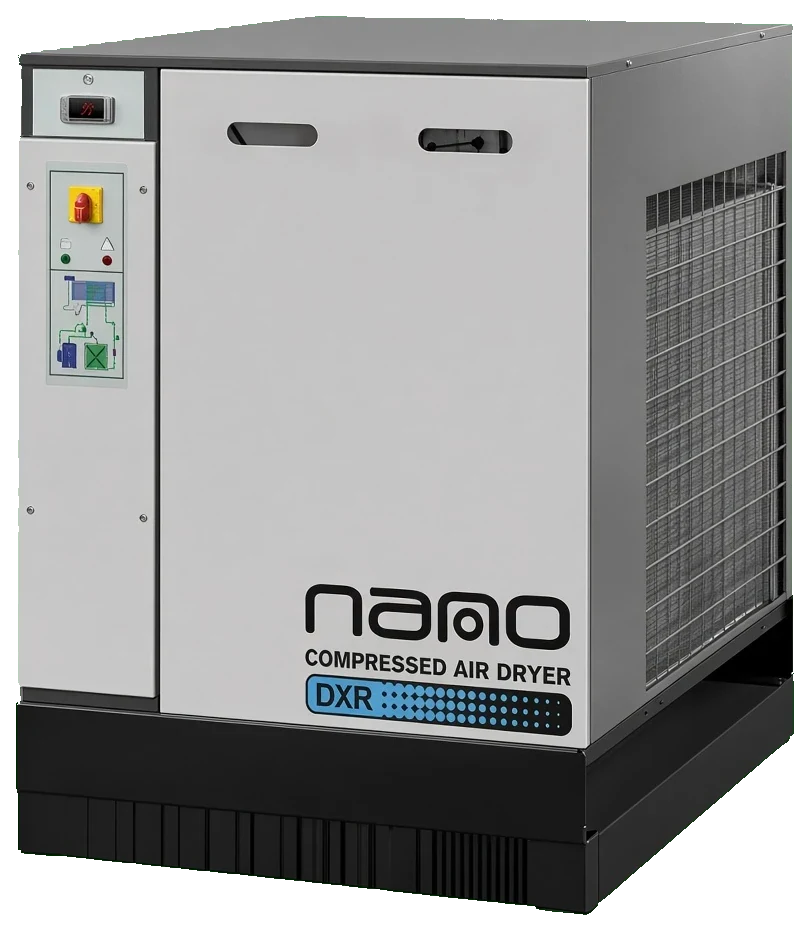
Every 65 to 250 SCFM non-cycling model
Flows at the standard rating point of 100 psig, 100°F inlet and 100°F ambient. Each part number opens its own specification page; the current line is listed first and the previous generation follows it with the series that replaces it.
| PART NUMBER | SERIES | SCFM | CONNECTION | VOLTAGE | STATUS |
| DXR 0065 NA | DXR Series | 65 | 3/4 in FNPT | 115/1/60 | Current |
| DXR 0085 NA | DXR Series | 85 | 1 in FNPT | 115/1/60 | Current |
| DXR 0105 NA | DXR Series | 105 | 1 in FNPT | 115/1/60 | Current |
| DXR 0125 NA | DXR Series | 125 | 1 in FNPT | 115/1/60 | Current |
| DXR 0150 NA | DXR Series | 150 | 1 in FNPT | 115/1/60 | Current |
| DXR 0185 NA | DXR Series | 185 | 1-1/2 in FNPT | 230/1/60 | Current |
| DXR 0230 NA | DXR Series | 230 | 1-1/2 in FNPT | 230/1/60 | Current |
| DXR 0250 NA | DXR Series | 250 | 1-1/2 in FNPT | 460/3/60 | Current |
| HPRN75 | HPRN Series | 75 | 1 in NPT | 115/1/60 | Legacy |
| HPRN100 | HPRN Series | 100 | 1 in NPT | 115/1/60 | Legacy |
| HPRN125 | HPRN Series | 125 | 1 in NPT | 115/1/60 | Legacy |
| HPRN150-1 | HPRN Series | 150 | 1 in NPT | 115/1/60 | Legacy |
| HPRN200-4 | HPRN Series | 200 | 1 in NPT | 460/3/60 | Legacy |
| HPRN250-4 | HPRN Series | 250 | 2 in NPT | 460/3/60 | Legacy |
Series with models in this band
Matching the compressor
A rotary screw in this class delivers 4.3 to 4.6 SCFM per horsepower at 100 to 125 psig: a 15 hp machine makes 65 to 70 SCFM, a 25 hp 105 to 115, a 40 hp 170 to 185 and a 50 hp 215 to 230. Select the dryer at or above the delivered figure rather than the horsepower rule, because two 30 hp packages from different builders can differ by 15 SCFM. Then apply the derates: a 110°F inlet costs 20 percent of capacity and a 110°F room another 12, so a 25 hp screw in a hot mezzanine room is a 150 SCFM dryer, not a 125.
Aftercooler performance sets the inlet
Package aftercoolers on screw compressors discharge air 15 to 20°F above the room, so the dryer inlet is normally 105 to 115°F in summer. That is inside the 131°F allowance of the current line, but every degree above 100°F is capacity given away. A blocked aftercooler core, a compressor boxed into a corner with no exhaust path, or a fan throttled back for noise can push the inlet past 120°F, where the dryer is down to two thirds of nameplate. Clean the core and measure the discharge temperature before blaming the dryer.
What is in the cabinet
Each current model carries a single aluminum exchanger block that precools the inlet air against the cold outlet, chills it against the refrigerant and separates the condensate in an integral separator, with a zero-air-loss drain and a digital dew point display on the panel. The 65 to 150 SCFM sizes run from a 115 V cord; 185 and 230 SCFM need a 230 V single-phase circuit and the 250 SCFM unit is 460 V three phase. The previous generation used stainless plate exchangers with a timed drain and the same 1 in and 2 in pipe sizes, which keeps a swap straightforward.
Piping and filtration at this size
Put the dryer after the receiver so it sees averaged flow rather than the compressor's load pulses, and size the prefilter and afterfilter for the compressor's full delivery, not the dryer's nameplate. A 1 micron coalescing prefilter protects the exchanger from compressor oil; a 0.01 micron afterfilter catches the aerosol that passes through. A three-valve bypass around dryer and filters lets the plant run wet for an hour while an element is changed. The piping and bypass page shows the layout, and the cycling dryers of the same size are the alternative when the plant idles nights and weekends.
65 to 250 SCFM dryer questions
A 30 hp screw delivers 125 to 135 SCFM at 100 psig, so the 150 SCFM model is the standard match with some margin for a warm room. If the compressor runs at 125 psig or its aftercooler discharges at 115°F in summer, the 185 SCFM size is the safer choice.
Not until 250 SCFM. The current line runs on 115 V single phase through 150 SCFM and 230 V single phase at 185 and 230 SCFM, drawing 0.9 to 2 kW. Only the 250 SCFM unit is wired for 460 V three phase.
The previous plant-air generation is in the table with its flow, connection and voltage so the current model can be matched by flow and pipe size. A 200 SCFM unit on 1 in NPT is normally replaced by the 230 SCFM direct-expansion model; we confirm adapters and any voltage change with the quote.
Between 2 and 5 psi across the exchanger at rated flow, plus 1 to 3 psi for each filter as its element loads. That is 5 to 10 psi in total, which matters in a plant that is already short of pressure at the far end of the header.
Only if the compressor idles for a large part of the week. A non-cycling dryer at 150 SCFM draws about 1.5 kW continuously; a cycling unit can halve that overnight but costs more up front. A two-shift plant with the compressor loaded most hours gets little back from cycling.