
1-805-484-2992
Quotes - Engineering - SalesRefrigerated Air Dryers for Tire & Service Bays
A tire shop or service garage runs on a 5 to 10 hp two-stage piston compressor and asks it to feed impact wrenches, tire changers with bead-seating blasts, air-over-hydraulic lifts, grease and oil pumps, brake bleeders, blow guns and the inflation hose reels at every bay. None of it has an aftercooler in front of it, so the tank fills with condensate and the lines carry the rest. Water rusts the impact wrench's vane motor, corrodes the tire changer's cylinders, sits in the bottom of a lift cylinder and pits it, and goes into the customer's tires with every inflation, where it corrodes aluminum wheels from the inside and swings the pressure with temperature.
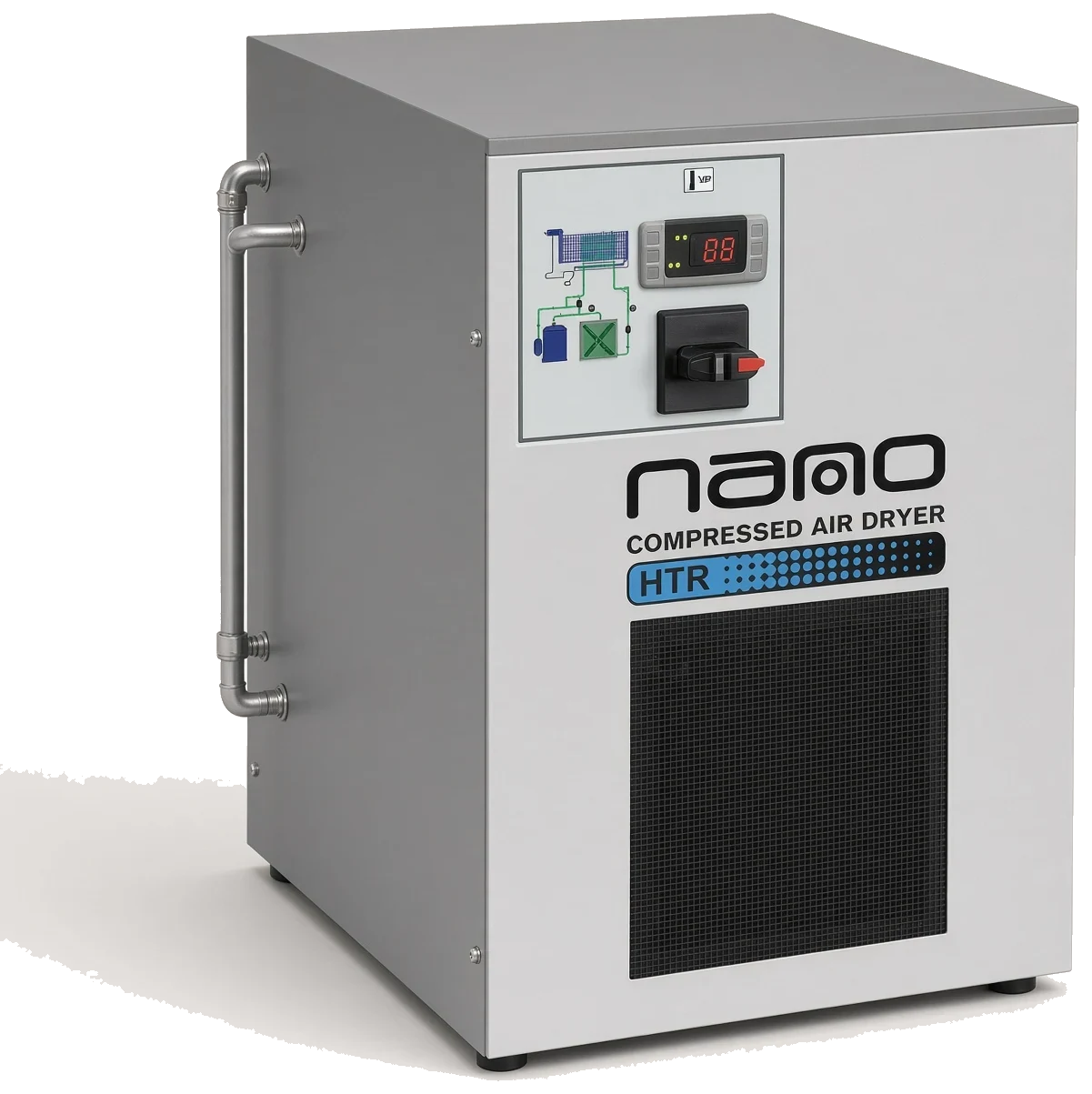
The dryer question in a service bay is about temperature before it is about flow. A piston compressor with no aftercooler discharges 180 to 200°F air, and a standard refrigerated dryer rated at 100°F cannot work with it. The HRHT and HTR high-inlet-temperature series are built for exactly this supply: they take the hot tank air directly, hold a 50°F pressure dew point, ISO 8573-1 class 6, and plug into a 115 V outlet beside the compressor.
A 5 hp two-stage piston delivers 17 to 20 SCFM at 175 psig, a 7.5 hp unit 25 to 30 and a 10 hp unit 35 to 40. The HRHT series covers 25 to 100 SCFM at 200°F inlet and the HTR series 25 to 125 SCFM at 180°F, so a 5 or 7.5 hp shop takes the 25 or 35 SCFM size and a 10 hp shop the 50. A busy fleet garage on a 15 hp screw with an aftercooler takes a standard 85 SCFM dryer instead.
Demand in a service bay is short bursts between long idles, which is why the drains matter more than the dryer type: a timer drain on the tank vents air every few minutes all night. The high-inlet-temperature dryers carry a zero-loss drain, and the tank should get a float drain to match.
Request a service bay dryer quote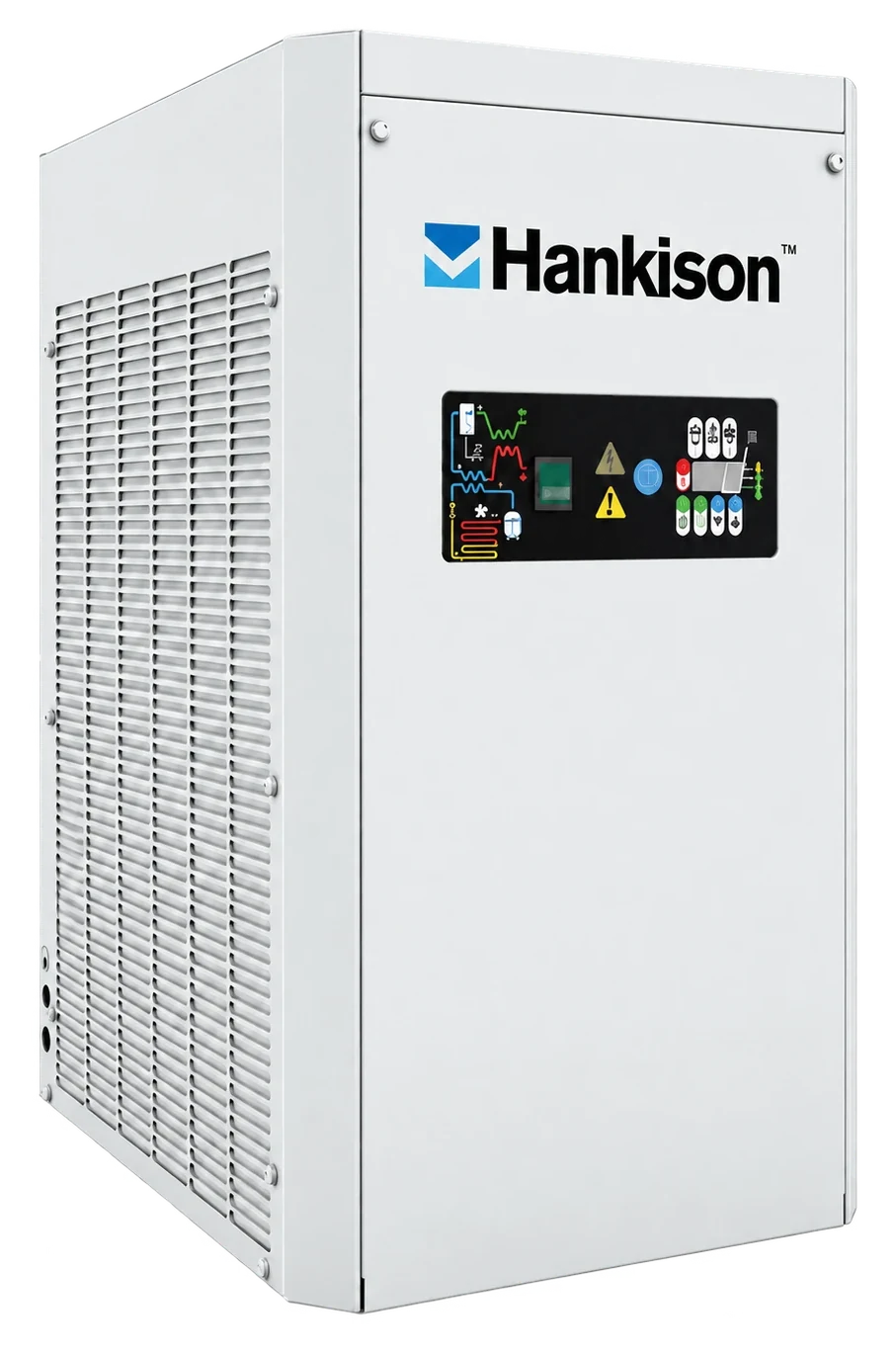
What water does in a service bay
Tools, lifts and the customer's tires
- Impact wrenches losing torque as water rusts the vanes and washes out the oil
- Tire changer and lift cylinders pitting where condensate sits at the bottom of the stroke
- Water blown into tires at inflation, corroding aluminum wheels and shifting the pressure
- Ice in outdoor hose reels and the inflation line in winter
The dryer built for a piston compressor
Hot air in, 50°F dew point out
- High-inlet-temperature dryer rated for 180 to 200°F air straight off the tank
- 50°F pressure dew point, class 6: dry enough for every tool and lift in a heated shop
- 115 V plug-in unit with a built-in separator and zero-loss drain
- Float drain on the tank, because half the day's water condenses there first
Dryers that fit a service bay
The HRHT and HTR series are rated at 200 and 180°F inlet respectively and cover every 5 to 15 hp piston compressor; the HPRB and DXR sizes fit a screw compressor with an aftercooler. The GHTN filter takes hot air ahead of the dryer.
| SERIES | TYPE | FLOW RANGE | MAX INLET | MAX PRESSURE |
| HRHT Series | High Inlet Temperature | 25 to 100 SCFM | 200°F | — |
| HTR Series | High Inlet Temperature | 25 to 125 SCFM | 180°F | 232 psig |
| HPRB Series | Non-Cycling | 7 to 50 SCFM | 120°F | 200 psig |
| DXR Series | Non-Cycling | 10 to 4,200 SCFM | 131°F | 203 psig |
| GHTN High-Temperature Filters | Compressed Air Filter | 15 to 1,600 SCFM | — | 150 psig |
| GFN Series Filters | Compressed Air Filter | 6 to 1,500 SCFM | — | 232 psig |
| 1701 Bypass Valves & Mounting Brackets | Bypass & Mounting | 5 to 35 SCFM | — | 200 psig |
| Snap-Trap & Trip-L-Trap Drains | Condensate Drain | Call for sizing | — | 175 psig |
Tell us the compressor horsepower, whether it has an aftercooler and how many bays it feeds; we pick the dryer size and the tank drain.
The tank drain is half the dryer
On a hot piston compressor the tank does the first half of the drying: air at 180°F cools toward room temperature in the tank and drops roughly half its water there. If the tank drain is a manual valve that gets opened when someone remembers, the tank fills, the air leaving it carries liquid, and the dryer spends its capacity on water the tank should have caught.
A pneumatic float drain on the tank costs little, needs no power and empties the tank as fast as it fills. With it, the dryer sees saturated air and vapor only, which is the job it was sized for, and the shop stops finding water at the inflation reel.
- Float drain on the tank, zero-loss drain on the dryer
- No timer drains on a compressor that idles between customers
- Drain leg at the end of the header for the hottest days
Where the dryer goes
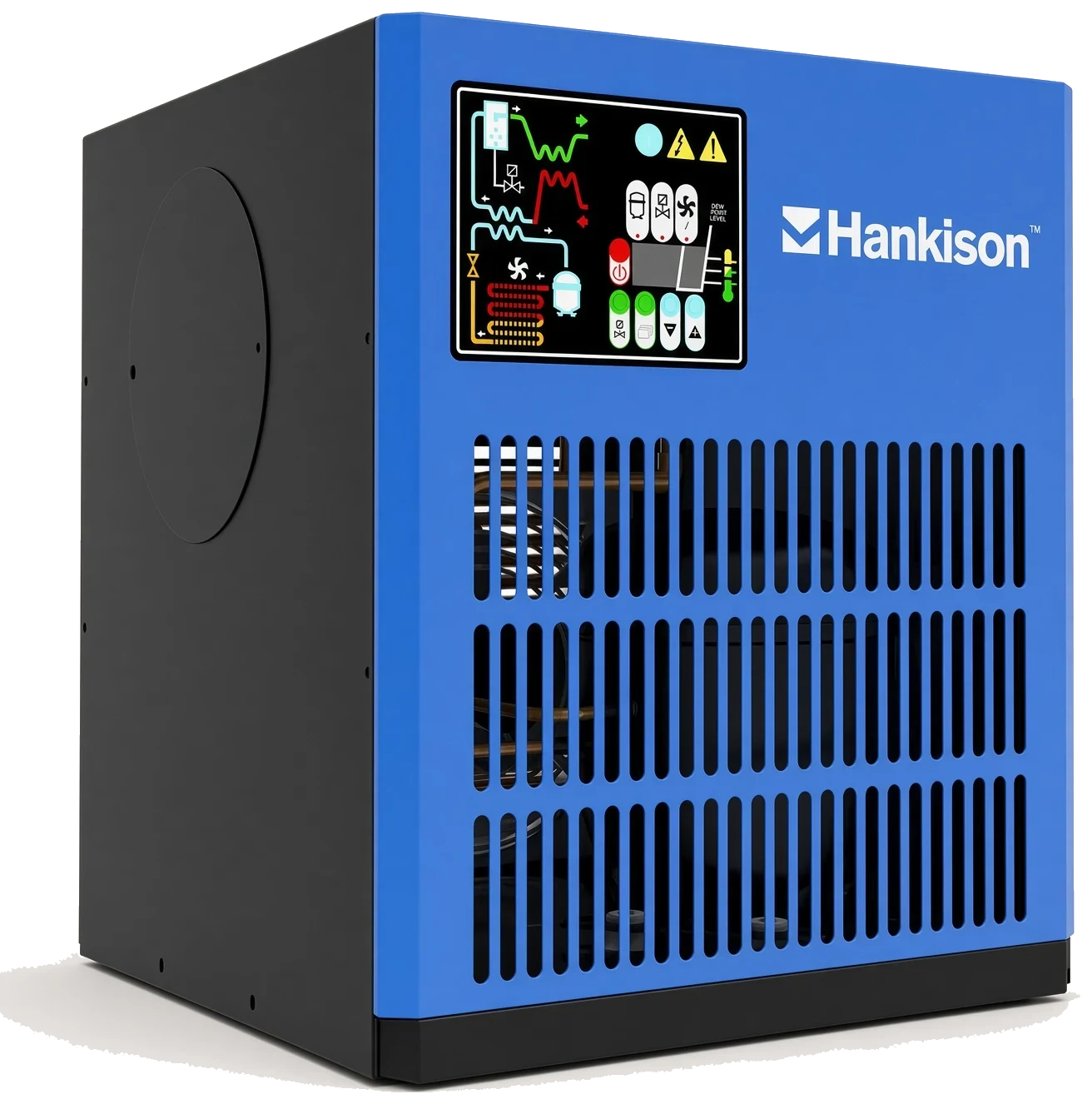
Tank outlet, high-temperature prefilter, dryer, afterfilter, header. On a receiver-mounted compressor the dryer hangs on the wall beside the tank and takes the tank outlet directly; a 1701 single-body bypass on dryers to 35 SCFM lets it be isolated for service without losing the shop's air. The header should leave the dryer at the top, drop to each bay through a swan neck and end in a drain leg, so that any water that gets past the dryer on the hottest day collects at the leg rather than at the inflation reel. The piping and bypass page shows it.
Tire inflation and dry air
Nitrogen inflation is sold on the moisture that shop air carries into the tire, and most of that argument goes away with a dryer. Air at a 50°F pressure dew point holds a fraction of the water of undried tank air, so the pressure swing with temperature that customers complain about, and the corrosion inside aluminum wheels, largely disappear. A shop that dries its air gives every customer most of the benefit of nitrogen at the inflation reel it already has.
Why not a standard dryer
A standard refrigerated dryer keeps about 65 percent of its rating with 120°F air and 55 percent at 130°F, and above that the correction runs out. A 5 hp piston compressor sends it 180°F air, so a standard 25 SCFM dryer piped to that tank behaves like a 10 SCFM unit on a cool day and like nothing at all on a hot one. The high-inlet-temperature dryers are built with the heat exchanger and refrigeration circuit for that duty; the alternative is 30 ft of pipe or an aftercooler ahead of a standard unit.
Cycling or non-cycling in a service bay
Non-cycling. At 25 to 50 SCFM the dryer's compressor draws a few hundred watts, and the on-off demand of a service bay would let a cycling dryer rest most of the day without saving enough to notice on the bill. The saving that does show up is in the drains: a zero-loss drain on the dryer and a float drain on the tank stop the compressor from cycling all night to feed a timer. The condensate drains page compares the types.
Service bay air questions
A 5 hp piston delivers 17 to 20 SCFM, so the 25 SCFM high-inlet-temperature dryer covers it with margin. Do not buy a standard 25 SCFM dryer for that compressor unless there is an aftercooler or a long cooling run of pipe ahead of it.
Yes, in a heated shop. Nothing in the building is colder than 50°F, so nothing condenses in the lines, the tools or the tires. The exception is an inflation reel or hose that runs outdoors in winter, which will freeze on any dew point above the outside temperature and needs to be drained or brought inside.
Because the tank is upstream of the dryer and catches the water that condenses as the hot air cools in it, which is a good thing. Fit the tank with an automatic float drain so it empties itself; a tank that is drained by hand once a week sends its water down the line on Monday morning.
Yes. The high-inlet-temperature and small cabinet dryers are 115 V plug-in units that mount on a bracket beside the tank. Leave clearance around the condenser fan, keep them out of direct sun and off the floor where the wash-down water runs.
Briefly, yes: a bead blaster dumps a tank of air in a second at ten times the compressor's output. The blast draws from the compressor tank and the dryer sees only the refill, so the dryer is sized for the compressor, not the blast. Pipe the blaster's own tank off the dried side so the air it stores is dry.
More on service bay air
Dryers for 2 to 5 hp piston compressors
The smallest shop compressors, the 7 to 20 SCFM they deliver, the temperature they deliver it at and the dryers that fit.
Learn More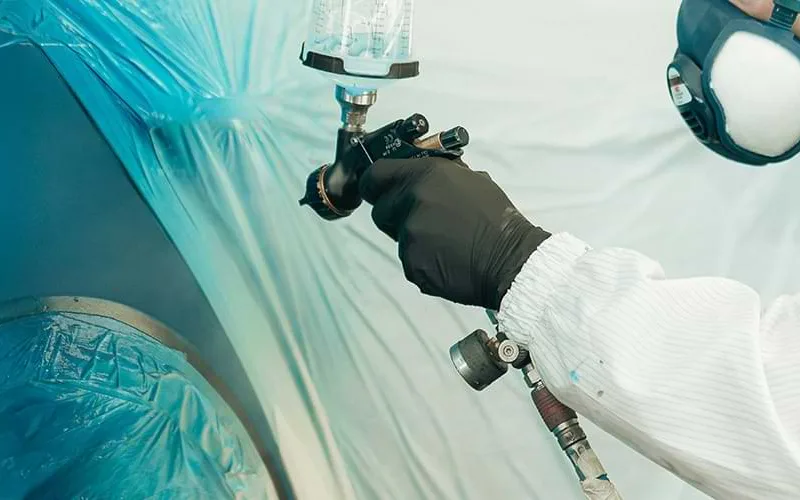
Paint Spraying
Compressed air drying for spray guns and paint lines: why fisheyes and blushing start at the compressor, and the dryer and filters to fix it.
Learn More
Body Shops
Compressed air drying for collision repair: sanders, spray guns, frame racks and piston compressors, and the dryer that handles hot tank air.
Learn More