
1-805-484-2992
Quotes - Engineering - SalesRefrigerated Air Dryers for Robotics & Automation
An automated cell packs more pneumatics into a few square feet than any other place in a plant: a valve island with twenty solenoid pilots, grippers and end-of-arm tooling on the robot, vacuum generators running on compressed air, short-stroke cylinders on the fixture and proportional regulators holding clamp force. The orifices are small, the cycle rates are high and the spares are expensive. Water in the air shows up as a valve that sticks once a shift, a gripper that loses force as its seals harden, a venturi that stops pulling vacuum because rust dust has bridged its throat, and a regulator whose setpoint drifts.
The component makers ask for a 38°F pressure dew point, ISO 8573-1 class 4, with filtration to 5 microns and oil no worse than class 4; proportional and servo valves push that to 1 micron and oil class 3. A refrigerated dryer at the compressor room with a 1 micron prefilter and a 0.01 micron oil-removal afterfilter meets all of it, so the cell needs only a filter-regulator at the drop.
Cells are light users individually, 5 to 20 SCFM average with peaks three times that, so the dryer is sized for the compressor that feeds the line, not the cell count. A 20 hp screw delivering 85 to 90 SCFM is the 105 SCFM dryer; a 60 hp screw at 260 to 275 SCFM feeding a dozen cells is the 300 or 325 SCFM size. Put the dryer after the receiver so every cell on the header gets the same class of air.
A three-shift line with cells cycling every few seconds keeps the compressor loaded and suits a non-cycling dryer. A line that runs days and holds pressure overnight for the safety circuits, or one fed by a variable-speed compressor, spends hours at low flow and saves 50 to 80 percent of dryer power with a cycling unit.
Request an automation air dryer quote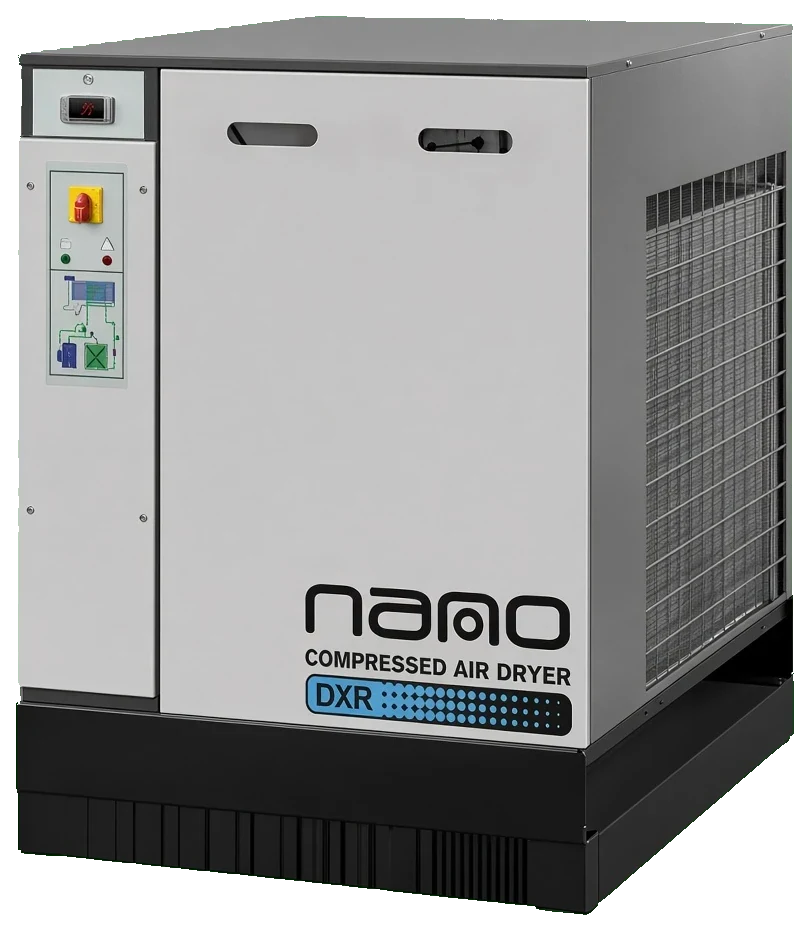
What water does inside a cell
Small orifices, high cycle rates, costly spares
- Solenoid pilot valves sticking as condensate washes the grease from the spool
- Vacuum generators losing pull as rust dust from a wet header bridges the venturi throat
- Gripper and cylinder seals hardening, then leaking, as water displaces the lubricant film
- Proportional regulators and servo valves drifting as moisture and particles reach the nozzle-flapper

The air class an automated line needs
Meet it once, at the compressor room
- 38°F pressure dew point, ISO 8573-1 class 4, for every valve, cylinder and gripper on the line
- 1 micron prefilter and 0.01 micron oil-removal afterfilter: oil class 3 or better for proportional valves
- Dryer sized for the compressor's full delivery at the summer temperature of the compressor room
- Filter-regulator at each cell as the last line of defense, not as the dryer
Dryers that fit an automated line
Flows at the standard 100 psig, 100°F inlet rating. Lines on a 15 to 50 hp screw sit in the 65 to 250 SCFM band, where the cycling series pay back fastest on a line that idles overnight; larger plants use the 300 to 1,250 SCFM sizes.
| SERIES | TYPE | FLOW RANGE | MAX INLET | MAX PRESSURE |
| DXR Series | Non-Cycling | 10 to 4,200 SCFM | 131°F | 203 psig |
| NXC Series | Cycling | 20 to 2,000 SCFM | 158°F | 232 psig |
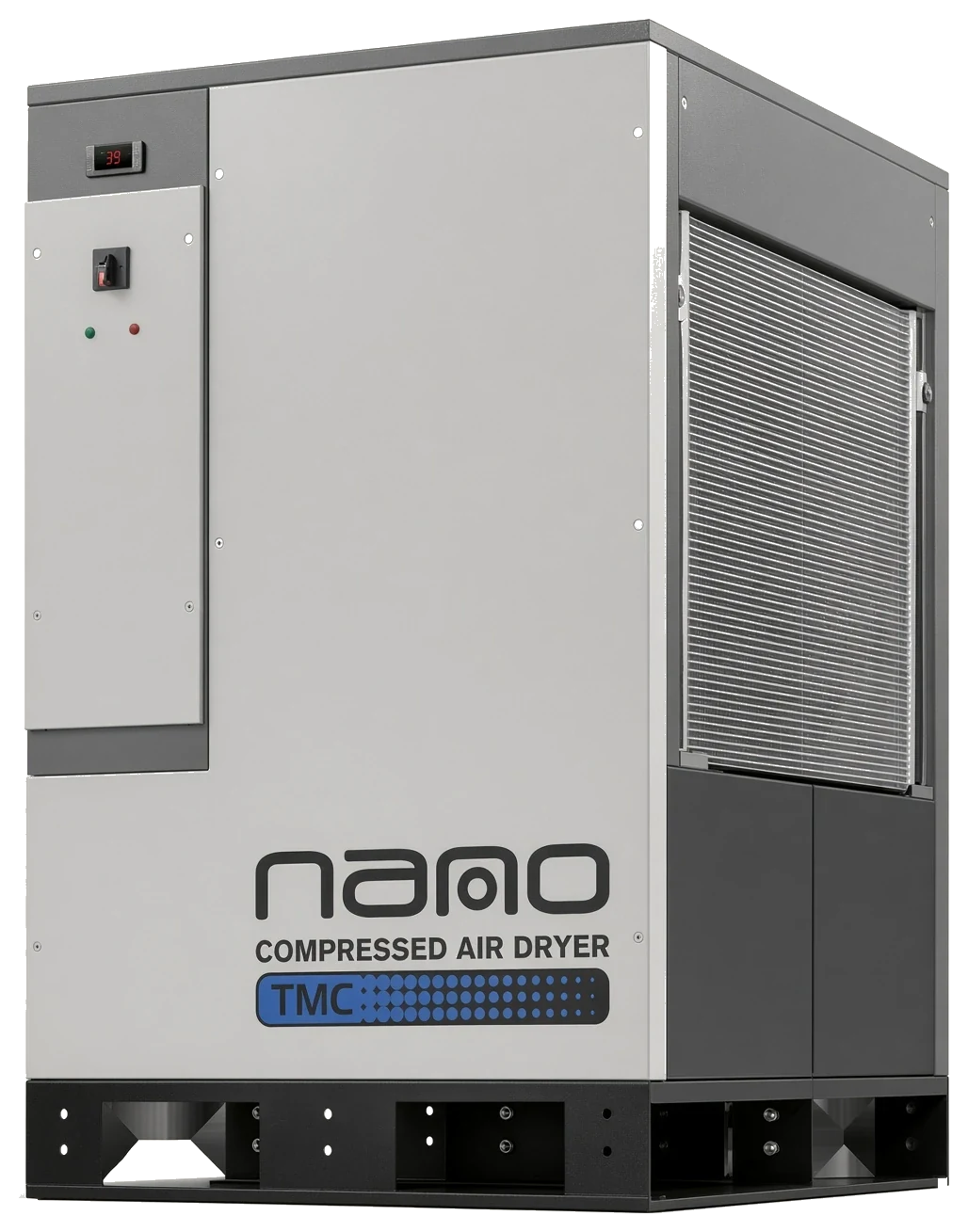
| TMC Series | Thermal Mass Cycling | 30 to 635 SCFM | 140°F | 210 psig |
| FLXA Series | Cycling | 75 to 2,000 SCFM | 120°F | — |
| HPRB Series | Non-Cycling | 7 to 50 SCFM | 120°F | 200 psig |
| GFN Series Filters | Compressed Air Filter | 6 to 1,500 SCFM | — | 232 psig |
| NGF Series Filters | Compressed Air Filter | 20 to 1,500 SCFM | — | 250 psig |
| ND Series Zero-Loss Drains | Condensate Drain | Call for sizing | — | 290 psig |
Send the compressor horsepower, the number of cells and whether any use proportional valves; we size the dryer and specify the filter grades.
The receiver is part of the sizing
An automated line's demand is spiky in a way the compressor cannot follow: forty cylinders firing together pull 200 SCFM for half a second and nothing for the next five. The receiver supplies those peaks, the compressor refills it, and the dryer between receiver and header sees a flow that never exceeds the compressor's output. Pipe the dryer ahead of the receiver and it sees the peaks instead, at three times its rating, and the dew point climbs every time the line indexes.
Size the receiver at three to five gallons per SCFM of compressor output, put the dryer after it, and give the receiver and the dryer a zero-loss drain each. A timer drain on a receiver serving an automated line wastes air every few minutes for the whole night the line is idle.
- Dryer after the receiver so it sees the compressor, not the cell peaks
- Receiver at three to five gallons per SCFM
- Zero-loss drains, not timers, on a line that idles
Where the dryer and filters go
Compressor, aftercooler, receiver, 1 micron prefilter, dryer, 0.01 micron afterfilter, header, then a filter-regulator at each cell. The temptation on an automated line is to put a small dryer at every cell because the cells are where the trouble shows; that gives the plant a dozen dryers to maintain and leaves the header wet, so the pipe keeps making rust for the cell filters to catch. One dryer in the compressor room keeps the header dry from the first fitting, and the filter placement page shows where each grade belongs.
Lubricated or non-lubricated cells
Modern valve islands and cylinders are greased for life and run on non-lubricated air; once a cell has seen oil mist it must stay on oiled air, because the mist washes out the original grease. The 0.01 micron oil-removal afterfilter behind the dryer keeps compressor lubricant out of a non-lubricated cell, which is why the afterfilter is not optional here even though a hand tool would be happy without it.
Cycling or non-cycling for automation
Automated cells cycle in bursts, but the line's shift pattern decides the dryer. A three-shift line with the compressor loaded most of the time gets little back from a cycling dryer, and the simpler non-cycling DXR is the right buy. A one- or two-shift line, or one fed by a variable-speed compressor, spends most of its hours at a fraction of the compressor's output, and there a cycling dryer such as the NXC or TMC rests for most of the night. The cycling versus non-cycling page has the payback arithmetic.
Dead legs and cell drops
Cells get added over years, and each one leaves a stub of pipe when it is moved. A dead leg on a header collects condensate the dryer never sees and feeds it to the next cell connected there. Cap dead legs at the header, take cell drops from the top of the pipe, and put a drain leg at the far end of every run. A cell that gets water when the dryer is holding 38°F is almost always fed from a low point.
Automation cell air questions
Most makers specify class 4 for water, a 38°F pressure dew point, with particles filtered to 5 microns and oil at class 4 or better. Proportional and servo-pneumatic valves tighten that to 1 micron particles and class 3 oil. A refrigerated dryer with a 1 micron prefilter and a 0.01 micron afterfilter meets the tighter specification for the whole line.
No. One dryer at the compressor room keeps the header itself dry, which a dozen point-of-use dryers cannot do. A cell-level dryer only makes sense for a cell on a long run from a header that is wet for some other reason, or for one cell that needs a lower dew point than the plant.
A venturi vacuum generator has a throat of a millimeter or two, and rust dust carried down a wet header bridges it. Dry the header at the compressor room, fit a 5 micron or finer filter at the cell, and blow the generators through once; after that they stay clean.
A 30 hp screw delivers 125 to 130 SCFM, so the 150 SCFM dryer at a normal compressor room temperature and the 165 to 185 SCFM size in a hot room. The eight cells together average perhaps 80 SCFM with peaks well above the compressor's rating, which the receiver absorbs; the dryer is sized for the compressor.
At 100 SCFM and above, yes. For sixteen hours a day the compressor is holding pressure against leaks and safety circuits at a small fraction of its output, and a cycling dryer's refrigeration compressor stays off for most of that time. The price difference is usually recovered in two to three years of power.
More on air for automated lines
Cycling versus non-cycling dryers
How a cycling dryer stores cold, what it saves on a line that idles, and where the non-cycling unit is the better buy.
Learn More
Pneumatic Tools & Controls
Compressed air drying for air tools, cylinders, valve manifolds and pneumatic controls: what water does to each and which dryer band fits.
Learn More
CNC & Machining
Compressed air drying for CNC machining centers and machine tools: why spindles, tool changers and air blast need a 38 degree dew point, and which dryers fit.
Learn More