
1-805-484-2992
Quotes - Engineering - SalesAir Dryers for Electronics & Laboratories
An electronics assembly floor uses compressed air in small, clean quantities: pick-and-place feeders and nozzle changers, the screen printer's squeegee and stencil wipe, spray fluxers on the wave and selective solder lines, conformal coating and dispensing valves, depaneling and test fixtures with pneumatic clamps, and ionizing air guns at every bench. A laboratory adds instrument air for pneumatic valves and autosamplers, oxidant air for an atomic absorption flame, purge air for spectrometers and the bench air of a teaching lab. The compressors are oil-free scrolls of 5 to 30 hp delivering 15 to 120 SCFM, often two or three modules in one enclosure.
Water and oil in this air cause defects that surface later rather than breakdowns. Moisture in the air over a moisture-curing adhesive or silicone cures it in the dispensing needle; a fluxer spitting condensate leaves a wet board that solders badly; conformal coating fisheyes over a droplet of water or oil; and an ionizing gun that blows water onto an assembly leaves the ionic residue that grows dendrites under a coating months later. Vacuum venturis on placement heads lose pull as their orifices scale, and pneumatic feeders index late.
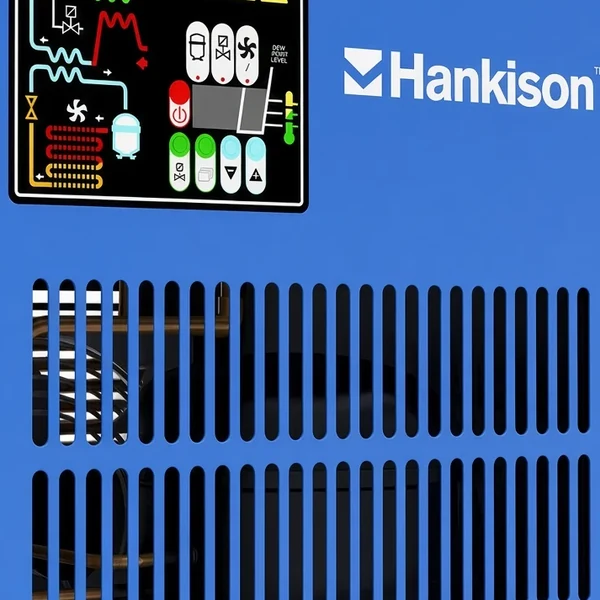
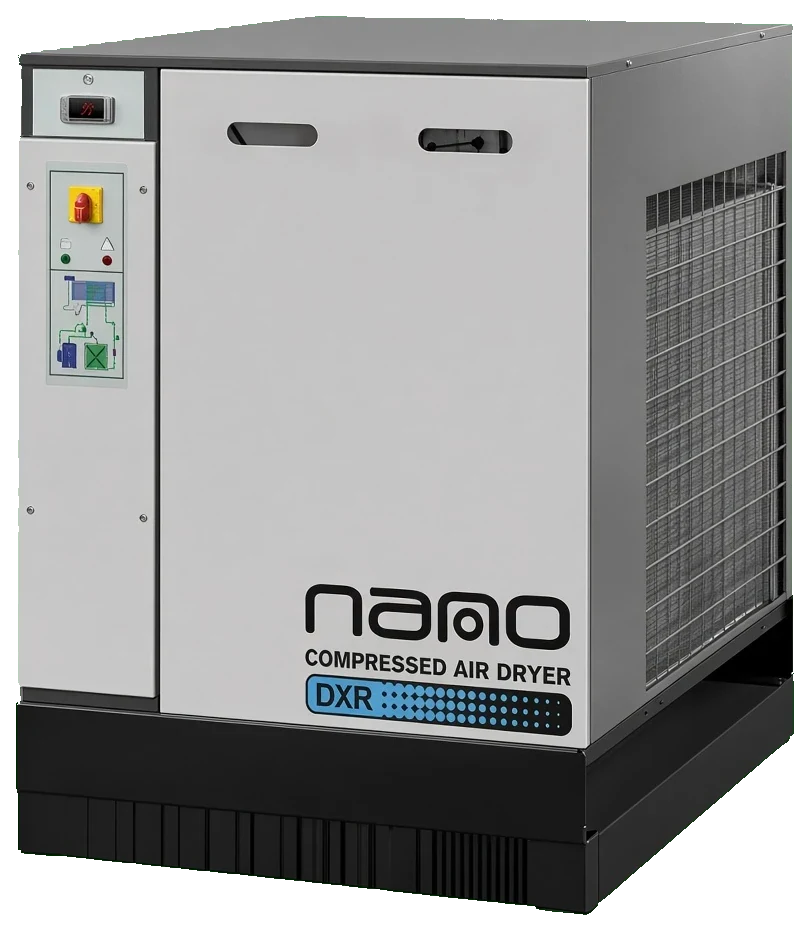
A refrigerated dryer holding a 38°F pressure dew point covers an assembly floor or laboratory held at 68 to 75°F, since nothing the air touches is colder than the room. Oil is the second specification: ISO 8573-1 class 1, which an oil-free scroll compressor reaches with a 0.01 micron coalescing afterfilter behind the dryer for particles and anything drawn in with the intake air, and a point-of-use 0.01 micron filter at the dispensing or coating station. The dryer goes in the compressor room after the receiver; the HPRB Series at 7 to 50 SCFM and the DXR Series or NXC Series to 130 SCFM cover the usual compressor sizes.
Three uses want more than a refrigerated dryer can give, and it is worth saying so plainly. Purge air for an infrared spectrometer or a dry box, and the clean dry air of a semiconductor or optics clean room, are specified at a -40 to -100°F dew point, ISO class 2 or 1, and take a desiccant dryer, usually a small one on that branch downstream of the refrigerated unit. The floor and the rest of the lab stay on the refrigerated dryer, and for a plant that runs business hours with a light weekend load, the thermal-mass TMC Series or NXC Series cycling dryer stops its refrigeration compressor through the idle time.
Request an electronics dryer quote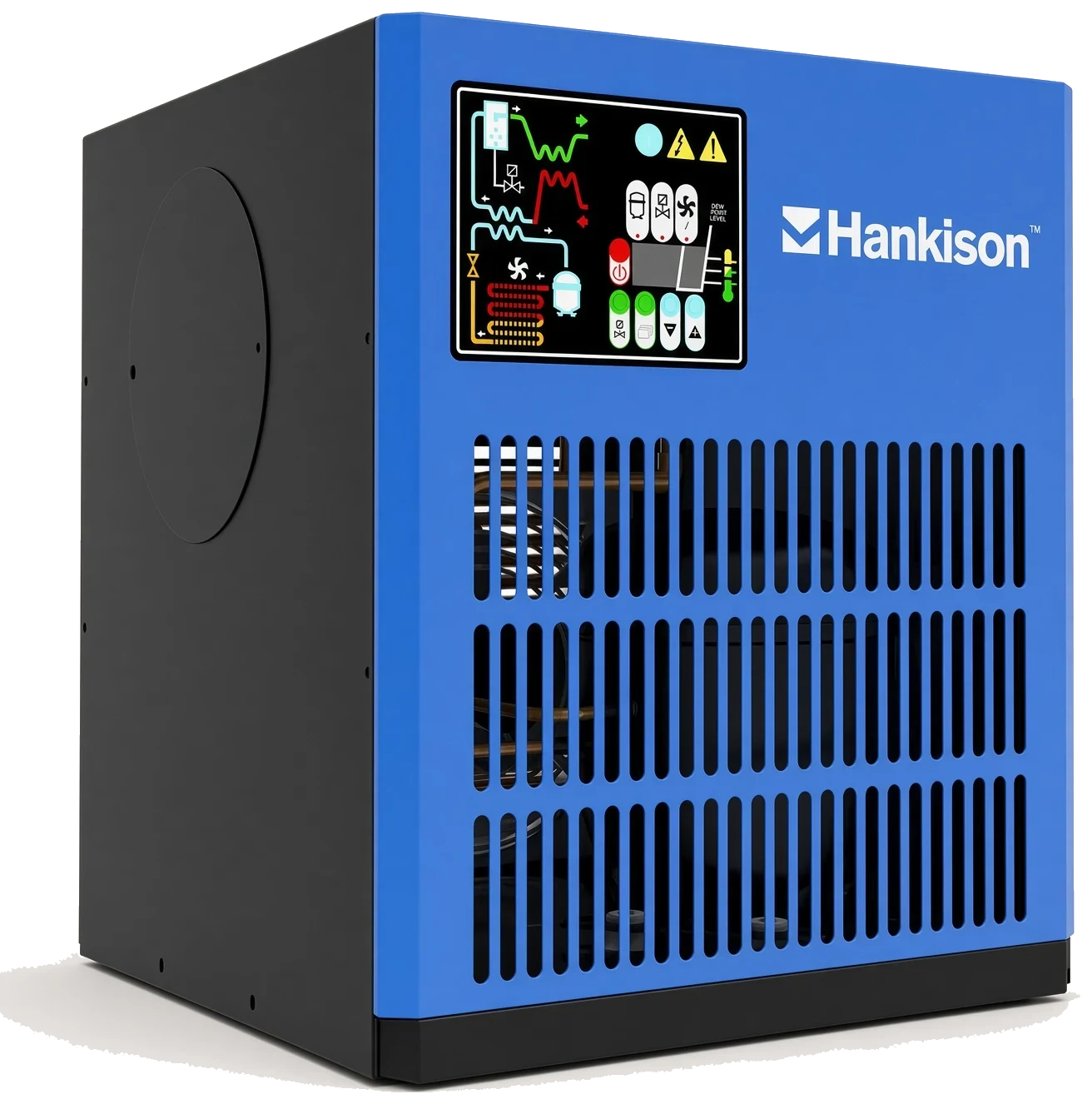
What wet or oily air does on an assembly floor
Defects that appear at test or in the field rather than at the machine
- Moisture-cure adhesives and silicones setting up in the dispensing needle
- Fluxer spitting condensate and conformal coating fisheyeing over a droplet
- Ionizing air guns leaving water and ionic residue that grows dendrites under coatings
- Placement head venturis losing vacuum as their orifices scale, feeders indexing late
The air specification for electronics and labs
Dryer, filters and where desiccant takes over
- 38°F pressure dew point, ISO 8573-1 class 4, from a refrigerated dryer sized to the oil-free compressor
- Oil class 1: 0.01 micron coalescing afterfilter behind the dryer and a point-of-use 0.01 micron filter at coating and dispensing stations
- Cycling dryer for business-hours plants with idle nights and weekends; non-cycling below 50 SCFM
- Desiccant stage on the branch feeding spectrometer purge, dry boxes and clean-room dry air
Dryers and filters that fit electronics and lab air
Ratings at 100 psig and 100°F inlet. A 5 to 10 hp oil-free scroll delivers 15 to 40 SCFM; a 20 to 30 hp multi-scroll package 75 to 120 SCFM.
| SERIES | TYPE | FLOW RANGE | MAX INLET | MAX PRESSURE |
| HPRB Series | Non-Cycling | 7 to 50 SCFM | 120°F | 200 psig |
| DXR Series | Non-Cycling | 10 to 4,200 SCFM | 131°F | 203 psig |
| NXC Series | Cycling | 20 to 2,000 SCFM | 158°F | 232 psig |
| TMC Series | Thermal Mass Cycling | 30 to 635 SCFM | 140°F | 210 psig |
| GFN Series Filters | Compressed Air Filter | 6 to 1,500 SCFM | — | 232 psig |
| NGF Series Filters | Compressed Air Filter | 20 to 1,500 SCFM | — | 250 psig |
| HF Series Filters | Compressed Air Filter | 20 to 21,250 SCFM | — | 300 psig |
| PDM Dew Point Monitor | Dew Point Monitor | Call for sizing | — | 145 psig |
Send the compressor size, the stations that need class 1 air and any branch that needs a desiccant dew point; we size the dryer and filter train together.
The point-of-use filter is not optional
A dryer and afterfilter in the compressor room deliver class 1 air to the header, and the header undoes some of it. Steel pipe sheds rust and scale for years, copper sheds oxide, and every drop and quick-connect adds a little of whatever it was assembled with. On a machine tool that is nothing; on a conformal coating valve or a dispensing needle it is a fisheye or a clogged tip. A 0.01 micron filter at the station, sized for that station's flow, catches what the piping adds and is the element the operator changes when the process complains.
Fit it after the regulator with a gauge, and keep the run from filter to valve short.
- Keep the compressor-room afterfilter and add a point-of-use 0.01 micron filter at each critical station
- Use clean, capped pipe and fittings on new header runs to an electronics floor
- Change point-of-use elements on the process, not the calendar; they are the cheapest part in the chain

Where the dryer and filters go
Compressor, receiver, 1 micron prefilter, dryer, 0.01 micron afterfilter, header, then a point-of-use 0.01 micron filter at each station whose process touches the product. Oil-free scroll compressors carry their own aftercoolers, so the dryer sees 100°F air and needs no high-inlet rating; what it does need is a receiver ahead of it, because a multi-scroll package staging its modules in and out sends flow to the dryer in steps rather than smoothly. The filter placement page sets out the order, and the point-of-use filter is the one that catches what the header piping sheds.
Sizing to a multi-scroll compressor
Size to the package's total delivery with every module running, not to the average draw of the floor. A three-module 15 hp package delivering 55 SCFM into a 95°F compressor room takes the 65 SCFM dryer; the same package in a 105°F room takes the 85. The 5 to 10 hp compressor page matches the small scroll sizes to dryers.
Where desiccant is required
Infrared spectrometers are purged with dry, carbon-dioxide-free air to keep water vapor bands out of the spectrum, and their purge specification is a -40°F dew point or better; dry boxes for moisture-sensitive components and the clean dry air of a wafer fab or optics clean room call for -40 to -100°F. A refrigerated dryer cannot go below about 35°F, so those branches take a desiccant or membrane dryer of their own, sized for their small flow, and the refrigerated dryer upstream keeps the desiccant's load light. The refrigerated versus desiccant page draws the line.
Cycling for business hours
An electronics plant or laboratory runs one shift five days a week, and the compressor holds pressure for ionizers and instrument valves through the other 128 hours. Above about 50 SCFM a thermal-mass TMC Series or an NXC Series cycling dryer rests its refrigeration compressor through that time and repays its premium in a year or two; below 50 SCFM the non-cycling HPRB Series draws so little that the premium never comes back. The cycling versus non-cycling page works the numbers for a one-shift schedule.
Electronics and laboratory air questions
Not the assembly floor. Pick-and-place, printing, soldering and coating run at room temperature, and a 38°F pressure dew point is 30°F below anything the air touches. Desiccant drying is reserved for spectrometer purge, dry boxes and clean-room dry air, which take a small desiccant unit on their own branch.
Moisture-curing silicones, urethanes and cyanoacrylates react with the water vapor in wet air pressurizing the syringe or cartridge, and they set from the air side in. A refrigerated dryer with a point-of-use 0.01 micron filter at the dispenser removes the water and the aerosol, and the cured plugs stop.
The 1 micron prefilter ahead of the dryer and the 0.01 micron coalescing afterfilter behind it, plus a point-of-use 0.01 micron filter at any station where the air touches the product. Oil-free scrolls shed fine particles as their tip seals wear, and the intake carries whatever the room air does.
Measure the dew point at the header and at the point of use with the PDM dew point monitor, which reads pressure dew point from -148 to +68°F and logs it through its 4-20 mA output. Oil and particle classes are verified by a sampling test against ISO 8573-1, which the filter grades are selected to meet.
Non-cycling. A 7.5 hp scroll delivers about 25 SCFM, and at that size the dryer draws a few hundred watts whether it cycles or not, so the HPRB or DXR Series non-cycling unit is the better buy. Cycling starts to pay from about 50 SCFM on a one-shift schedule.
More on clean dry air for electronics
Refrigerated versus desiccant: where the line falls
The dew points each type reaches and the applications, such as purge air and dry boxes, that need desiccant.
Learn More
Woodworking
Refrigerated air drying for cabinet and millwork shops: nailers, edgebanders, sanders, spray finishing and dust collector pulse valves.
Learn More
Textiles
Refrigerated air drying for air-jet looms, texturing, winders and dye houses: loom stops from wet air, oil class and central plant sizing.
Learn More